Hamming Lesley M, Qiao Rui, Messersmith Phillip B, Brinson L Catherine
Materials Science and Engineering Department, Northwestern University, 2145 Sheridan Rd. Evanston, IL 60208.
Compos Sci Technol. 2009 Sep 1;69(11-12):1880-1886. doi: 10.1016/j.compscitech.2009.04.005.
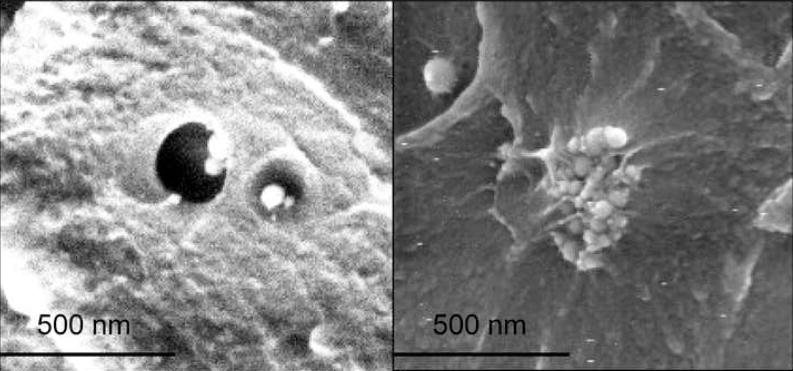
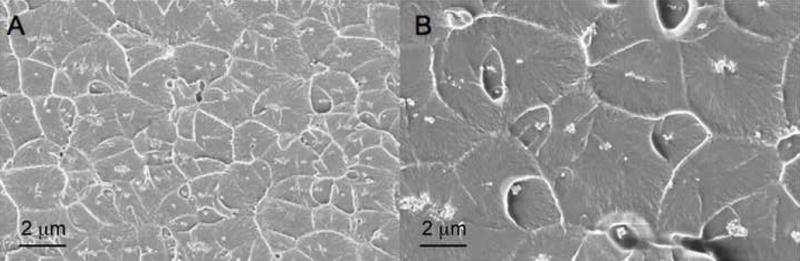
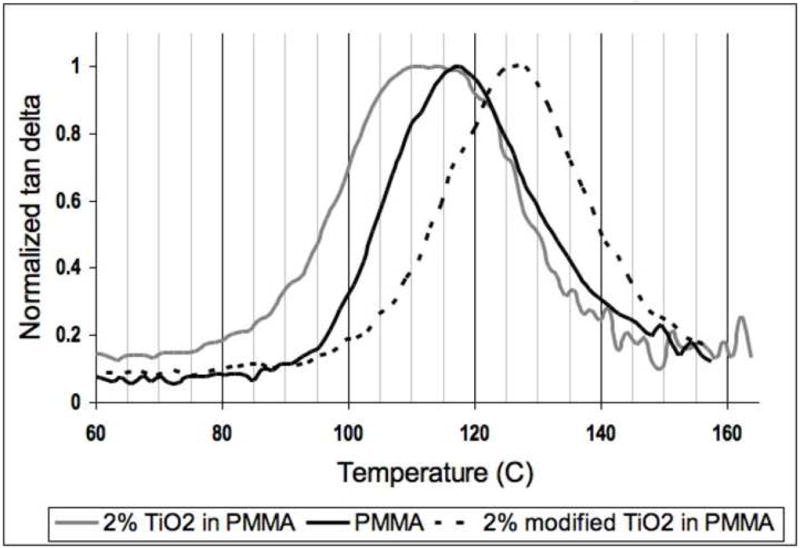
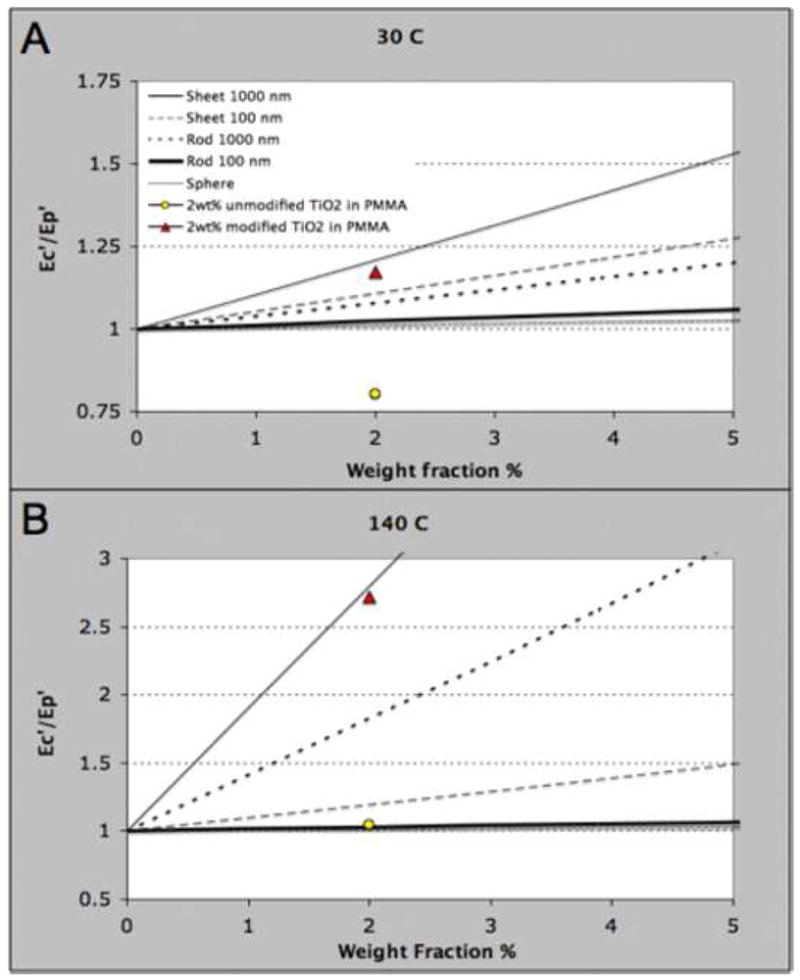
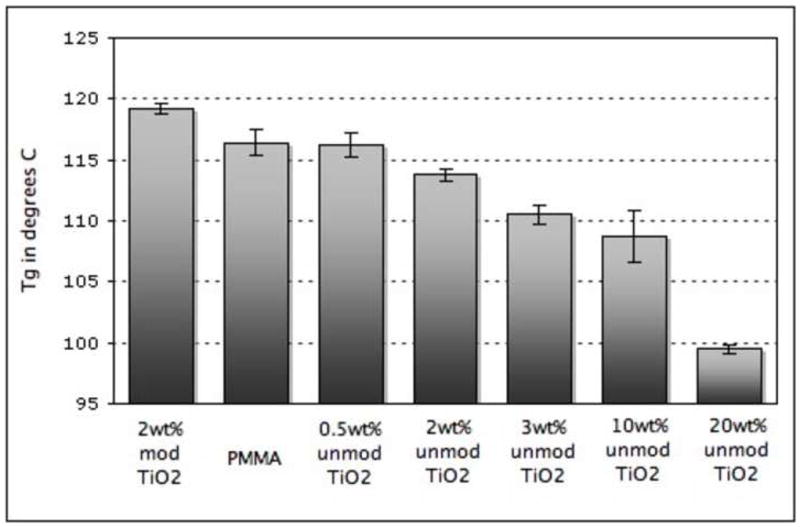
This paper quantifies how the quality of dispersion and the quality of the interfacial interaction between TiO(2) nanoparticles and host polymer independently affect benchmark properties such as glass transition temperature (Tg), elastic modulus and loss modulus. By examining these composites with differential scanning calorimetry (DSC), dynamic mechanical analysis (DMA) and scanning electron microscopy (SEM), we were able to demonstrate changes in properties depending on the adhesive/wetting or repulsive/dewetting interactions the nanoparticles have with the bulk polymer. We further quantified the dispersion of TiO(2) nanoparticles in polymethylmethacrylate (PMMA) matrices by a digital-optical method and correlated those values to the degree of Tg depression compared to neat PMMA. Samples with the same weight percent of nanoparticles but better dispersion showed larger shifts in Tg.
本文量化了TiO₂纳米颗粒与主体聚合物之间的分散质量和界面相互作用质量如何独立影响诸如玻璃化转变温度(Tg)、弹性模量和损耗模量等基准性能。通过差示扫描量热法(DSC)、动态力学分析(DMA)和扫描电子显微镜(SEM)对这些复合材料进行研究,我们能够证明性能的变化取决于纳米颗粒与本体聚合物之间的粘附/润湿或排斥/去湿相互作用。我们进一步通过数字光学方法量化了TiO₂纳米颗粒在聚甲基丙烯酸甲酯(PMMA)基体中的分散情况,并将这些值与相对于纯PMMA的Tg降低程度相关联。具有相同纳米颗粒重量百分比但分散性更好的样品显示出更大的Tg偏移。