Freedman Laurence S, Kipnis Victor, Schatzkin Arthur, Tasevska Natasa, Potischman Nancy
Biostatistics Unit, Gertner Institute for Epidemiology, Tel Hashomer 52161, Israel.
Epidemiol Perspect Innov. 2010 Jan 20;7(1):2. doi: 10.1186/1742-5573-7-2.
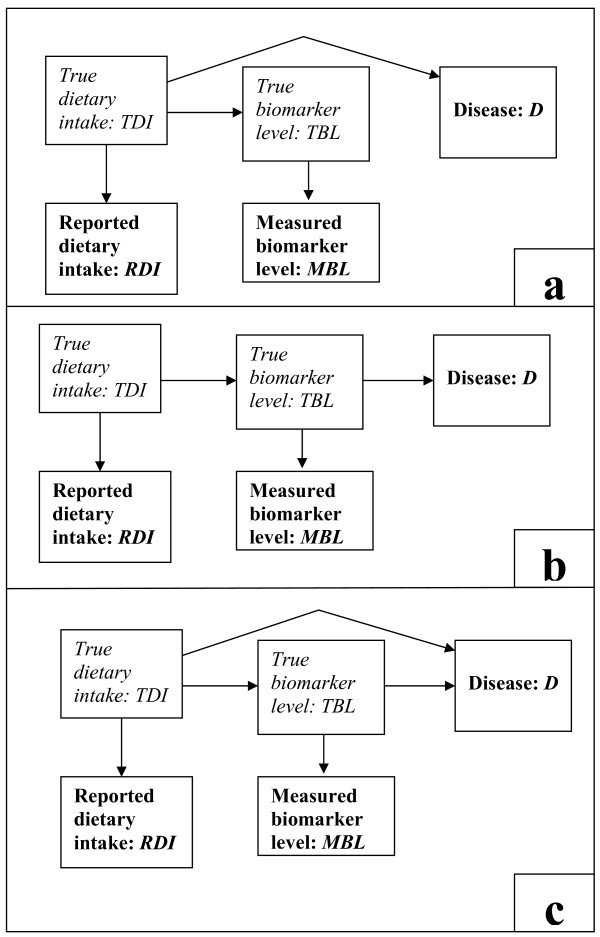
Identifying diet-disease relationships in nutritional cohort studies is plagued by the measurement error in self-reported intakes. The authors propose using biomarkers known to be correlated with dietary intake, so as to strengthen analyses of diet-disease hypotheses. The authors consider combining self-reported intakes and biomarker levels using principal components, Howe's method, or a joint statistical test of effects in a bivariate model. They compared the statistical power of these methods with that of conventional univariate analyses of self-reported intake or of biomarker level. They used computer simulation of different disease risk models, with input parameters based on data from the literature on the relationship between lutein intake and age-related macular degeneration. The results showed that if the dietary effect on disease was fully mediated through the biomarker level, then the univariate analysis of the biomarker was the most powerful approach. However, combination methods, particularly principal components and Howe's method, were not greatly inferior in this situation, and were as good as, or better than, univariate biomarker analysis if mediation was only partial or non-existent. In some circumstances sample size requirements were reduced to 20-50% of those required for conventional analyses of self-reported intake. The authors conclude that (i) including biomarker data in addition to the usual dietary data in a cohort could greatly strengthen the investigation of diet-disease relationships, and (ii) when the extent of mediation through the biomarker is unknown, use of principal components or Howe's method appears a good strategy.
在营养队列研究中,确定饮食与疾病的关系受到自我报告摄入量测量误差的困扰。作者建议使用已知与饮食摄入量相关的生物标志物,以加强对饮食与疾病假说的分析。作者考虑使用主成分分析、豪氏方法或双变量模型中的效应联合统计检验来结合自我报告的摄入量和生物标志物水平。他们将这些方法的统计功效与传统的自我报告摄入量或生物标志物水平单变量分析的功效进行了比较。他们使用不同疾病风险模型的计算机模拟,输入参数基于叶黄素摄入量与年龄相关性黄斑变性关系的文献数据。结果表明,如果饮食对疾病的影响完全通过生物标志物水平介导,那么生物标志物的单变量分析是最有效的方法。然而,在这种情况下,联合方法,特别是主成分分析和豪氏方法,并不逊色很多,并且如果介导只是部分或不存在,它们与单变量生物标志物分析一样好或更好。在某些情况下,样本量要求降低到传统自我报告摄入量分析所需样本量的20%-50%。作者得出结论:(i)在队列中除了通常的饮食数据外纳入生物标志物数据可以大大加强对饮食与疾病关系的研究,(ii)当通过生物标志物的介导程度未知时,使用主成分分析或豪氏方法似乎是一个好策略。