Research Group on Behaviour and Health, Laval University, Quebec City, Canada.
Int J Behav Nutr Phys Act. 2010 Feb 2;7:12. doi: 10.1186/1479-5868-7-12.
Accumulating evidence suggests that fruit and vegetable intake (FVI) plays a protective role against major diseases. Despite this protective role and the obesity pandemic context, populations in Western countries usually eat far less than five servings of fruits and vegetables per day. In order to increase the efficiency of interventions, they should be tailored to the most important determinants or mediators of FVI. The objective was to systematically review social cognitive theory-based studies of FVI and to identify its main psychosocial determinants.
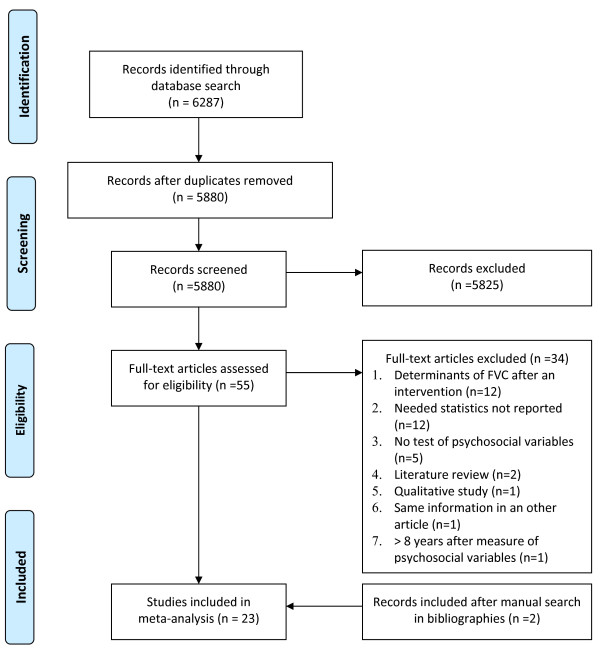
Published papers were systematically sought using Current Contents (2007-2009) and Medline, Embase, PsycINFO, Proquest and Thesis, as well as Cinhal (1980-2009). Additional studies were identified by a manual search in the bibliographies. Search terms included fruit, vegetable, behaviour, intention, as well as names of specific theories. Only studies predicting FVI or intention to eat fruits and vegetables in the general population and using a social cognitive theory were included. Independent extraction of information was carried out by two persons using predefined data fields, including study quality criteria.
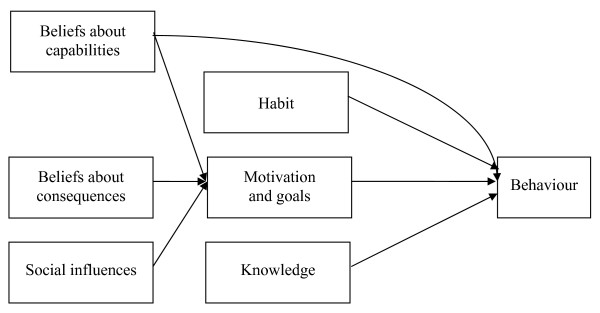
A total of 23 studies were identified and included, 15 studying only the determinants of FVI, seven studying the determinants of FVI and intention and one studying only the determinants of intention. All pooled analyses were based on random-effects models. The random-effect R2 observed for the prediction of FVI was 0.23 and it was 0.34 for the prediction of intention. Multicomponent theoretical frameworks and the theory of planned behaviour (TPB) were most often used. A number of methodological moderators influenced the efficacy of prediction of FVI. The most consistent variables predicting behaviour were habit, motivation and goals, beliefs about capabilities, knowledge and taste; those explaining intention were beliefs about capabilities, beliefs about consequences and perceived social influences.
Our results suggest that the TPB and social cognitive theory (SCT) are the preferable social cognitive theories to predict behaviour and TPB to explain intention. Efficacy of prediction was nonetheless negatively affected by methodological factors such as the study design and the quality of psychosocial and behavioural measures.
越来越多的证据表明,水果和蔬菜的摄入量(FVI)对预防主要疾病起着保护作用。尽管有这种保护作用,再加上肥胖流行的背景,西方国家的人群通常每天远远没有吃够五份水果和蔬菜。为了提高干预措施的效率,应该根据 FVI 的最重要决定因素或中介因素进行调整。本研究的目的是系统地回顾基于社会认知理论的 FVI 研究,并确定其主要心理社会决定因素。
使用当前目录(2007-2009 年)和 Medline、Embase、PsycINFO、Proquest 和 Thesis 以及 Cinhal(1980-2009 年)系统地搜索已发表的论文。通过手动查阅参考文献,确定了其他研究。检索词包括水果、蔬菜、行为、意图以及特定理论的名称。仅包括在普通人群中预测 FVI 或食用水果和蔬菜的意图并使用社会认知理论的研究。使用预定义的数据字段,由两个人独立提取信息,包括研究质量标准。
共确定并纳入了 23 项研究,其中 15 项仅研究 FVI 的决定因素,7 项研究 FVI 和意图的决定因素,1 项仅研究意图的决定因素。所有汇总分析均基于随机效应模型。FVI 预测的随机效应 R2 为 0.23,意图预测的随机效应 R2 为 0.34。多成分理论框架和计划行为理论(TPB)最常被使用。一些方法学调节因素影响 FVI 预测的效果。最能预测行为的变量是习惯、动机和目标、能力信念、知识和口味;解释意图的变量是能力信念、后果信念和感知社会影响。
我们的研究结果表明,TPB 和社会认知理论(SCT)是预测行为的首选社会认知理论,而 TPB 是解释意图的首选理论。然而,预测效果受到研究设计和心理社会及行为措施质量等方法因素的负面影响。