NIVEL, Netherlands Institute for Health Services Research, P,O, Box 1568, 3500 BN Utrecht, the Netherlands.
Implement Sci. 2010 Feb 25;5:19. doi: 10.1186/1748-5908-5-19.
Despite the widespread use of quality improvement collaboratives (QICs), evidence underlying this method is limited. A QIC is a method for testing and implementing evidence-based changes quickly across organisations. To extend the knowledge about conditions under which QICs can be used, we explored in this study the applicability of the QIC method for process redesign.
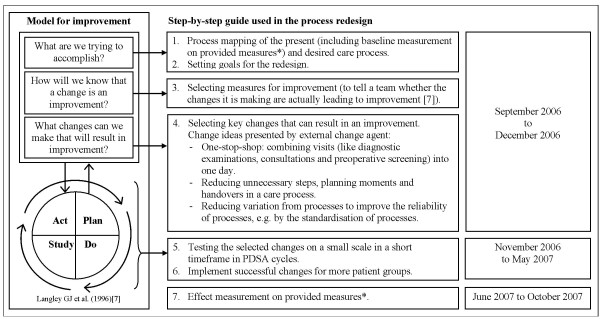
We evaluated a Dutch process redesign collaborative of seventeen project teams using a multiple case study design. The goals of this collaborative were to reduce the time between the first visit to the outpatient's clinic and the start of treatment and to reduce the in-hospital length of stay by 30% for involved patient groups. Data were gathered using qualitative methods, such as document analysis, questionnaires, semi-structured interviews and participation in collaborative meetings.
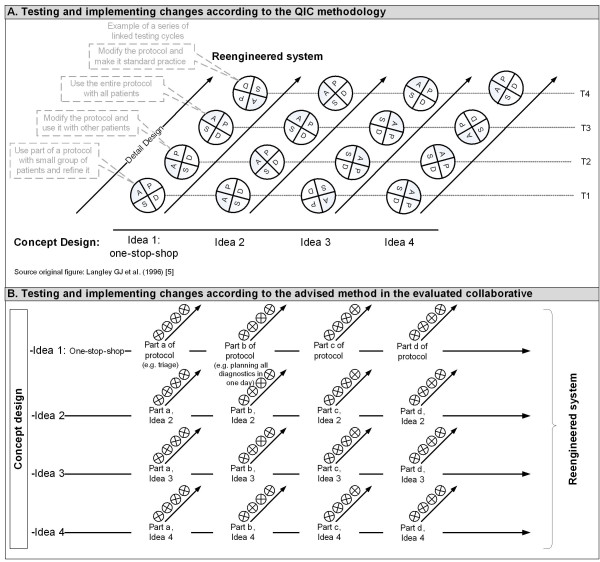
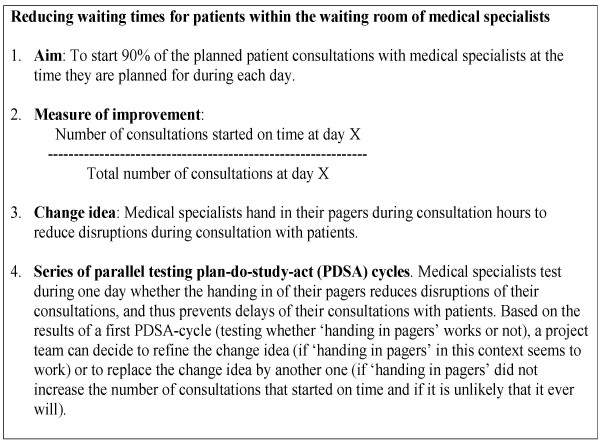
Application of the QIC method to process redesign proved to be difficult. First, project teams did not use the provided standard change ideas, because of their need for customized solutions that fitted with context-specific causes of waiting times and delays. Second, project teams were not capable of testing change ideas within short time frames due to: the need for tailoring changes ideas and the complexity of aligning interests of involved departments; small volumes of involved patient groups; and inadequate information and communication technology (ICT) support. Third, project teams did not experience peer stimulus because they saw few similarities between their projects, rarely shared experiences, and did not demonstrate competitive behaviour. Besides, a number of project teams reported that organisational and external change agent support was limited.
This study showed that the perceived need for tailoring standard change ideas to local contexts and the complexity of aligning interests of involved departments hampered the use of the QIC method for process redesign. We cannot determine whether the QIC method would have been appropriate for process redesign. Peer stimulus was non-optimal as a result of the selection process for participation of project teams by the external change agent. In conclusion, project teams felt that necessary preconditions for successful use of the QIC method were lacking.
尽管质量改进合作(QIC)已被广泛应用,但该方法的证据有限。QIC 是一种在组织之间快速测试和实施基于证据的改进的方法。为了扩展关于 QIC 可以使用的条件的知识,我们在这项研究中探索了 QIC 方法在流程重新设计中的适用性。
我们使用多案例研究设计评估了一个由十七个项目团队组成的荷兰流程重新设计合作。该合作的目标是减少从首次就诊到开始治疗之间的时间,并将涉及患者群体的住院时间减少 30%。数据收集采用了定性方法,例如文件分析、问卷调查、半结构化访谈和参与合作会议。
将 QIC 方法应用于流程重新设计证明具有挑战性。首先,由于需要定制解决方案以适应特定于上下文的等待时间和延迟原因,项目团队没有使用提供的标准更改思路。其次,由于需要调整更改思路和协调涉及部门的利益的复杂性、涉及患者群体的数量较小以及信息和通信技术(ICT)支持不足,项目团队无法在短时间内测试更改思路。第三,由于项目团队之间很少有相似之处,很少分享经验,也没有表现出竞争行为,因此项目团队没有体验到同行的激励。此外,一些项目团队报告称,组织和外部变革推动者的支持有限。
本研究表明,对定制标准更改思路以适应本地环境的需求以及协调涉及部门利益的复杂性阻碍了 QIC 方法在流程重新设计中的应用。我们无法确定 QIC 方法是否适合流程重新设计。由于外部变革推动者选择参与项目团队的过程,同行激励效果不佳。总之,项目团队认为成功使用 QIC 方法所需的必要前提条件不足。