University of Massachusetts Medical School, Worcester, MA 01655, USA.
Clin Infect Dis. 2010 Apr 15;50(8):1135-43. doi: 10.1086/651268.
Dengue virus infection causes a spectrum of clinical manifestations, usually classified according to the World Health Organization (WHO) guidelines into dengue fever (DF) and dengue hemorrhagic fever (DHF). The ability of these guidelines to categorize severe dengue illness has recently been questioned.
We evaluated dengue case definitions in a prospective study at a pediatric hospital in Bangkok, Thailand, during 1994-2005. One thousand thirteen children were enrolled within the first 3 days after onset of fever and observed with standardized data collection. Cases were classified on the basis of application of the strict WHO criteria. All dengue virus infections were laboratory confirmed. We retrospectively grouped patients on the basis of whether they received significant intervention based on fluid replacement and/or requirements for blood transfusion.
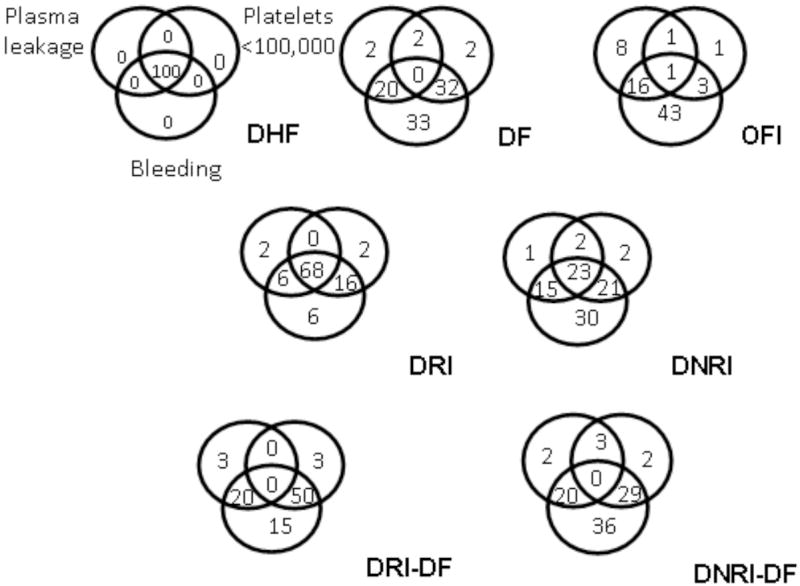
Eighty-five (58%) of 150 persons with DHF, 40 (15%) of 264 with DF, and 73 (12%) of 599 with other febrile illnesses (OFIs) received significant intervention. Sixty-eight percent of dengue cases requiring intervention met strict WHO criteria for DHF. In contrast, only 1% of OFI cases met WHO criteria for DHF. Plasma leakage and thrombocytopenia were the 2 components contributing to the specificity of the WHO case definition and identified dengue cases that required intervention. Hemorrhagic tendency did not reliably differentiate DF and DHF. In DF cases, thrombocytopenia and bleeding were associated with severity.
Dengue illness is heterogeneous in severity, and severe clinical features occurred in patients whose cases were not characterized as DHF. The WHO case definition of DHF demonstrated sensitivity of 62% and specificity of 92% for identification of dengue illness requiring intervention, without the need for laboratory confirmation of dengue virus infection, in an area of endemicity.
登革病毒感染引起一系列临床表现,通常根据世界卫生组织(WHO)的指南分为登革热(DF)和登革出血热(DHF)。这些指南对严重登革热疾病的分类能力最近受到质疑。
我们在泰国曼谷的一家儿科医院进行了一项前瞻性研究,评估了登革热病例的定义。在 1994 年至 2005 年期间,在发热后 3 天内入组了 1013 名儿童,并进行了标准化数据收集。根据严格的 WHO 标准应用对病例进行分类。所有登革热病毒感染均通过实验室确认。我们根据是否根据液体替代和/或输血需求对患者进行了重大干预来回顾性分组。
85 例(58%)DHF 患者、40 例(15%)DF 患者和 599 例(12%)其他发热性疾病(OFIs)患者接受了重大干预。需要干预的登革热病例中有 68%符合严格的 WHO 登革出血热标准。相比之下,只有 1%的 OFI 病例符合 WHO 登革出血热标准。血浆渗漏和血小板减少是 WHO 病例定义特异性的两个组成部分,可识别需要干预的登革热病例。出血倾向不能可靠地区分 DF 和 DHF。在 DF 病例中,血小板减少和出血与严重程度相关。
登革热疾病的严重程度存在异质性,严重的临床特征发生在不符合 DHF 特征的患者中。在流行地区,无需登革热病毒感染的实验室确认,WHO 登革出血热的病例定义具有 62%的敏感性和 92%的特异性,可识别需要干预的登革热疾病。