
虾青素可降低氧化应激和炎症,增强人体的免疫反应。
Astaxanthin decreased oxidative stress and inflammation and enhanced immune response in humans.
机构信息
School of Food Science, Washington State University, Pullman, WA 99164-6376 USA.
出版信息
Nutr Metab (Lond). 2010 Mar 5;7:18. doi: 10.1186/1743-7075-7-18.
BACKGROUND
Astaxanthin modulates immune response, inhibits cancer cell growth, reduces bacterial load and gastric inflammation, and protects against UVA-induced oxidative stress in in vitro and rodent models. Similar clinical studies in humans are unavailable. Our objective is to study the action of dietary astaxanthin in modulating immune response, oxidative status and inflammation in young healthy adult female human subjects.
METHODS
Participants (averaged 21.5 yr) received 0, 2, or 8 mg astaxanthin (n = 14/diet) daily for 8 wk in a randomized double-blind, placebo-controlled study. Immune response was assessed on wk 0, 4 and 8, and tuberculin test performed on wk 8.
RESULTS
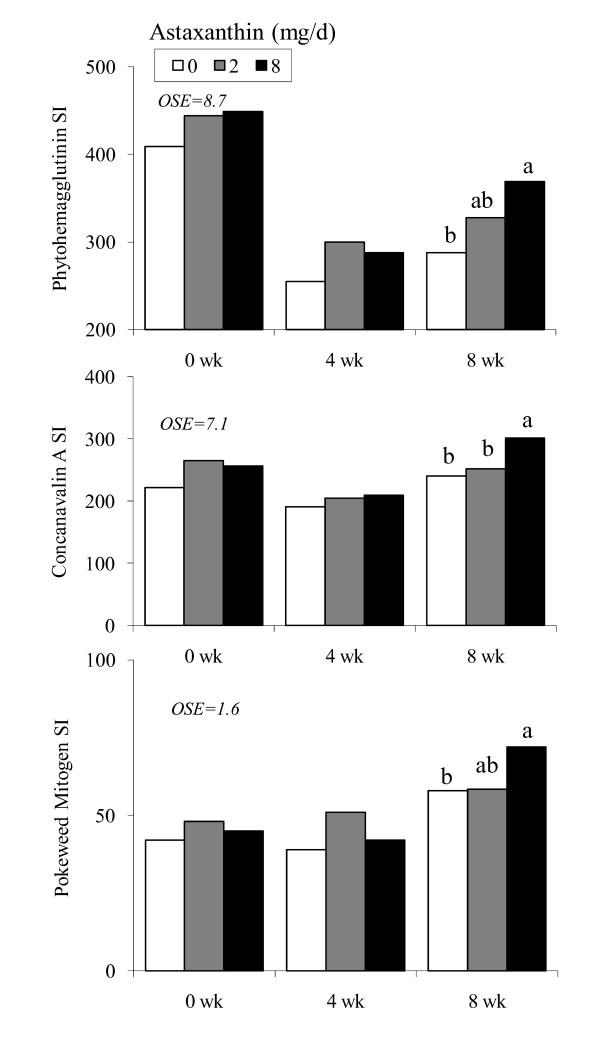
Plasma astaxanthin increased (P < 0.01) dose-dependently after 4 or 8 wk of supplementation. Astaxanthin decreased a DNA damage biomarker after 4 wk but did not affect lipid peroxidation. Plasma C-reactive protein concentration was lower (P < 0.05) on wk 8 in subjects given 2 mg astaxanthin. Dietary astaxanthin stimulated mitogen-induced lymphoproliferation, increased natural killer cell cytotoxic activity, and increased total T and B cell subpopulations, but did not influence populations of Thelper, Tcytotoxic or natural killer cells. A higher percentage of leukocytes expressed the LFA-1 marker in subjects given 2 mg astaxanthin on wk 8. Subjects fed 2 mg astaxanthin had a higher tuberculin response than unsupplemented subjects. There was no difference in TNF and IL-2 concentrations, but plasma IFN-gamma and IL-6 increased on wk 8 in subjects given 8 mg astaxanthin.
CONCLUSION
Therefore, dietary astaxanthin decreases a DNA damage biomarker and acute phase protein, and enhances immune response in young healthy females.
背景
虾青素可调节免疫反应,抑制癌细胞生长,减少细菌负荷和胃炎症,并防止 UVA 诱导的体外和啮齿动物模型中的氧化应激。在人类中,类似的临床研究尚不可用。我们的目的是研究饮食虾青素对调节年轻健康成年女性人体免疫反应、氧化状态和炎症的作用。
方法
参与者(平均年龄 21.5 岁)在一项随机、双盲、安慰剂对照研究中,每天接受 0、2 或 8mg 虾青素(n=14/饮食),持续 8 周。在第 0、4 和 8 周评估免疫反应,并在第 8 周进行结核菌素试验。
结果
补充 4 或 8 周后,血浆虾青素水平呈剂量依赖性增加(P<0.01)。虾青素在第 4 周降低了 DNA 损伤生物标志物,但不影响脂质过氧化。在给予 2mg 虾青素的受试者中,第 8 周时血浆 C 反应蛋白浓度较低(P<0.05)。饮食虾青素刺激有丝分裂原诱导的淋巴细胞增殖,增加自然杀伤细胞细胞毒性活性,并增加总 T 和 B 细胞亚群,但不影响辅助性 T 细胞、Tcytotoxic 或自然杀伤细胞群体。在第 8 周,给予 2mg 虾青素的受试者中,白细胞表达 LFA-1 标记的比例更高。给予 2mg 虾青素的受试者结核菌素反应高于未补充的受试者。TNF 和 IL-2 浓度没有差异,但在给予 8mg 虾青素的受试者中,第 8 周时血浆 IFN-γ和 IL-6 增加。
结论
因此,饮食虾青素可降低 DNA 损伤生物标志物和急性期蛋白,并增强年轻健康女性的免疫反应。




 Zotero 插件