Centre for Functional MRI of the Brain, University of Oxford, Oxford, UK.
Neuroimage. 2010 Jun;51(2):555-64. doi: 10.1016/j.neuroimage.2010.02.062. Epub 2010 Mar 4.
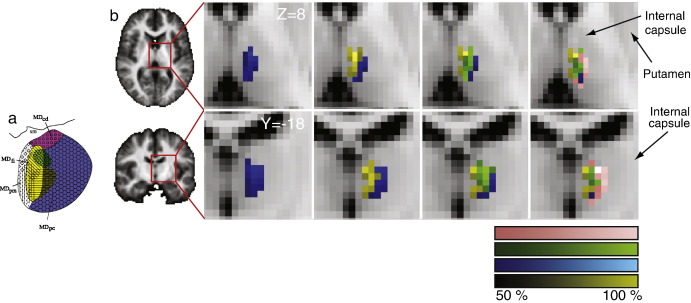
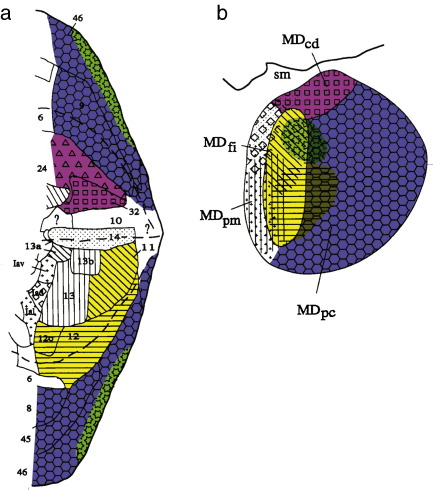
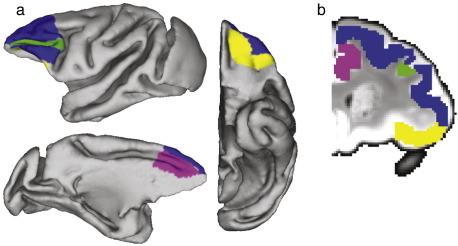
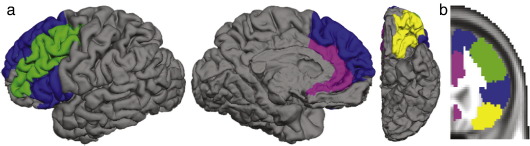
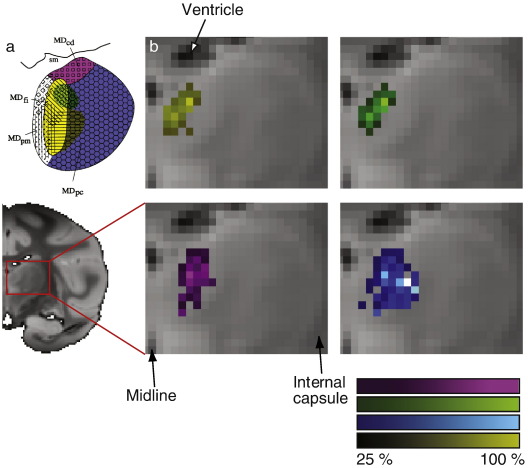
Studies in monkeys show clear anatomical and functional distinctions among networks connecting with subregions within the prefrontal cortex. Three such networks are centered on lateral orbitofrontal cortex, medial frontal and cingulate cortex, and lateral prefrontal cortex and all have been identified with distinct cognitive roles. Although these areas differ in a number of their cortical connections, some of the first anatomical evidence for these networks came from tracer studies demonstrating their distinct patterns of connectivity with the mediodorsal (MD) nucleus of the thalamus. Here, we present evidence for a similar topography of MD thalamus prefrontal connections, using non-invasive imaging and diffusion tractography (DWI-DT) in human and macaque. DWI-DT suggested that there was a high probability of interconnection between medial MD and lateral orbitofrontal cortex, between caudodorsal MD and medial frontal/cingulate cortex, and between lateral MD and lateral prefrontal cortex, in both species. Within the lateral prefrontal cortex a dorsolateral region (the principal sulcus in the macaque and middle frontal gyrus in the human) was found to have a high probability of interconnection with the MD region between the regions with a high probability of interconnection with other parts of the lateral prefrontal cortex and with the lateral orbitofrontal cortex. In addition to suggesting that the thalamic connectivity in the macaque is a good guide to human prefrontal cortex, and therefore that there are likely to be similarities in the cognitive roles played by the prefrontal areas in both species, the present results are also the first to provide insight into the topography of projections of an individual thalamic nucleus in the human brain.
在猴子中的研究表明,与前额叶皮层内的各个亚区相连的网络之间存在明显的解剖学和功能差异。有三个这样的网络,分别以外侧眶额皮层、内侧额前皮质和扣带皮层以及外侧前额叶皮层为中心,它们都具有独特的认知作用。尽管这些区域在许多皮质连接上存在差异,但这些网络的一些最初的解剖学证据来自示踪研究,这些研究表明它们与丘脑的中背核(MD)有着独特的连接模式。在这里,我们使用人类和猕猴的非侵入性成像和弥散张量成像(DWI-DT),为 MD 丘脑与前额叶连接的类似拓扑结构提供了证据。DWI-DT 表明,在两种物种中,内侧 MD 和外侧眶额皮层之间、尾侧 MD 和内侧额前皮质/扣带皮层之间以及外侧 MD 和外侧前额叶皮层之间都存在高度的相互连接的可能性。在外侧前额叶皮层中,一个背外侧区域(猕猴的主沟和人类的中额回)与 MD 区域之间存在高度的相互连接的可能性,与外侧前额叶皮层的其他部分以及外侧眶额皮层之间也存在高度的相互连接的可能性。这些结果不仅表明,猕猴的丘脑连接是人类前额叶皮层的一个很好的指南,因此,两种物种的前额叶区域在认知作用上可能存在相似性,而且还首次提供了关于人类大脑中单个丘脑核的投射拓扑结构的深入了解。