Department of Health Sciences, Faculty of Earth and Life Sciences, EMGO Institute for Health Care Research, VU University, Amsterdam, The Netherlands.
PLoS One. 2010 Mar 2;5(3):e9434. doi: 10.1371/journal.pone.0009434.
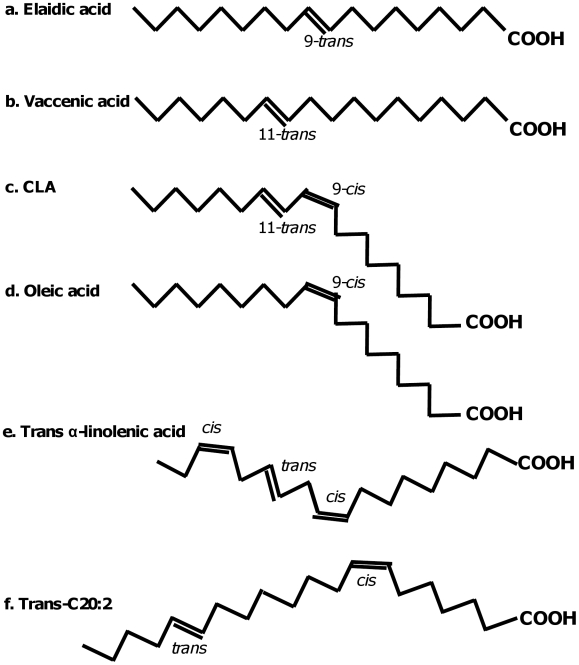
Trans fatty acids are produced either by industrial hydrogenation or by biohydrogenation in the rumens of cows and sheep. Industrial trans fatty acids lower HDL cholesterol, raise LDL cholesterol, and increase the risk of coronary heart disease. The effects of conjugated linoleic acid and trans fatty acids from ruminant animals are less clear. We reviewed the literature, estimated the effects trans fatty acids from ruminant sources and of conjugated trans linoleic acid (CLA) on blood lipoproteins, and compared these with industrial trans fatty acids.
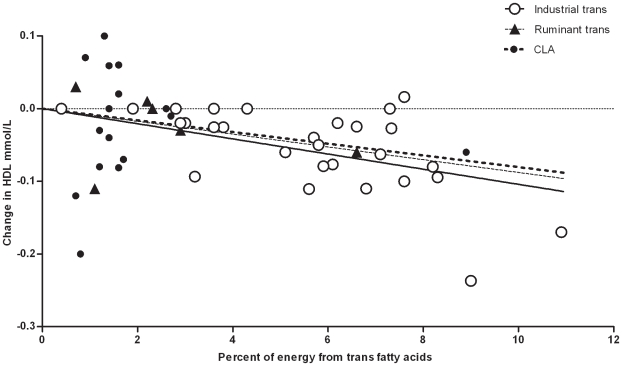
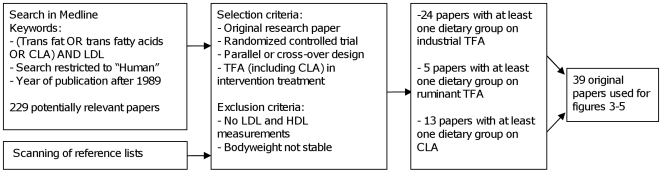
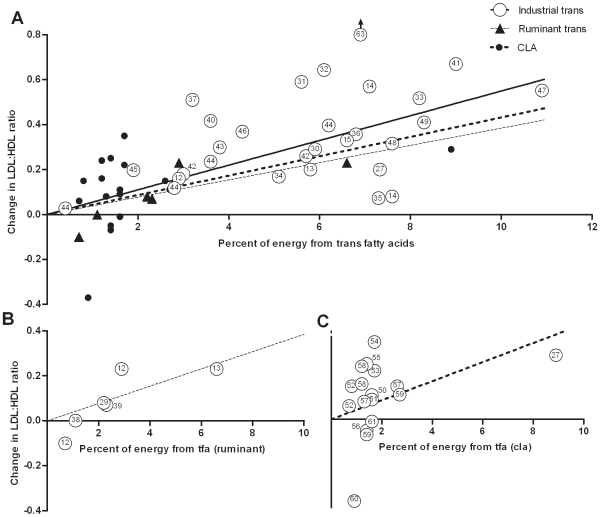
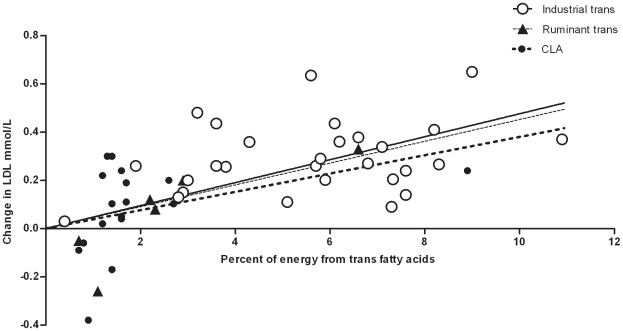
METHODOLOGY/PRINCIPAL FINDINGS: We searched Medline and scanned reference lists for intervention trials that reported effects of industrial trans fatty acids, ruminant trans fatty acids or conjugated linoleic acid on LDL and HDL cholesterol in humans. The 39 studies that met our criteria provided results of 29 treatments with industrial trans fatty acids, 6 with ruminant trans fatty acids and 17 with CLA. Control treatments differed between studies; to enable comparison between studies we recalculated for each study what the effect of trans fatty acids on lipoprotein would be if they isocalorically replaced cis mono unsaturated fatty acids. In linear regression analysis the plasma LDL to HDL cholesterol ratio increased by 0.055 (95%CI 0.044-0.066) for each % of dietary energy from industrial trans fatty acids replacing cis monounsaturated fatty acids The increase in the LDL to HDL ratio for each % of energy was 0.038 (95%CI 0.012-0.065) for ruminant trans fatty acids, and 0.043 (95% CI 0.012-0.074) for conjugated linoleic acid (p = 0.99 for difference between CLA and industrial trans fatty acids; p = 0.37 for ruminant versus industrial trans fatty acids).
CONCLUSIONS/SIGNIFICANCE: Published data suggest that all fatty acids with a double bond in the trans configuration raise the ratio of plasma LDL to HDL cholesterol.
反式脂肪酸要么通过工业氢化产生,要么通过牛羊瘤胃中的生物氢化产生。工业反式脂肪酸会降低高密度脂蛋白胆固醇,升高低密度脂蛋白胆固醇,并增加患冠心病的风险。反刍动物来源的共轭亚油酸和反式脂肪酸的影响则不太明确。我们对文献进行了综述,评估了来自反刍动物源的反式脂肪酸和共轭反式亚油酸(CLA)对血液脂蛋白的影响,并与工业反式脂肪酸进行了比较。
方法/主要发现:我们在 Medline 上进行了检索,并对报告了工业反式脂肪酸、反刍动物反式脂肪酸或共轭亚油酸对人体 LDL 和 HDL 胆固醇影响的干预试验的参考文献进行了扫描。符合我们标准的 39 项研究提供了 29 项工业反式脂肪酸、6 项反刍动物反式脂肪酸和 17 项 CLA 治疗的结果。研究之间的对照处理有所不同;为了能够在研究之间进行比较,我们重新计算了如果它们等热量替代顺式单不饱和脂肪酸,反式脂肪酸对脂蛋白的影响。在线性回归分析中,膳食能量中来自工业反式脂肪酸的比例每增加 1%,血浆 LDL 与 HDL 胆固醇比值就会增加 0.055(95%CI 0.044-0.066)。对于反刍动物反式脂肪酸,能量的每增加 1%,LDL 与 HDL 比值增加 0.038(95%CI 0.012-0.065),而对于共轭亚油酸则增加 0.043(95%CI 0.012-0.074)(CLA 和工业反式脂肪酸之间差异的 p 值为 0.99;反刍动物与工业反式脂肪酸之间差异的 p 值为 0.37)。
结论/意义:已发表的数据表明,所有具有反式构型双键的脂肪酸都会提高血浆 LDL 与 HDL 胆固醇的比值。