Department of Health Sciences and the EMGO Institute for Health Care Research, VU University Amsterdam, Amsterdam, The Netherlands.
PLoS One. 2010 Feb 3;5(2):e9000. doi: 10.1371/journal.pone.0009000.
Trans fatty acids are produced either by industrial hydrogenation or by biohydrogenation in the rumens of cows and sheep. Industrial trans fatty acids lower high-density lipoprotein (HDL) cholesterol, raise low-density lipoprotein (LDL) cholesterol, and increase the risk of coronary heart disease. The effects of trans fatty acids from ruminants are less clear. We investigated the effect on blood lipids of cis-9, trans-11 conjugated linoleic acid (CLA), a trans fatty acid largely restricted to ruminant fats.
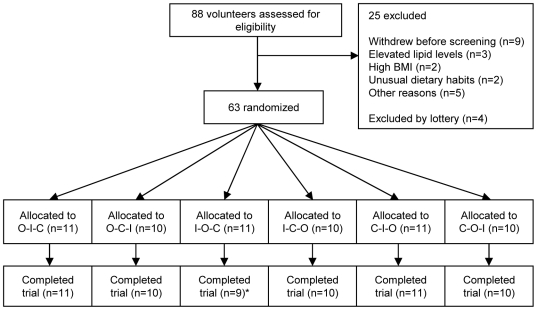
METHODOLOGY/PRINCIPAL FINDINGS: Sixty-one healthy women and men were sequentially fed each of three diets for three weeks, in random order, for a total of nine weeks. Diets were identical except for 7% of energy (approximately 20 g/day), which was provided either by oleic acid, by industrial trans fatty acids, or by a mixture of 80% cis-9, trans-11 and 20% trans-10, cis-12 CLA. After the oleic acid diet, mean (+/- SD) serum LDL cholesterol was 2.68+/-0.62 mmol/L compared to 3.00+/-0.66 mmol/L after industrial trans fatty acids (p<0.001), and 2.92+/-0.70 mmol/L after CLA (p<0.001). Compared to oleic acid, HDL-cholesterol was 0.05+/-0.12 mmol/L lower after industrial trans fatty acids (p = 0.001) and 0.06+/-0.10 mmol/L lower after CLA (p<0.001). The total-to-HDL cholesterol ratio was 11.6% higher after industrial trans fatty acids (p<0.001) and 10.0% higher after CLA (p<0.001) relative to the oleic acid diet.
CONCLUSIONS/SIGNIFICANCE: High intakes of an 80:20 mixture of cis-9, trans-11 and trans-10, cis-12 CLA raise the total to HDL cholesterol ratio in healthy volunteers. The effect of CLA may be somewhat less than that of industrial trans fatty acids.
ClinicalTrials.gov NCT00529828.
反式脂肪酸可通过工业氢化或牛羊瘤胃中的生物氢化产生。工业反式脂肪酸会降低高密度脂蛋白(HDL)胆固醇,升高低密度脂蛋白(LDL)胆固醇,并增加患冠心病的风险。反刍动物来源的反式脂肪酸的影响则不太明确。我们研究了顺-9,反-11 共轭亚油酸(CLA)——一种主要存在于反刍动物脂肪中的反式脂肪酸——对血脂的影响。
方法/主要发现:61 名健康的女性和男性被依次连续食用三种饮食,每种饮食持续三周,总共九周。三种饮食完全相同,只是 7%的能量(约 20 克/天)来自油酸、工业反式脂肪酸或 80%顺-9,反-11 和 20%反-10,顺-12 CLA 的混合物。在油酸饮食后,血清 LDL 胆固醇的平均值(+/- SD)为 2.68+/-0.62mmol/L,而工业反式脂肪酸组为 3.00+/-0.66mmol/L(p<0.001),CLA 组为 2.92+/-0.70mmol/L(p<0.001)。与油酸相比,工业反式脂肪酸组的 HDL-胆固醇低 0.05+/-0.12mmol/L(p=0.001),CLA 组低 0.06+/-0.10mmol/L(p<0.001)。与油酸饮食相比,工业反式脂肪酸组的总胆固醇与 HDL 胆固醇的比值高 11.6%(p<0.001),CLA 组高 10.0%(p<0.001)。
结论/意义:健康志愿者大量摄入顺-9,反-11 和反-10,顺-12 CLA 的 80:20 混合物,会升高总胆固醇与 HDL 胆固醇的比值。CLA 的作用可能略低于工业反式脂肪酸。
ClinicalTrials.gov NCT00529828。