Max Planck Institute of Psychiatry, Munich, Germany.
PLoS One. 2010 Mar 1;5(3):e9444. doi: 10.1371/journal.pone.0009444.
Recent epidemiological and experimental data suggest a negative influence of shortened or disturbed night sleep on glucose tolerance. Due to the high prevalence of sleep disorders this might be a major health issue. However, no comparative studies of carbohydrate metabolism have been conducted in clinical sleep disorders.
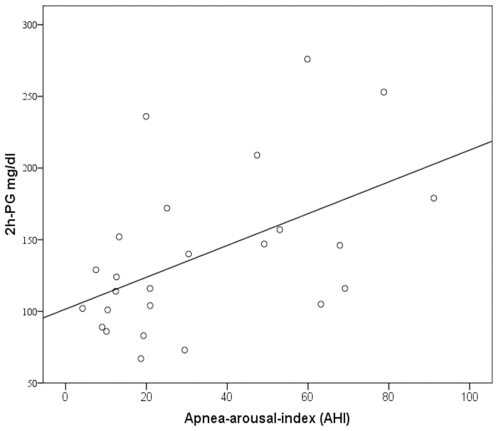
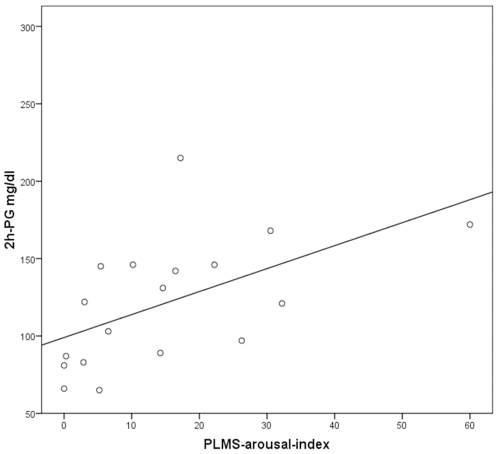
METHODOLOGY/PRINCIPAL FINDINGS: We performed oral glucose tolerance tests (OGTT) and assessed additional parameters of carbohydrate metabolism in patients suffering from obstructive sleep apnea syndrome (OSAS, N = 25), restless legs syndrome (RLS, N = 18) or primary insomnia (N = 21), and in healthy controls (N = 33). Compared to controls, increased rates of impaired glucose tolerance were found in OSAS (OR: 4.9) and RLS (OR: 4.7) patients, but not in primary insomnia patients (OR: 1.6). In addition, HbA1c values were significantly increased in the same two patient groups. Significant positive correlations were found between 2-h plasma glucose values measured during the OGTT and the apnea-arousal-index in OSAS (r = 0.56; p<0.05) and the periodic leg movement-arousal-index in RLS (r = 0.56, p<0.05), respectively. Sleep duration and other quantitative aspects of sleep were similar between patient groups.
CONCLUSIONS/SIGNIFICANCE: Our findings suggest that some, but not all sleep disorders considerably compromise glucose metabolism. Repeated arousals during sleep might be a pivotal causative factor deserving further experimental investigations to reveal potential novel targets for the prevention of metabolic diseases.
最近的流行病学和实验数据表明,夜间睡眠缩短或睡眠紊乱会对葡萄糖耐量产生负面影响。由于睡眠障碍的高发,这可能是一个主要的健康问题。然而,在临床睡眠障碍中,尚未对碳水化合物代谢进行过比较研究。
方法/主要发现:我们对患有阻塞性睡眠呼吸暂停综合征(OSAS,N=25)、不安腿综合征(RLS,N=18)或原发性失眠(N=21)的患者以及健康对照组(N=33)进行了口服葡萄糖耐量试验(OGTT),并评估了碳水化合物代谢的其他参数。与对照组相比,OSAS(OR:4.9)和 RLS(OR:4.7)患者的葡萄糖耐量受损率增加,但原发性失眠患者(OR:1.6)则没有。此外,HbA1c 值在这两个患者组中也显著升高。在 OSAS 中,OGTT 期间 2 小时血浆葡萄糖值与呼吸暂停-觉醒指数之间存在显著正相关(r = 0.56;p<0.05),在 RLS 中,2 小时血浆葡萄糖值与周期性肢体运动-觉醒指数之间也存在显著正相关(r = 0.56,p<0.05)。OSAS 和 RLS 患者的睡眠时间和其他睡眠的定量方面在各组之间相似。
结论/意义:我们的研究结果表明,一些睡眠障碍,但并非所有睡眠障碍都会显著损害葡萄糖代谢。睡眠期间的反复觉醒可能是一个关键的致病因素,值得进一步的实验研究,以揭示预防代谢性疾病的潜在新靶点。