Department of Psychology, Stanford University, Stanford, CA 94305, USA.
Behav Res Ther. 2010 Jun;48(6):459-66. doi: 10.1016/j.brat.2010.01.007. Epub 2010 Feb 10.
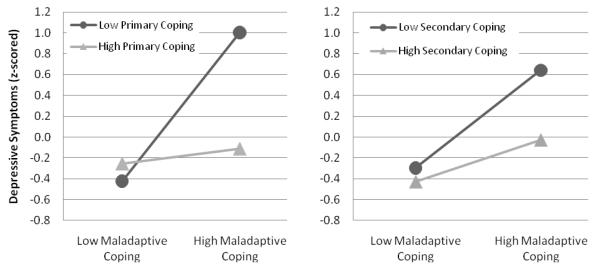
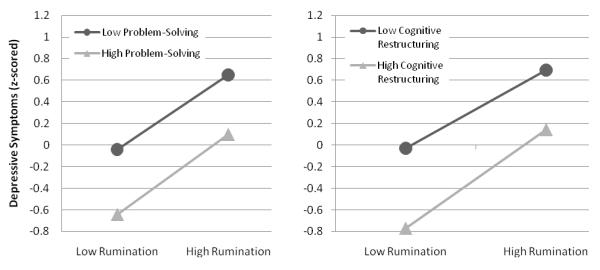
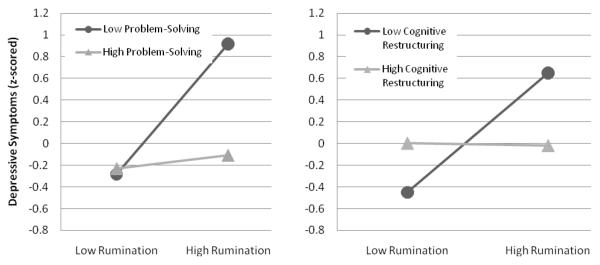
Rumination has consistently been found to be associated with the onset and duration of major depressive episodes. Little research, however, has examined factors that may weaken the association between maladaptive coping, such as rumination, and depressive symptoms. In three samples of participants, including 149 never-depressed adolescent girls, 41 never-depressed women, and 39 depressed women, we examined whether generally adaptive forms of coping interacted with generally maladaptive forms of coping to predict depressive symptoms. Age-appropriate measures of coping and depression were administered to participants in each sample. In never-depressed females, maladaptive coping/rumination were more strongly related to depressive symptoms in the presence of lower levels of adaptive coping. The relation between depression and maladaptive coping/rumination was weaker in the context of higher levels of adaptive coping. In contrast, for the depressed females, we found main effects for rumination and adaptive coping, with higher levels of rumination and lower levels of adaptive coping being associated with higher levels of depressive symptoms. The present findings highlight how adaptive coping and maladaptive coping, including rumination, differentially relate to each other and depressive symptoms depending on individuals' current depressive state.
反刍思维一直与重度抑郁发作的发生和持续时间有关。然而,很少有研究探讨可能会削弱适应不良应对方式(如反刍思维)与抑郁症状之间关联的因素。在包括 149 名从未抑郁的青春期女孩、41 名从未抑郁的女性和 39 名抑郁女性在内的三个参与者样本中,我们研究了一般适应性应对方式与一般适应不良应对方式是否相互作用,从而预测抑郁症状。每个样本中的参与者都接受了适合年龄的应对和抑郁措施。在从未抑郁的女性中,在适应性应对水平较低的情况下,适应不良的应对/反刍与抑郁症状的关系更为密切。在适应性应对水平较高的情况下,抑郁与适应不良应对/反刍之间的关系较弱。相比之下,对于抑郁女性,我们发现反刍和适应性应对有主要影响,反刍水平较高和适应性应对水平较低与抑郁症状水平较高有关。这些发现强调了适应性应对和适应不良应对(包括反刍思维)如何根据个体当前的抑郁状态,以不同的方式相互关联,并与抑郁症状相关。