Department of Internal Medicine, Mayo Clinic, Rochester, MN, USA.
BMJ. 2010 Mar 18;340:c1344. doi: 10.1136/bmj.c1344.
To explore a possible link between authors' financial conflicts of interest and their position on the association of rosiglitazone with increased risk of myocardial infarction in patients with diabetes.
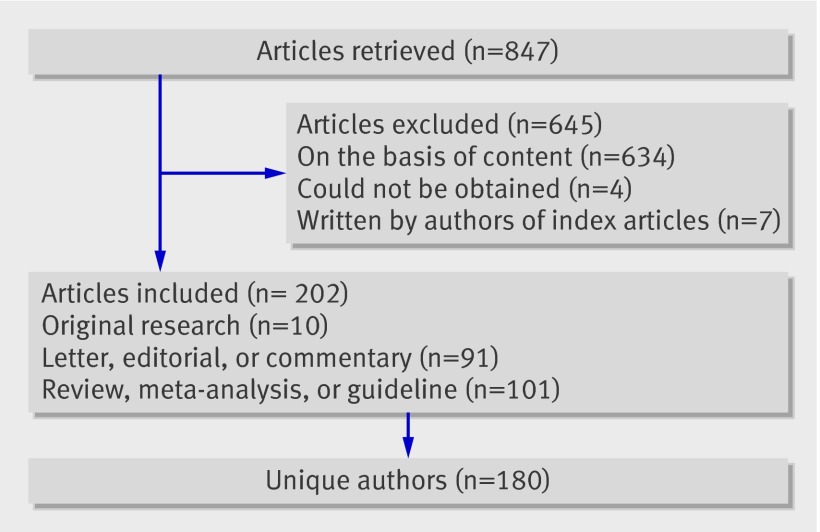
On 10 April 2009, we searched Web of Science and Scopus for articles citing and commenting on either of two index publications that contributed key data to the controversy (a meta-analysis of small trials and a subsequent large trial). Data selection Articles had to comment on rosiglitazone and the risk of myocardial infarction. Guidelines, meta-analyses, reviews, clinical trials, letters, commentaries, and editorials were included.
For each article, we sought information about the authors' financial conflicts of interest in the report itself and elsewhere (that is, in all publications within two years of the original publication and online). Two reviewers blinded to the authors' financial relationships independently classified each article as presenting a favourable (that is, rosiglitazone does not increase the risk of myocardial infarction), neutral, or unfavourable view on the risk of myocardial infarction with rosiglitazone and on recommendations on the use of the drug.
Of the 202 included articles, 108 (53%) had a conflict of interest statement. Ninety authors (45%) had financial conflicts of interest. Authors who had a favourable view of the risk of myocardial infarction with rosiglitazone were more likely to have financial conflicts of interest with manufacturers of antihyperglycaemic agents in general, and with rosiglitazone manufacturers in particular, than authors who had an unfavourable view (rate ratio 3.38, 95% CI 2.26 to 5.06 and 4.29, 2.63 to 7.02, respectively). There was likewise a strong association between favourable recommendations on the use of rosiglitazone and financial conflicts of interest (3.36, 1.94 to 5.83). These links persisted when articles rather than authors were used as the unit of analysis (4.69, 2.84 to 7.72), when the analysis was restricted to opinion articles (6.29, 2.15 to 18.38) or to articles in which the rosiglitazone controversy was the main focus (6.50, 2.56 to 16.53), and both in articles published before and after the Food and Drug Administration issued a safety warning for rosiglitazone (3.43, 0.99 to 11.82 and 4.95, 2.87 to 8.53, respectively).
Disclosure rates for financial conflicts of interest were unexpectedly low, and there was a clear and strong link between the orientation of authors' expressed views on the rosiglitazone controversy and their financial conflicts of interest with pharmaceutical companies. Although these findings do not necessarily indicate a causal link between the position taken on the cardiac risk of rosiglitazone in patients with diabetes and the authors' financial conflicts of interest, they underscore the need for further changes in disclosure procedures in order for the scientific record to be trusted.
探讨作者的财务利益冲突与他们对罗格列酮增加糖尿病患者心肌梗死风险的看法之间可能存在的联系。
2009 年 4 月 10 日,我们在 Web of Science 和 Scopus 上搜索了引用和评论两篇索引出版物的文章,这两篇出版物为争议提供了关键数据(一项小型试验的荟萃分析和随后的一项大型试验)。
文章必须对罗格列酮和心肌梗死风险进行评论。指南、荟萃分析、综述、临床试验、信件、评论和社论均包含在内。
对于每一篇文章,我们都在报告本身和其他地方(即原始出版物两年内的所有出版物和在线出版物)寻找作者财务利益冲突的信息。两位对作者财务关系不知情的审稿人独立地将每篇文章分类为对罗格列酮增加心肌梗死风险的有利(即罗格列酮不会增加心肌梗死风险)、中立或不利的观点,以及对该药物使用的建议。
在纳入的 202 篇文章中,有 108 篇(53%)有利益冲突声明。90 名作者(45%)存在财务利益冲突。与对罗格列酮增加心肌梗死风险持不利观点的作者相比,对罗格列酮增加心肌梗死风险持有利观点的作者与一般抗高血糖药物制造商、特别是罗格列酮制造商的财务利益冲突更为密切(比值比 3.38,95%CI 2.26 至 5.06 和 4.29,2.63 至 7.02)。与罗格列酮使用的有利建议之间也存在强烈关联(3.36,1.94 至 5.83)。当使用文章而不是作者作为分析单位(4.69,2.84 至 7.72)、当分析仅限于意见文章(6.29,2.15 至 18.38)或当罗格列酮争议是主要焦点的文章(6.50,2.56 至 16.53)时,以及在食品和药物管理局发布罗格列酮安全警告之前和之后发表的文章中(3.43,0.99 至 11.82 和 4.95,2.87 至 8.53),这些联系仍然存在。
财务利益冲突披露率出人意料地低,作者对罗格列酮争议的表达观点的方向与他们与制药公司的财务利益冲突之间存在明显而强烈的联系。尽管这些发现并不一定表明作者在糖尿病患者使用罗格列酮的心脏风险方面的立场与他们的财务利益冲突之间存在因果关系,但它们强调需要进一步改变披露程序,以便让科学界相信科学记录。
