Sbarro Institute for Cancer Research and Molecular Medicine, Center for Biotechnology, College of Science and Technology, Temple University, Philadelphia, Pennsylvania 19122, USA.
J Cell Biochem. 2010 May;110(1):182-90. doi: 10.1002/jcb.22525.
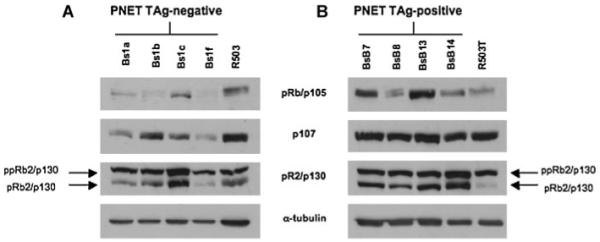
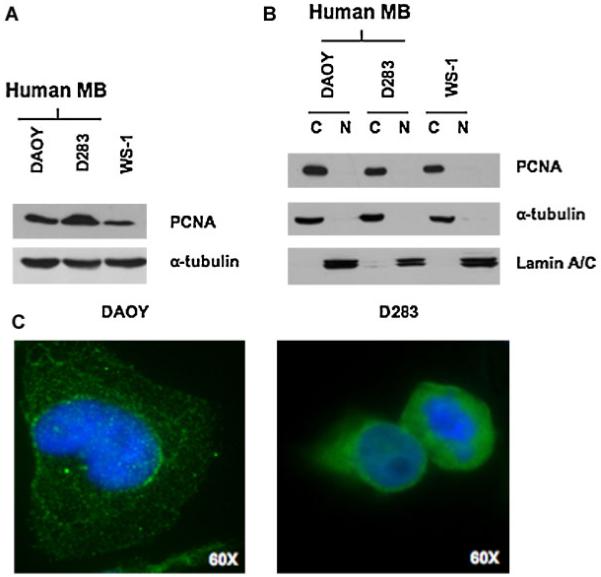
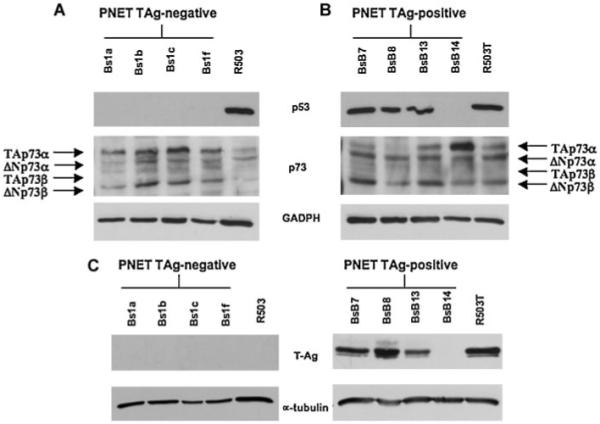
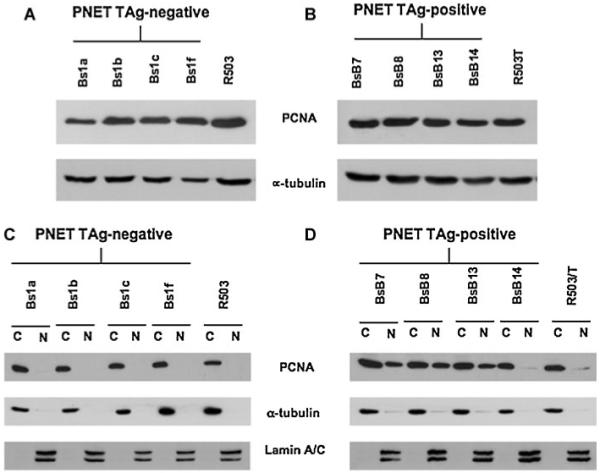
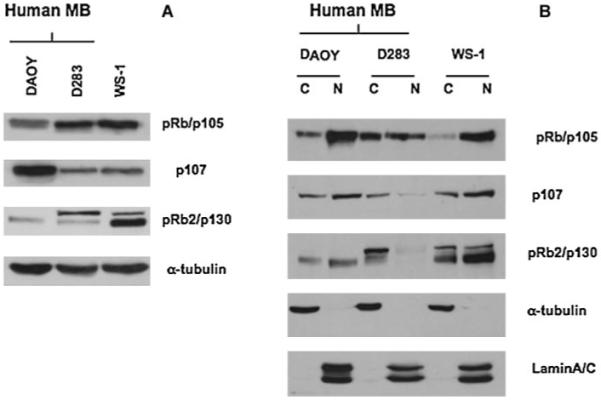
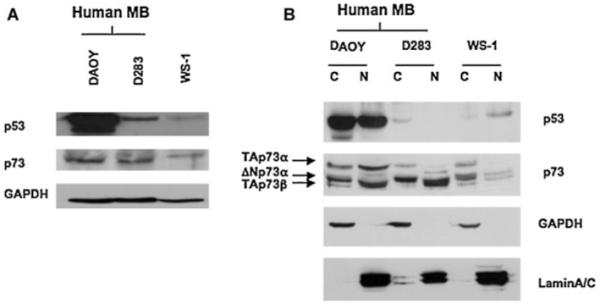
The formation and progression of mudulloblastoma (MB) is poorly understood. However, somatic inactivation of pRb/p105, in combination with a somatic or a germ-line TP53 inactivation, leads to MB in a mouse model. Presently, there is no specific evidence of pathway/s alterations for the other two members of the retinoblastoma family, pRb2/p130 and/or p107 in MB. JC virus (JCV) is a human polyomavirus. Although there is no firm evidence that this virus plays a causal role in human neoplasia, it has been clearly proven that JCV is highly oncogenic when injected into the brain of experimental animals. The mechanism of JCV-induced tumorigenesis is not entirely clear. However, several studies relate the oncogenic properties of JCV mainly to its early protein large T-antigen (T-Ag), which is able to bind and inactivate both TP53 and Rb family proteins. Here, we compared the protein expression profiles of p53, p73, pRb family proteins, and PCNA, as main regulators of cell proliferation and death, in different cell lines of mouse primitive neuroectodermal tumors (PNET), either T-Ag-positive or -negative, and in human MB cell lines. Our goal was to determine if changes in the relative expression of these regulators could trigger molecular perturbations underlying MB pathogenesis in mouse and human cells. Our results support that the presence of JCV T-Ag may interfere with the expression of pRb family proteins, specific p73 isoforms, and p53. In turn, this "perturbation" may trigger a network of signals strictly connected with survival and apoptosis.
成神经管细胞瘤(MB)的形成和进展尚不清楚。然而,在小鼠模型中,pRb/p105 的体细胞失活,加上体细胞或种系 TP53 的失活,会导致 MB 的发生。目前,对于视网膜母细胞瘤家族的其他两个成员 pRb2/p130 和/或 p107,在 MB 中没有特定的通路/改变的证据。JC 病毒(JCV)是一种人类多瘤病毒。虽然没有确凿的证据表明该病毒在人类肿瘤发生中起因果作用,但已经清楚地证明,当 JCV 被注射到实验动物的大脑中时,它具有高度的致癌性。JCV 诱导肿瘤发生的机制尚不完全清楚。然而,有几项研究将 JCV 的致癌特性主要与它的早期蛋白大 T 抗原(T-Ag)联系起来,T-Ag 能够结合并失活 TP53 和 Rb 家族蛋白。在这里,我们比较了不同的小鼠原始神经外胚层肿瘤(PNET)细胞系中 p53、p73、pRb 家族蛋白和 PCNA 的蛋白表达谱,这些蛋白是细胞增殖和死亡的主要调节剂,这些细胞系中 T-Ag 阳性或阴性,以及人类 MB 细胞系。我们的目标是确定这些调节剂的相对表达变化是否会引发小鼠和人类细胞中 MB 发病机制的分子扰动。我们的结果支持 JCV T-Ag 的存在可能会干扰 pRb 家族蛋白、特定的 p73 同工型和 p53 的表达。反过来,这种“扰动”可能会触发与存活和细胞凋亡密切相关的信号网络。