
ftsZ是大肠杆菌中的一个必需细胞分裂基因。
ftsZ is an essential cell division gene in Escherichia coli.
作者信息
Dai K, Lutkenhaus J
机构信息
Department of Microbiology, Molecular Genetics and Immunology, University of Kansas Medical Center, Kansas City 66103.
出版信息
J Bacteriol. 1991 Jun;173(11):3500-6. doi: 10.1128/jb.173.11.3500-3506.1991.
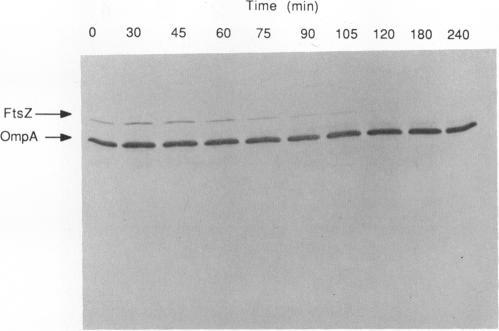
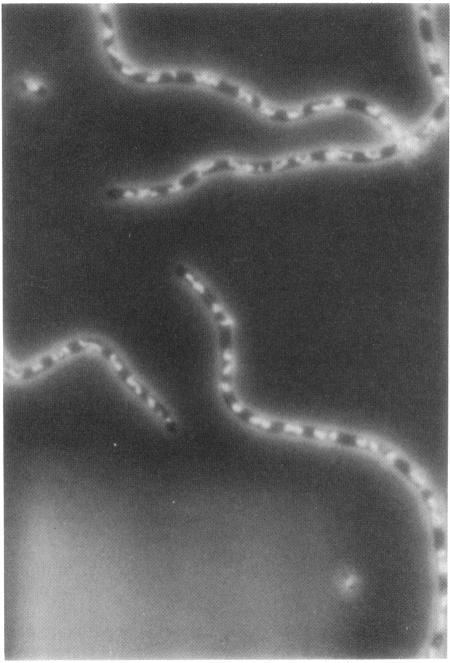
The ftsZ gene is thought to be an essential cell division gene in Escherichia coli. We constructed a null allele of ftsZ in a strain carrying additional copies of ftsZ on a plasmid with a temperature-sensitive replication defect. This strain was temperature sensitive for cell division and viability, confirming that ftsZ is an essential cell division gene. Further analysis revealed that after a shift to the nonpermissive temperature, cell division ceased when the level of FtsZ started to decrease, indicating that septation is very sensitive to the level of FtsZ. Subsequent studies showed that nucleoid segregation was normal while FtsZ was decreasing and that ftsZ expression was not autoregulated. The null allele could not be complemented by lambda 16-2, even though this bacteriophage can complement the thermosensitive ftsZ84 mutation and carries 6 kb of DNA upstream of the ftsZ gene.
ftsZ基因被认为是大肠杆菌中一个必不可少的细胞分裂基因。我们在一个携带温度敏感型复制缺陷质粒上ftsZ额外拷贝的菌株中构建了ftsZ的无效等位基因。该菌株在细胞分裂和活力方面对温度敏感,证实ftsZ是一个必不可少的细胞分裂基因。进一步分析表明,转移到非允许温度后,当FtsZ水平开始下降时细胞分裂停止,这表明隔膜形成对FtsZ水平非常敏感。随后的研究表明,在FtsZ下降时类核分离正常,并且ftsZ表达不受自动调节。即使这种噬菌体可以互补温度敏感型ftsZ84突变并携带ftsZ基因上游6 kb的DNA,但无效等位基因仍不能被λ16 - 2互补。

 Zotero 插件