Department of Chemistry, Brown University, Providence, RI 02912, USA.
Int J Nanomedicine. 2010 May 13;5:269-75.
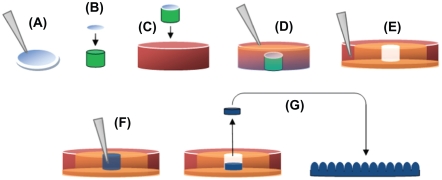
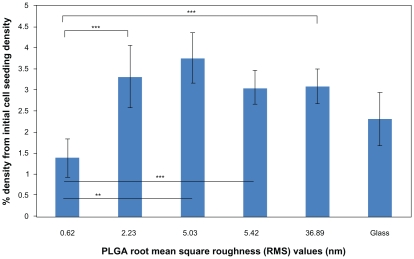
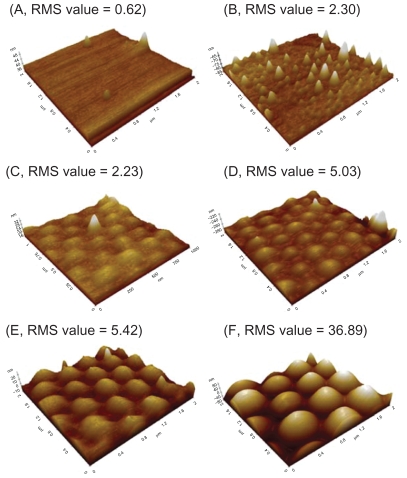
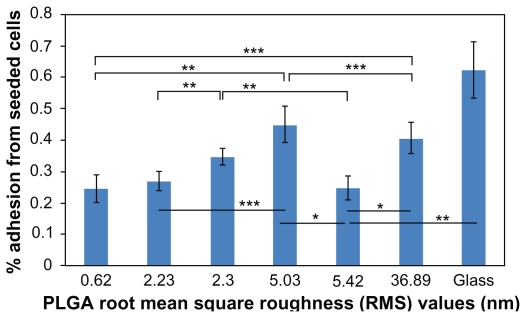
Poly(lactic-co-glycolic) acid (PLGA) has been widely used as a biomaterial in regenerative medicine because of its biocompatibility and biodegradability properties. Previous studies have shown that cells (such as bladder smooth muscle cells, chondrocytes, and osteoblasts) respond differently to nanostructured PLGA surfaces compared with nanosmooth surfaces. The purpose of the present in vitro research was to prepare PLGA films with various nanometer surface features and determine whether lung cancer epithelial cells respond differently to such topographies. To create nanosurface features on PLGA, different sized (190 nm, 300 nm, 400 nm, and 530 nm diameter) polystyrene beads were used to cast polydimethylsiloxane (PDMS) molds which were used as templates to create nanofeatured PLGA films. Atomic force microscopy (AFM) images and root mean square roughness (RMS) values indicated that the intended spherical surface nanotopographies on PLGA with RMS values of 2.23, 5.03, 5.42, and 36.90 nm were formed by employing 190, 300, 400, and 530 nm beads. A solution evaporation method was also utilized to modify PLGA surface features by using 8 wt% (to obtain an AFM RMS value of 0.62 nm) and 4 wt% (to obtain an AFM RMS value of 2.23 nm) PLGA in chloroform solutions. Most importantly, lung cancer epithelial cells adhered less on the PLGA surfaces with RMS values of 0.62, 2.23, and 5.42 nm after four hours of culture compared with any other PLGA surface created here. After three days, PLGA surfaces with an RMS value of 0.62 nm had much lower cell density than any other sample. In this manner, PLGA with specific nanometer surface features may inhibit lung cancer cell density which may provide an important biomaterial for the treatment of lung cancer (from drug delivery to regenerative medicine).
聚(乳酸-共-乙醇酸)(PLGA)因其生物相容性和可生物降解性而被广泛用作再生医学中的生物材料。先前的研究表明,与纳米光滑表面相比,细胞(如膀胱平滑肌细胞、软骨细胞和成骨细胞)对纳米结构的 PLGA 表面有不同的反应。本体外研究的目的是制备具有各种纳米表面特征的 PLGA 薄膜,并确定肺癌上皮细胞是否对这些形貌有不同的反应。为了在 PLGA 上形成纳米表面特征,使用不同尺寸(190nm、300nm、400nm 和 530nm 直径)的聚苯乙烯珠来浇铸聚二甲基硅氧烷(PDMS)模具,该模具用作模板来制造具有纳米特征的 PLGA 薄膜。原子力显微镜(AFM)图像和均方根粗糙度(RMS)值表明,通过使用 190nm、300nm、400nm 和 530nm 珠,在 RMS 值为 2.23nm、5.03nm、5.42nm 和 36.90nm 的 PLGA 上形成了预期的球形表面纳米形貌。还利用溶液蒸发法通过使用 8wt%(获得 AFM RMS 值为 0.62nm)和 4wt%(获得 AFM RMS 值为 2.23nm)的 PLGA 在氯仿溶液中修饰 PLGA 表面特征。最重要的是,与这里创建的任何其他 PLGA 表面相比,肺癌上皮细胞在培养四小时后在 RMS 值为 0.62nm、2.23nm 和 5.42nm 的 PLGA 表面上的黏附性更低。三天后,RMS 值为 0.62nm 的 PLGA 表面的细胞密度明显低于任何其他样品。通过这种方式,具有特定纳米表面特征的 PLGA 可能会抑制肺癌细胞密度,这可能为肺癌的治疗(从药物输送到再生医学)提供一种重要的生物材料。