Nonlinear Dynamics Group, Instituto Superior Técnico, Lisbon, Portugal.
PLoS One. 2010 May 27;5(5):e10743. doi: 10.1371/journal.pone.0010743.
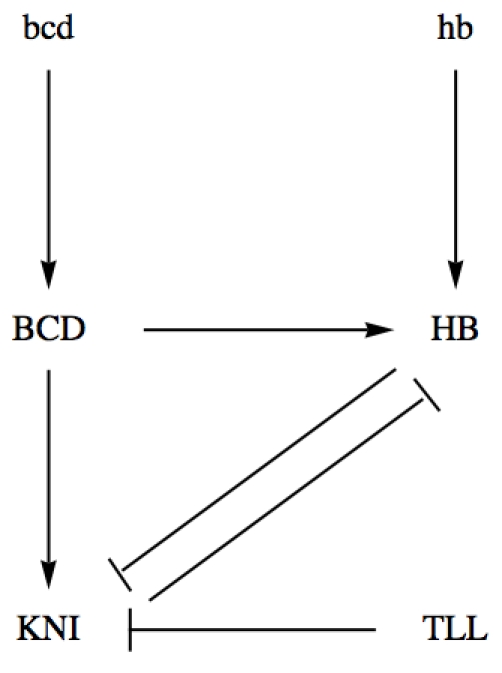
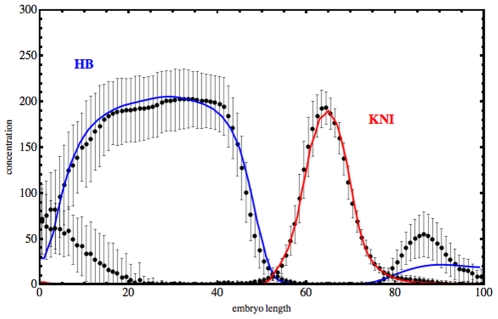
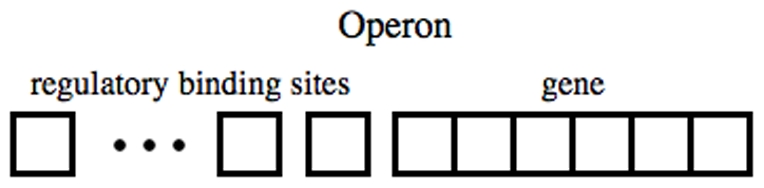
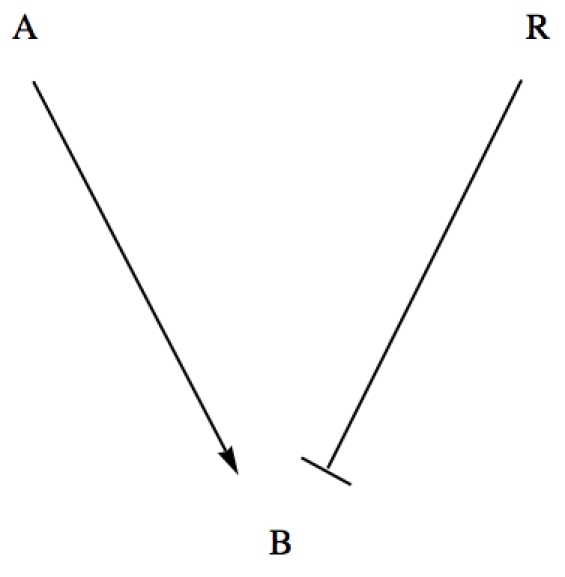
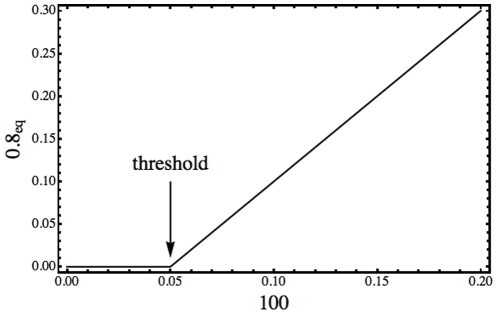
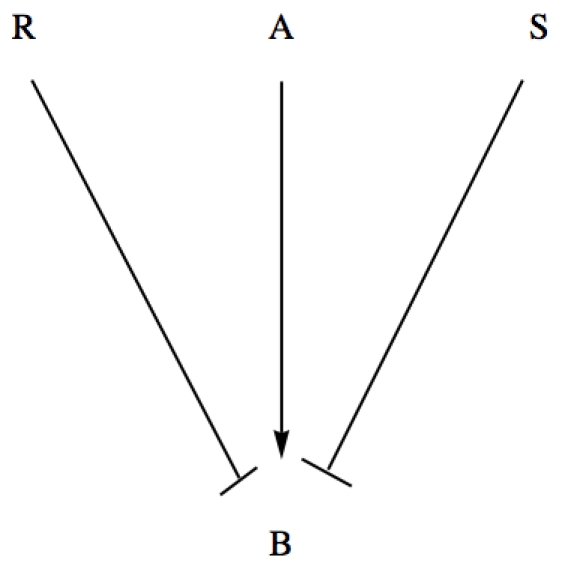
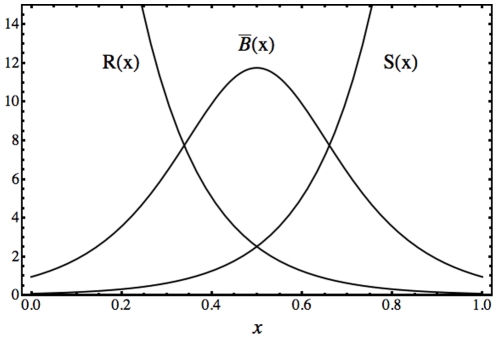
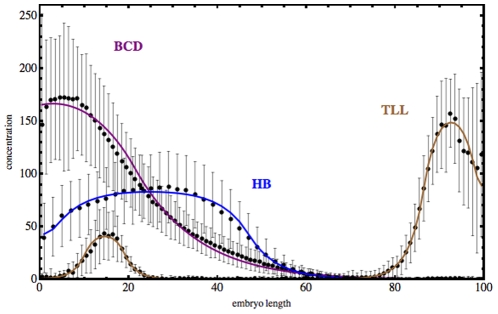
We present a general methodology in order to build mathematical models of genetic regulatory networks. This approach is based on the mass action law and on the Jacob and Monod operon model. The mathematical models are built symbolically by the Mathematica software package GeneticNetworks. This package accepts as input the interaction graphs of the transcriptional activators and repressors of a biological process and, as output, gives the mathematical model in the form of a system of ordinary differential equations. All the relevant biological parameters are chosen automatically by the software. Within this framework, we show that concentration dependent threshold effects in biology emerge from the catalytic properties of genes and its associated conservation laws. We apply this methodology to the segment patterning in Drosophila early development and we calibrate the genetic transcriptional network responsible for the patterning of the gap gene proteins Hunchback and Knirps, along the antero-posterior axis of the Drosophila embryo. In this approach, the zygotically produced proteins Hunchback and Knirps do not diffuse along the antero-posterior axis of the embryo of Drosophila, developing a spatial pattern due to concentration dependent thresholds. This shows that patterning at the gap genes stage can be explained by the concentration gradients along the embryo of the transcriptional regulators.
我们提出了一种构建遗传调控网络数学模型的通用方法。该方法基于质量作用定律和 Jacob 和 Monod 操纵子模型。数学模型通过 Mathematica 软件包 GeneticNetworks 进行符号构建。该软件包接受生物过程的转录激活剂和抑制剂的相互作用图作为输入,并以常微分方程组的形式给出数学模型。所有相关的生物学参数都由软件自动选择。在这个框架内,我们表明生物学中浓度依赖的阈值效应源自基因的催化特性及其相关的守恒定律。我们将这种方法应用于果蝇早期发育中的分段模式,并对负责沿果蝇胚胎前后轴的缺口基因蛋白 Hunchback 和 Knirps 进行图案形成的遗传转录网络进行了校准。在这种方法中,合子产生的蛋白质 Hunchback 和 Knirps 不会沿果蝇胚胎的前后轴扩散,而是由于浓度依赖的阈值而形成空间模式。这表明,在缺口基因阶段的模式形成可以通过转录调节因子沿胚胎的浓度梯度来解释。