Department of Mathematics, Pennsylvania State University, State College, Pennsylvania, United States of America.
PLoS Comput Biol. 2010 May 27;6(5):e1000793. doi: 10.1371/journal.pcbi.1000793.
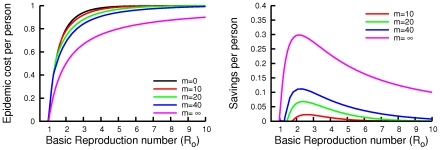
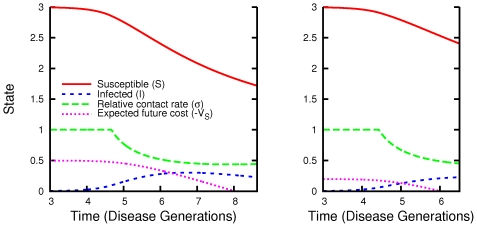
Social distancing practices are changes in behavior that prevent disease transmission by reducing contact rates between susceptible individuals and infected individuals who may transmit the disease. Social distancing practices can reduce the severity of an epidemic, but the benefits of social distancing depend on the extent to which it is used by individuals. Individuals are sometimes reluctant to pay the costs inherent in social distancing, and this can limit its effectiveness as a control measure. This paper formulates a differential-game to identify how individuals would best use social distancing and related self-protective behaviors during an epidemic. The epidemic is described by a simple, well-mixed ordinary differential equation model. We use the differential game to study potential value of social distancing as a mitigation measure by calculating the equilibrium behaviors under a variety of cost-functions. Numerical methods are used to calculate the total costs of an epidemic under equilibrium behaviors as a function of the time to mass vaccination, following epidemic identification. The key parameters in the analysis are the basic reproduction number and the baseline efficiency of social distancing. The results show that social distancing is most beneficial to individuals for basic reproduction numbers around 2. In the absence of vaccination or other intervention measures, optimal social distancing never recovers more than 30% of the cost of infection. We also show how the window of opportunity for vaccine development lengthens as the efficiency of social distancing and detection improve.
社交距离措施是通过降低易感染个体与可能传播疾病的感染者之间的接触率来预防疾病传播的行为改变。社交距离措施可以减轻疫情的严重程度,但社交距离的效果取决于个人的使用程度。个人有时不愿意承担社交距离所固有的成本,这可能会限制其作为控制措施的有效性。本文通过制定一个微分博弈来确定个人在疫情期间如何最好地使用社交距离和相关的自我保护行为。疫情由一个简单的、充分混合的常微分方程模型来描述。我们使用微分博弈来通过计算各种成本函数下的均衡行为来研究社交距离作为缓解措施的潜在价值。数值方法用于计算均衡行为下的疫情总成本,作为大规模接种后疫情识别的时间的函数。分析中的关键参数是基本繁殖数和社交距离的基线效率。结果表明,对于基本繁殖数约为 2 的个体,社交距离最有益。在没有疫苗接种或其他干预措施的情况下,最优社交距离从未恢复超过感染成本的 30%。我们还展示了随着社交距离和检测效率的提高,疫苗开发的机会窗口如何延长。