Clinical Research Unit for Anxiety and Depression, St Vincent's Hospital, Sydney, New South Wales, Australia.
PLoS One. 2010 Jun 3;5(6):e10942. doi: 10.1371/journal.pone.0010942.
Internet-based cognitive behavioural therapy (iCBT) for generalized anxiety disorder (GAD) has been shown to be effective when guided by a clinician. The present study sought to replicate this finding, and determine whether support from a technician is as effective as guidance from a clinician.
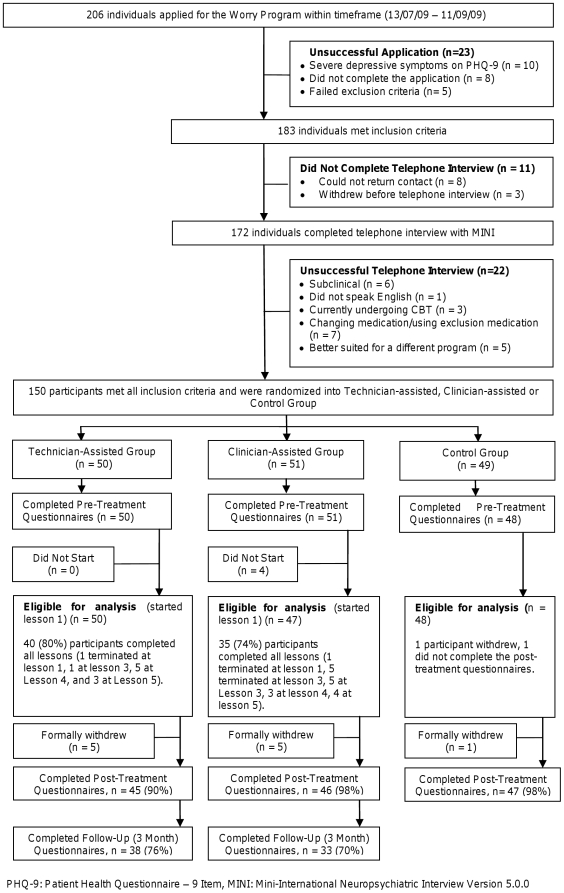
Randomized controlled non-inferiority trial comparing three groups: Clinician-assisted vs. technician-assisted vs. delayed treatment. Community-based volunteers applied to the VirtualClinic (www.virtualclinic.org.au) research program and 150 participants with GAD were randomized. Participants in the clinician- and technician-assisted groups received access to an iCBT program for GAD comprising six online lessons, weekly homework assignments, and weekly supportive contact over a treatment period of 10 weeks. Participants in the clinician-assisted group also received access to a moderated online discussion forum. The main outcome measures were the Penn State Worry Questionnaire (PSWQ) and the Generalized Anxiety Disorder-7 Item (GAD-7). Completion rates were high, and both treatment groups reduced scores on the PSWQ (p<0.001) and GAD-7 (p<0.001) compared to the delayed treatment group, but did not differ from each other. Within group effect sizes on the PSWQ were 1.16 and 1.07 for the clinician- and technician-assisted groups, respectively, and on the GAD-7 were 1.55 and 1.73, respectively. At 3 month follow-up participants in both treatment groups had sustained the gains made at post-treatment. Participants in the clinician-assisted group had made further gains on the PSWQ. Approximately 81 minutes of clinician time and 75 minutes of technician time were required per participant during the 10 week treatment program.
Both clinician- and technician-assisted treatment resulted in large effect sizes and clinically significant improvements comparable to those associated with face-to-face treatment, while a delayed treatment/control group did not improve. These results provide support for large scale trials to determine the clinical effectiveness and acceptability of technician-assisted iCBT programs for GAD. This form of treatment has potential to increase the capacity of existing mental health services.
Australian New Zealand Clinical Trials Registry ACTRN12609000563268.
基于互联网的认知行为疗法(iCBT)已被证明在有临床医生指导的情况下对广泛性焦虑症(GAD)有效。本研究旨在复制这一发现,并确定技术人员的支持是否与临床医生的指导同样有效。
这是一项比较三组的随机对照非劣效性试验:临床医生辅助组、技术人员辅助组和延迟治疗组。社区志愿者申请了 VirtualClinic(www.virtualclinic.org.au)研究计划,150 名 GAD 患者被随机分组。在临床医生和技术人员辅助组中,参与者可以使用包含六个在线课程、每周作业和每周支持的 iCBT 程序,治疗期为 10 周。临床医生辅助组的参与者还可以访问一个有 moderation 的在线讨论论坛。主要结局指标是宾夕法尼亚州立大学担忧问卷(PSWQ)和广泛性焦虑症 7 项(GAD-7)。完成率很高,与延迟治疗组相比,临床医生辅助组和技术人员辅助组的 PSWQ(p<0.001)和 GAD-7(p<0.001)评分均有所降低,但彼此之间没有差异。在 PSWQ 上,临床医生辅助组和技术人员辅助组的个体内效应大小分别为 1.16 和 1.07,在 GAD-7 上,个体内效应大小分别为 1.55 和 1.73。在 3 个月随访时,治疗组的参与者都维持了治疗后的改善。临床医生辅助组的参与者在 PSWQ 上取得了进一步的改善。在 10 周的治疗过程中,每位参与者需要大约 81 分钟的临床医生时间和 75 分钟的技术人员时间。
临床医生辅助和技术人员辅助治疗都导致了较大的效果量和临床显著的改善,与面对面治疗相关的改善相当,而延迟治疗/对照组没有改善。这些结果为大规模试验提供了支持,以确定技术人员辅助 iCBT 方案对 GAD 的临床有效性和可接受性。这种治疗形式有可能增加现有的心理健康服务能力。
澳大利亚新西兰临床试验注册 ACTRN12609000563268。