Provincial Health Department, Ministry of Health, Siem Reap, Cambodia.
PLoS One. 2010 Jun 3;5(6):e10930. doi: 10.1371/journal.pone.0010930.
There is substantial evidence that ill-health is a major cause of impoverishment in developing countries. Major illnesses can have a serious economic impact on poor households through treatment costs and income loss. However, available methods for measuring the impact of ill-health on household welfare display several shortcomings and new methods are thus needed. To understand the potential complex impact of major illnesses on household livelihoods, a study on poverty and illness was conducted in rural Cambodia, as part of an international comparative research project. A cross-sectional survey was performed to identify households affected by major illness for further in-depth interviews.
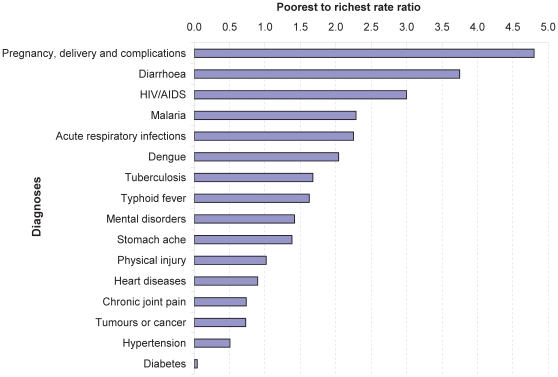
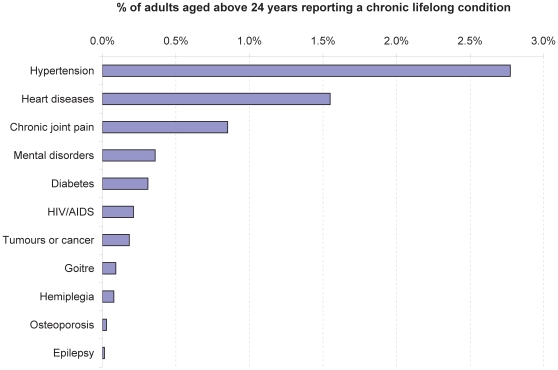
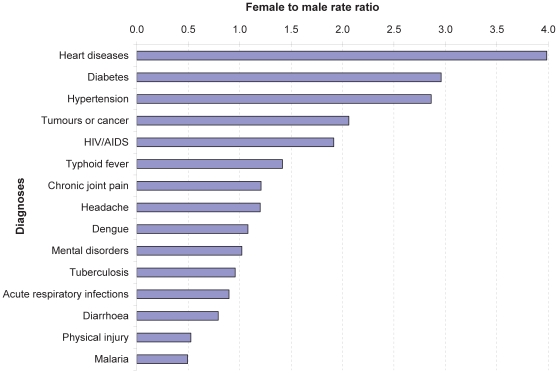
5,975 households in three rural health districts were randomly selected through a two-stage cluster sampling and interviewed. 27% of the households reported at least one member with a serious illness in the year preceding the survey and 15% of the household members reported suffering from at least one serious illness. The most reported conditions include common tropical infectious diseases, chronic diseases (notably hypertension and heart diseases) and road traffic accidents. Such conditions were particularly concentrated among the poor, children under five, women, and the elderly. Poor women often reported complications related to pregnancy and delivery as serious illnesses.
Despite some methodological limitations, this study provides new information on the frequency of self-reported serious illnesses among the rural Cambodia's population, which serves as a basis for further in-depth investigation on 'major illnesses' and their economic consequences on poor households. This can in turn help policy makers to formulate appropriate interventions to protect the poor from the financial burden associated with ill-health. Our findings suggest that every year a considerable proportion of rural population in Cambodia, especially the poor and vulnerable, are affected by serious illnesses, both communicable and non-communicable diseases.
大量证据表明,在发展中国家,健康状况不佳是贫困的主要原因。重病会给贫困家庭带来严重的经济影响,包括治疗费用和收入损失。然而,现有的衡量健康状况对家庭福利影响的方法存在一些缺陷,因此需要新的方法。为了了解重大疾病对家庭生计的潜在复杂影响,柬埔寨农村地区进行了一项关于贫困和疾病的研究,作为国际比较研究项目的一部分。进行了一项横断面调查,以确定受重大疾病影响的家庭,以便进行进一步的深入访谈。
通过两阶段聚类抽样随机选择了三个农村卫生区的 5975 户家庭进行访谈。27%的家庭报告在前一年有至少一名成员患有严重疾病,15%的家庭成员报告患有至少一种严重疾病。报告最多的疾病包括常见的热带传染病、慢性病(特别是高血压和心脏病)和道路交通伤害。这些疾病特别集中在穷人、五岁以下儿童、妇女和老年人中。贫困妇女经常报告与妊娠和分娩相关的并发症为严重疾病。
尽管存在一些方法上的限制,但这项研究提供了柬埔寨农村人口中自我报告的严重疾病频率的新信息,这为进一步深入调查“重大疾病”及其对贫困家庭的经济后果提供了基础。这反过来又有助于政策制定者制定适当的干预措施,保护贫困人口免受与健康不佳相关的经济负担。我们的研究结果表明,每年都有相当一部分柬埔寨农村人口,特别是穷人,受到传染性和非传染性疾病等严重疾病的影响。