Lymphatic Filariasis Support Center, The Task Force for Global Health, Decatur, Georgia, USA.
PLoS Negl Trop Dis. 2010 Jun 1;4(6):e708. doi: 10.1371/journal.pntd.0000708.
Between 2000-2007, the Global Programme to Eliminate Lymphatic Filariasis (GPELF) delivered more than 1.9 billion treatments to nearly 600 million individuals via annual mass drug administration (MDA) of anti-filarial drugs (albendazole, ivermectin, diethylcarbamazine) to all at-risk for 4-6 years. Quantifying the resulting economic benefits of this significant achievement is important not only to justify the resources invested in the GPELF but also to more fully understand the Programme's overall impact on some of the poorest endemic populations.
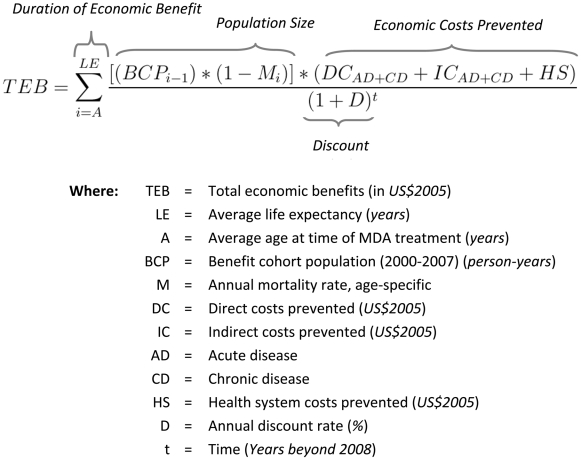
To calculate the economic benefits, the number of clinical manifestations averted was first quantified and the savings associated with this disease prevention then analyzed in the context of direct treatment costs, indirect costs of lost-labor, and costs to the health system to care for affected individuals. Multiple data sources were reviewed, including published literature and databases from the World Health Organization, International Monetary Fund, and International Labour Organization
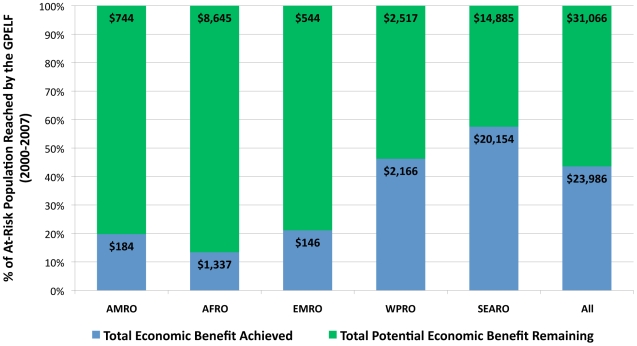
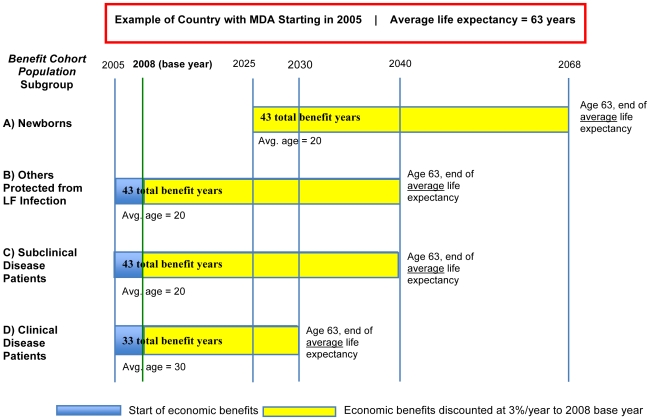
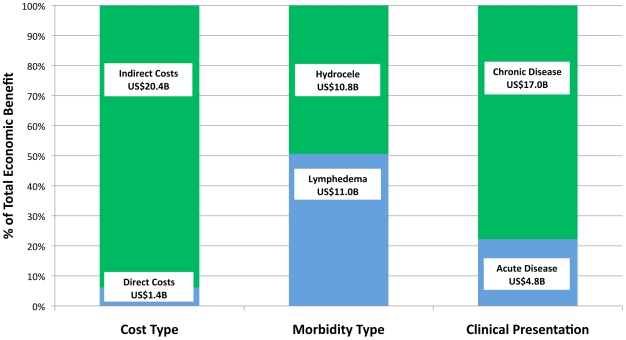
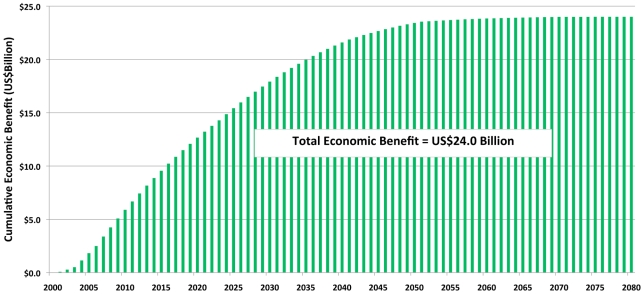
An estimated US$21.8 billion of direct economic benefits will be gained over the lifetime of 31.4 million individuals treated during the first 8 years of the GPELF. Of this total, over US$2.3 billion is realized by the protection of nearly 3 million newborns and other individuals from acquiring lymphatic filariasis as a result of their being born into areas freed of LF transmission. Similarly, more than 28 million individuals already infected with LF benefit from GPELF's halting the progression of their disease, which results in an associated lifetime economic benefit of approximately US$19.5 billion. In addition to these economic benefits to at-risk individuals, decreased patient services associated with reduced LF morbidity saves the health systems of endemic countries approximately US$2.2 billion.
CONCLUSIONS/SIGNIFICANCE: MDA for LF offers significant economic benefits. Moreover, with favorable program implementation costs (largely a result of the sustained commitments of donated drugs from the pharmaceutical industry) it is clear that the economic rate of return of the GPELF is extremely high and that this Programme continues to prove itself an excellent investment in global health.
在 2000 年至 2007 年期间,全球消灭淋巴丝虫病规划(GPELF)通过每年对所有高危人群进行为期 4-6 年的抗丝虫药物(阿苯达唑、伊维菌素、乙胺嗪)集体药物治疗,向近 6 亿人提供了超过 19 亿次治疗。量化这一重大成就所带来的经济效益不仅对证明投入全球消灭淋巴丝虫病规划的资源是合理的很重要,而且对于更全面地了解该规划对一些最贫困流行地区人口的总体影响也很重要。
为了计算经济效益,首先量化了避免的临床表现数量,然后在直接治疗成本、失去劳动的间接成本以及卫生系统为照顾受影响者而付出的成本的背景下,分析了这一疾病预防措施带来的节省。审查了多个数据源,包括出版物和世界卫生组织、国际货币基金组织和国际劳工组织的数据库。
在全球消灭淋巴丝虫病规划的头 8 年中,对 3140 万人进行治疗,预计将在其一生中获得 218 亿美元的直接经济效益。在这一总额中,由于保护了近 300 万新生儿和其他在无淋巴丝虫病传播地区出生的人免受感染,实现了 23 亿美元以上的保护效益。同样,由于全球消灭淋巴丝虫病规划阻止了 2800 多万已经感染淋巴丝虫病的人病情的发展,也带来了大约 195 亿美元的相关终生经济效益。除了这些对高危人群的经济效益外,减少淋巴丝虫病发病率相关的患者服务也使流行国家的卫生系统节省了约 22 亿美元。
结论/意义:淋巴丝虫病大规模药物治疗带来了显著的经济效益。此外,由于制药行业持续承诺提供捐赠药物,使得方案实施成本有利(这主要是由于制药行业持续承诺提供捐赠药物),很明显,全球消灭淋巴丝虫病规划的经济回报率极高,而且该规划继续证明是全球卫生的一项极好投资。