McGovern Institute for Brain Research, Massachusetts Institute of Technology, Cambridge, MA 02139, USA.
Neuron. 2010 Jun 10;66(5):781-95. doi: 10.1016/j.neuron.2010.04.036.
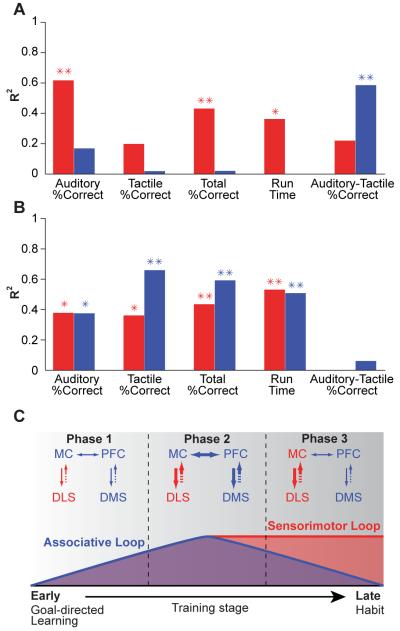
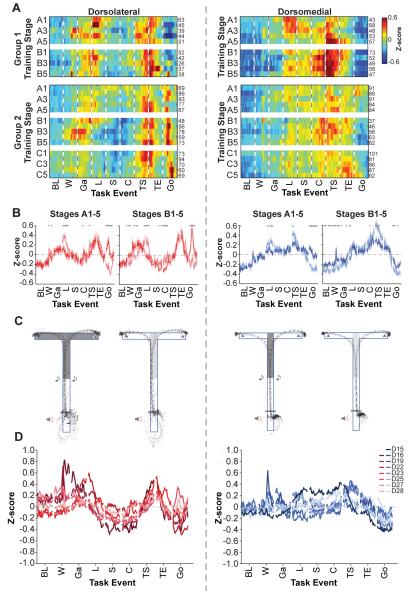
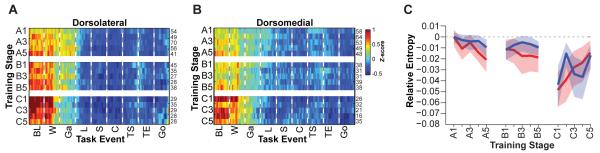
The basal ganglia are implicated in a remarkable range of functions influencing emotion and cognition as well as motor behavior. Current models of basal ganglia function hypothesize that parallel limbic, associative, and motor cortico-basal ganglia loops contribute to this diverse set of functions, but little is yet known about how these loops operate and how their activities evolve during learning. To address these issues, we recorded simultaneously in sensorimotor and associative regions of the striatum as rats learned different versions of a conditional T-maze task. We found highly contrasting patterns of activity in these regions during task performance and found that these different patterns of structured activity developed concurrently, but with sharply different dynamics. Based on the region-specific dynamics of these patterns across learning, we suggest a working model whereby dorsomedial associative loops can modulate the access of dorsolateral sensorimotor loops to the control of action.
基底神经节参与了一系列显著的功能,这些功能影响着情绪和认知以及运动行为。目前的基底神经节功能模型假设,平行的边缘、联想和运动皮质基底神经节回路有助于实现这一组多样化的功能,但对于这些回路如何运作以及它们的活动如何在学习过程中演变,我们知之甚少。为了解决这些问题,我们在大鼠学习不同版本的条件 T 迷宫任务时,同时记录了纹状体的感觉运动和联想区域的活动。我们发现,在任务执行过程中,这些区域的活动呈现出高度对比的模式,并且发现这些不同模式的结构化活动是同时发展的,但具有明显不同的动态。基于这些模式在学习过程中的区域特异性动态,我们提出了一个工作模型,即背内侧联想回路可以调节背外侧感觉运动回路对动作控制的访问。