Centro Nacional de Epidemiología, Instituto de Salud Carlos III, Calle Monforte de Lemos 5, Madrid, Spain.
J Neurol Neurosurg Psychiatry. 2011 Feb;82(2):204-12. doi: 10.1136/jnnp.2009.188425. Epub 2010 Jun 14.
Evidence of surgical transmission of sporadic Creutzfeldt-Jakob disease (sCJD) remains debatable in part due to misclassification of exposure levels. In a registry-based case-control study, the authors applied a risk-based classification of surgical interventions to determine the association between a history of surgery and sCJD.
Case-control study, allowing for detailed analysis according to time since exposure.
National populations of Denmark and Sweden.
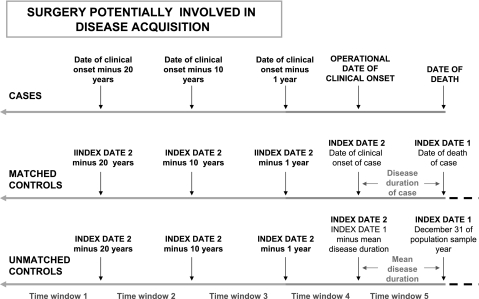
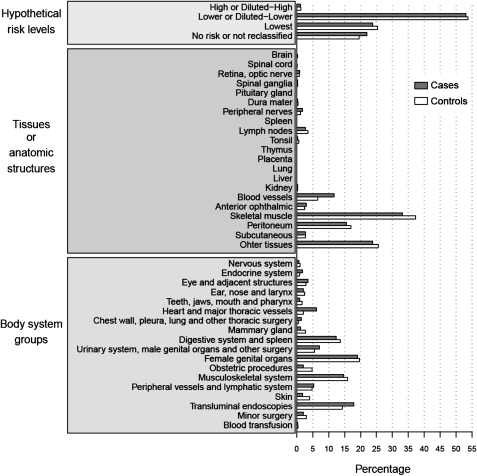
From national registries of Denmark and Sweden, the authors included 167 definite and probable sCJD cases with onset during the period 1987-2003, 835 age-, sex- and residence-matched controls and 2224 unmatched. Surgical procedures were categorised by anatomical structure and presumed risk of transmission level. The authors used logistic regression to determine the odds ratio (OR) for sCJD by surgical interventions in specified time-windows before disease-onset.
From comparisons with matched controls, procedures involving retina and optic nerve were associated with an increased risk at a latency of ≥1 year OR (95% CI) 5.53 (1.08 to 28.0). At latencies of 10 to 19 years, interventions on peripheral nerves 4.41 (1.17 to 16.6) and skeletal muscle 1.58 (1.01 to 2.48) were directly associated. Interventions on blood vessels 4.54 (1.01 to 20.0), peritoneum 2.38 (1.14 to 4.96) and skeletal muscle 2.04 (1.06 to 3.92), interventions conducted by vaginal approach 2.26 (1.14 to 4.47) and a pooled category of lower-risk procedures 2.81 (1.62 to 4.88) had an increased risk after ≥20 years. Similar results were found when comparing with unmatched controls.
This observation is in concordance with animal models of prion neuroinvasion and is likely to represent a causal relation of surgery with a non-negligible proportion of sCJD cases.
由于暴露水平的分类错误,手术传播散发性克雅氏病(sCJD)的证据仍存在争议。在一项基于登记的病例对照研究中,作者应用了一种基于风险的手术干预分类方法来确定手术史与 sCJD 之间的关联。
病例对照研究,允许根据暴露时间进行详细分析。
丹麦和瑞典的全国人群。
作者从丹麦和瑞典的全国登记处纳入了 1987 年至 2003 年间发病的 167 例明确和可能的 sCJD 病例、835 例年龄、性别和居住地匹配的对照以及 2224 例不匹配对照。手术程序按解剖结构和假定的传播水平风险进行分类。作者使用逻辑回归来确定疾病发病前特定时间窗内手术干预与 sCJD 的比值比(OR)。
与匹配对照相比,视网膜和视神经手术在潜伏期≥1 年时,OR(95%CI)为 5.53(1.08 至 28.0),风险增加。在潜伏期为 10 至 19 年时,外周神经手术(OR 4.41,1.17 至 16.6)和骨骼肌手术(OR 1.58,1.01 至 2.48)直接相关。血管手术(OR 4.54,1.01 至 20.0)、腹膜手术(OR 2.38,1.14 至 4.96)和骨骼肌手术(OR 2.04,1.06 至 3.92)、阴道入路手术(OR 2.26,1.14 至 4.47)和低风险手术的综合类别(OR 2.81,1.62 至 4.88)的风险增加发生在≥20 年之后。与不匹配对照相比,也得到了类似的结果。
这一观察结果与朊病毒神经入侵的动物模型一致,很可能代表了手术与相当一部分 sCJD 病例之间存在因果关系。