Department of Cardiovascular Magnetic Resonance, Royal Brompton and Harefield NHS Foundation Trust, London, UK.
J Cardiovasc Magn Reson. 2010 Jul 2;12(1):38. doi: 10.1186/1532-429X-12-38.
The aetiology and clinical significance of troponin release following endurance exercise is unclear but may be due to transient myocardial inflammation. Cardiovascular magnetic resonance (CMR) affords us the opportunity to evaluate the presence of myocardial inflammation and focal fibrosis and is the ideal imaging modality to study this hypothesis. We sought to correlate the relationship between acute bouts of ultra endurance exercise leading to cardiac biomarkers elevation and the presence of myocardial inflammation and fibrosis using CMR.
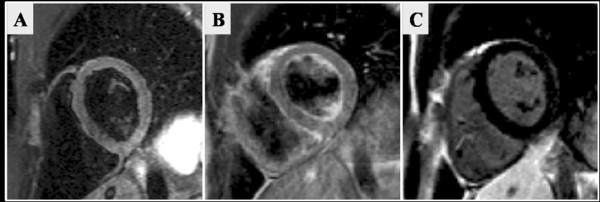
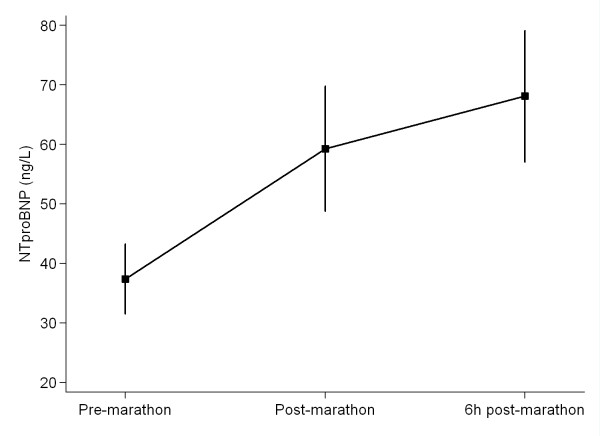
17 recreation athletes (33.5 +/- 6.5 years) were studied before and after a marathon run with troponin, NTproBNP, and CMR. Specific imaging parameters to look for inflammation included T2 weighted images, and T1 weighted spin-echo images before and after an intravenous gadolinium-DTPA to detect myocardial hyperemia secondary to inflammation. Late gadolinium imaging was performed (LGE) to detect any focal regions of replacement fibrosis.
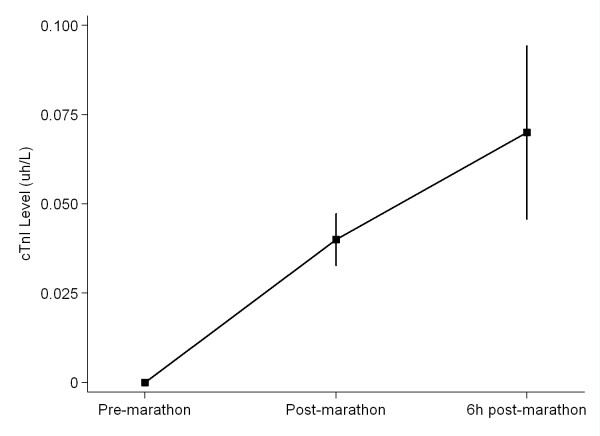
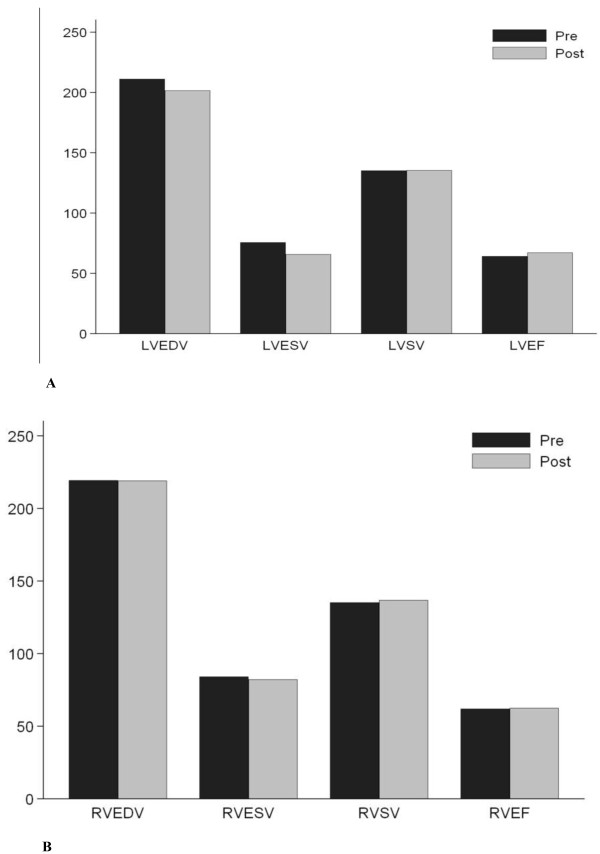
Eleven of the 17 participant had elevations of TnI above levels of cut off for myocardial infarction 6 hrs after the marathon (0.075 +/- 0.02, p = 0.007). Left ventricular volumes were reduced post marathon and a small increase in ejection fraction was noted (64+/- 1% pre, 67+/- 1.2% post, P = 0.014). Right ventricular volumes, stroke volume, and ejection fraction were unchanged post marathon. No athlete fulfilled criteria for myocardial inflammation based on current criteria. No regions of focal fibrosis were seen in any of the participants.
Exercise induced cardiac biomarker release is not associated with any functional changes by CMR or any detectable myocardial inflammation or fibrosis.
运动后肌钙蛋白释放的病因和临床意义尚不清楚,但可能是由于短暂的心肌炎症。心血管磁共振(CMR)使我们有机会评估心肌炎症和局灶性纤维化的存在,是研究这一假说的理想成像方式。我们试图通过 CMR 来研究导致心脏生物标志物升高的急性超耐力运动与心肌炎症和纤维化之间的关系。
17 名业余运动员(33.5 +/- 6.5 岁)在马拉松比赛前后进行了肌钙蛋白、NTproBNP 和 CMR 检查。用于寻找炎症的特定成像参数包括 T2 加权图像和 T1 加权自旋回波图像,以及静脉内钆-DTPA 后检测炎症引起的心肌充血的 T1 加权图像。进行延迟钆增强成像(LGE)以检测任何局灶性替代纤维化区域。
17 名参与者中有 11 名在马拉松后 6 小时 TnI 升高超过心肌梗死的截断值(0.075 +/- 0.02,p = 0.007)。马拉松后左心室容积减少,射血分数略有增加(64 +/- 1%,67 +/- 1.2%,p = 0.014)。马拉松后右心室容积、每搏量和射血分数不变。根据目前的标准,没有运动员符合心肌炎症的标准。没有发现任何参与者有局灶性纤维化。
运动引起的心脏生物标志物释放与 CMR 检测到的任何功能变化或任何可检测到的心肌炎症或纤维化无关。