Faculty of Medicine and Life Sciences/LCRC (-MHU), Hasselt University, Agoralaan, 3590, Diepenbeek, Belgium.
Department of Radiology and Department of Jessa & Science, Jessa Hospital, Stadsomvaart 11, 3500, Hasselt, Belgium.
Eur J Appl Physiol. 2023 Oct;123(10):2107-2117. doi: 10.1007/s00421-023-05259-4. Epub 2023 Jul 22.
Although cardiac troponin I (cTnI) increase following strenuous exercise has been observed, the development of exercise-induced myocardial edema remains unclear. Cardiac magnetic resonance (CMR) native T1/T2 mapping is sensitive to the pathological increase of myocardial water content. Therefore, we evaluated exercise-induced acute myocardial changes in recreational cyclists by incorporating biomarkers, echocardiography and CMR.
Nineteen male recreational participants (age: 48 ± 5 years) cycled the 'L'étape du tour de France" (EDT) 2021' (175 km, 3600 altimeters). One week before the race, a maximal graded cycling test was conducted to determine individual heart rate (HR) training zones. One day before and 3-6 h post-exercise 3 T CMR and echocardiography were performed to assess myocardial native T1/T2 relaxation times and cardiac function, and blood samples were collected. All participants were asked to cycle 2 h around their anaerobic gas exchange threshold (HR zone 4).
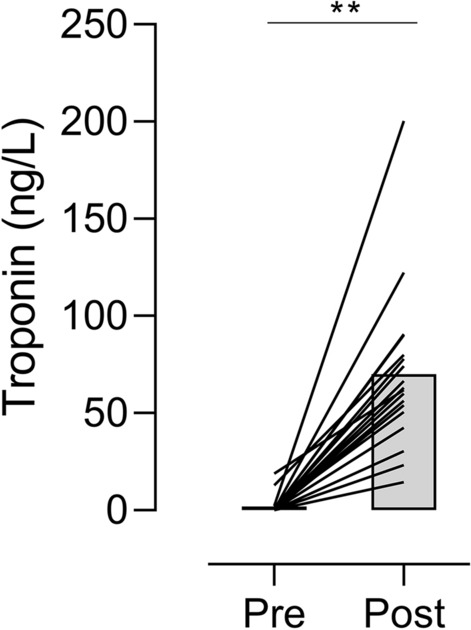
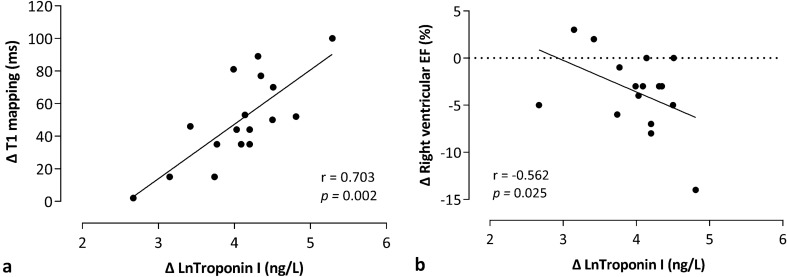
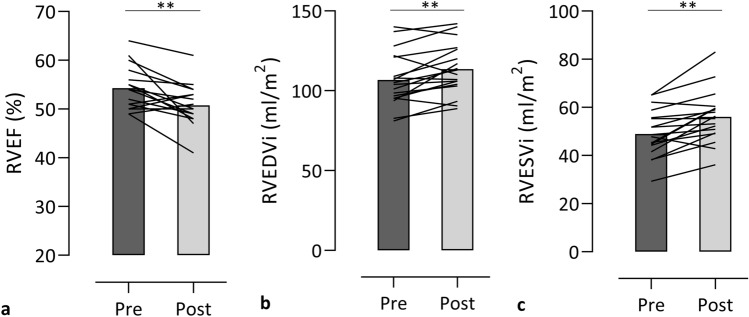
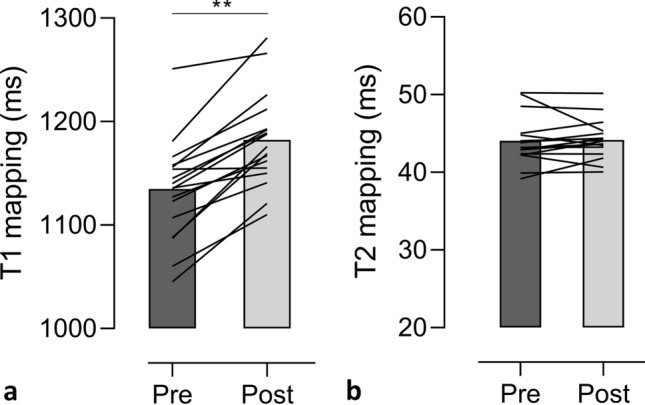
Eighteen participants completed the EDT stage in 537 ± 58 min, including 154 ± 61 min of cycling time in HR zone 4. Post-race right ventricular (RV) dysfunction with reduced strain and increased volumes (p < 0.05) and borderline significant left ventricular global longitudinal strain reduction (p = 0.05) were observed. Post-exercise cTnI (0.75 ± 5.1 ng/l to 69.9 ± 41.6 ng/l; p < 0.001) and T1 relaxation times (1133 ± 48 ms to 1182 ± 46 ms, p < 0.001) increased significantly with no significant change in T2 (p = 0.474). cTnI release correlated with increase in T1 relaxation time (p = 0.002; r = 0.703), post-race RV dysfunction (p < 0.05; r = 0.562) and longer cycling in HR zone 4 (p < 0.05; r = 0.607).
Strenuous exercise causes early post-race cTnI increase, increased T1 relaxation time and RV dysfunction in recreational cyclists, which showed interdependent correlation. The long-term clinical significance of these changes needs further investigation.
NCT04940650 06/18/2021. NCT05138003 06/18/2021.
虽然已经观察到剧烈运动后心肌肌钙蛋白 I (cTnI) 增加,但运动引起的心肌水肿的发展仍不清楚。心脏磁共振 (CMR) 原生 T1/T2 映射对心肌含水量的病理性增加敏感。因此,我们通过结合生物标志物、超声心动图和 CMR 评估了休闲自行车运动员运动引起的急性心肌变化。
19 名男性休闲参与者(年龄:48±5 岁)参加了 2021 年“环法自行车赛的一个赛段”(EDT)(175 公里,3600 个海拔高度)。在比赛前一周进行了最大递增式自行车测试,以确定个体的心率 (HR) 训练区。在比赛前一天和运动后 3-6 小时进行 3T CMR 和超声心动图检查,以评估心肌原生 T1/T2 弛豫时间和心脏功能,并采集血样。所有参与者均被要求以他们的无氧气体交换阈值周围的 2 小时(HR 区 4)进行骑行。
18 名参与者在 537±58 分钟内完成了 EDT 阶段,包括在 HR 区 4 中骑行 154±61 分钟。运动后出现右心室 (RV) 功能障碍,应变减少,容积增加(p<0.05),左心室整体纵向应变减少有边界显著(p=0.05)。运动后 cTnI(0.75±5.1ng/l 至 69.9±41.6ng/l;p<0.001)和 T1 弛豫时间(1133±48ms 至 1182±46ms,p<0.001)显著增加,T2 无明显变化(p=0.474)。cTnI 释放与 T1 弛豫时间的增加相关(p=0.002;r=0.703),运动后 RV 功能障碍(p<0.05;r=0.562)和 HR 区 4 中更长时间的骑行(p<0.05;r=0.607)。
剧烈运动导致休闲自行车运动员赛后早期 cTnI 增加、T1 弛豫时间增加和 RV 功能障碍,这些变化相互关联。这些变化的长期临床意义需要进一步研究。
NCT04940650 06/18/2021;NCT05138003 06/18/2021。