Liu Liang, Mondal Mohammed Mh, Idris Mohamed A, Lokman Hakim S, Rajapakse Prv Jayanthe, Satrija Fadjar, Diaz Jose L, Upatham E Suchart, Attwood Stephen W
State Key Laboratory of Biotherapy, West China Hospital, West China Medical School, Sichuan University, Chengdu 610041, China.
Parasit Vectors. 2010 Jul 5;3:57. doi: 10.1186/1756-3305-3-57.
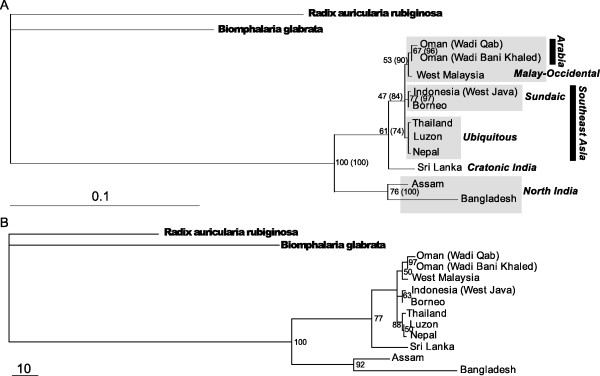
The freshwater snail Indoplanorbis exustus is found across India, Southeast Asia, central Asia (Afghanistan), Arabia and Africa. Indoplanorbis is of economic importance in that it is responsible for the transmission of several species of the genus Schistosoma which infect cattle and cause reduced livestock productivity. The snail is also of medical importance as a source of cercarial dermatitis among rural workers, particularly in India. In spite of its long history and wide geographical range, it is thought that Indoplanorbis includes only a single species. The aims of the present study were to date the radiation of Indoplanorbis across Asia so that the factors involved in its dispersal in the region could be tested, to reveal potential historical biogeographical events shaping the phylogeny of the snail, and to look for signs that I. exustus might be polyphyletic.
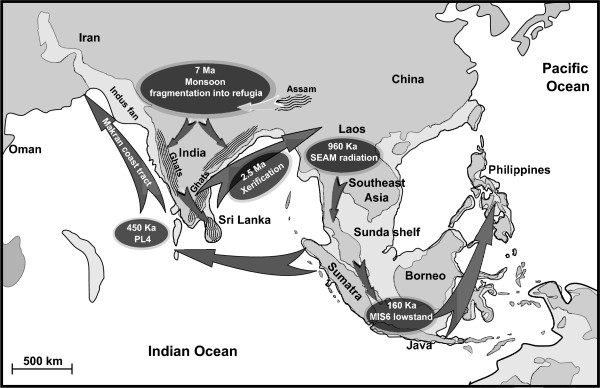
The results indicated a radiation beginning in the late Miocene with a divergence of an ancestral bulinine lineage into Assam and peninsular India clades. A Southeast Asian clade diverged from the peninsular India clade late-Pliocene; this clade then radiated at a much more rapid pace to colonize all of the sampled range of Indoplanorbis in the mid-Pleistocene.
The phylogenetic depth of divergences between the Indian clades and Southeast Asian clades, together with habitat and parasitological differences suggest that I. exustus may comprise more than one species. The timescale estimated for the radiation suggests that the dispersal to Arabia and to Southeast Asia was facilitated by palaeogeographical events and climate change, and did not require human involvement. Further samples from Afghanistan, Africa and western India are required to refine the phylogeographical hypothesis and to include the African Recent dispersal.
淡水螺类印度扁卷螺分布于印度、东南亚、中亚(阿富汗)、阿拉伯半岛和非洲。印度扁卷螺具有经济重要性,因为它是几种血吸虫属物种的传播媒介,这些血吸虫会感染牛并导致牲畜生产力下降。这种螺在医学上也很重要,是农村工人,尤其是印度农村工人患尾蚴性皮炎的一个来源。尽管其历史悠久且地理分布广泛,但人们认为印度扁卷螺仅包含单一物种。本研究的目的是确定印度扁卷螺在亚洲辐射分化的时间,以便检验其在该地区扩散所涉及的因素,揭示塑造该螺系统发育的潜在历史生物地理事件,并寻找印度扁卷螺可能是多系起源的迹象。
结果表明,辐射分化始于中新世晚期,一个祖先环口螺谱系分化为阿萨姆邦和印度半岛分支。东南亚分支在晚上新世从印度半岛分支分化出来;然后这个分支在更新世中期以更快的速度辐射扩散,占据了印度扁卷螺所有采样分布范围。
印度分支和东南亚分支之间分化的系统发育深度,以及栖息地和寄生虫学差异表明,印度扁卷螺可能包含不止一个物种。辐射分化估计的时间尺度表明,向阿拉伯半岛和东南亚的扩散是由古地理事件和气候变化促成的,并不需要人类参与。需要从阿富汗、非洲和印度西部获取更多样本,以完善系统发育地理学假设,并纳入非洲近期的扩散情况。