Department of Anesthesiology, Children's Hospital Boston, 300 Longwood Ave, Boston, Mass 02115, USA.
Circulation. 2010 Jul 20;122(3):245-54. doi: 10.1161/CIRCULATIONAHA.109.902338. Epub 2010 Jul 6.
Near-infrared spectroscopy monitoring of cerebral oxygen saturation (rSo(2)) has become routine in many centers, but no studies have reported the relationship of intraoperative near-infrared spectroscopy to long-term neurodevelopmental outcomes after cardiac surgery.
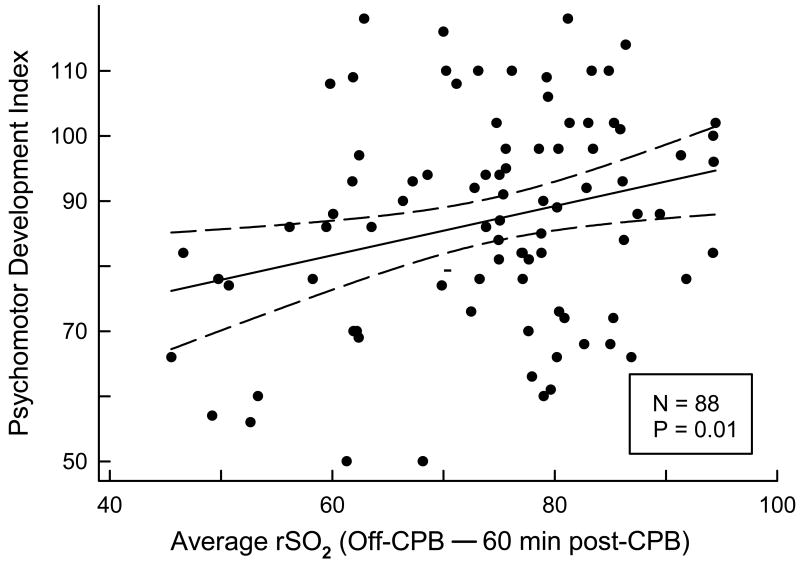
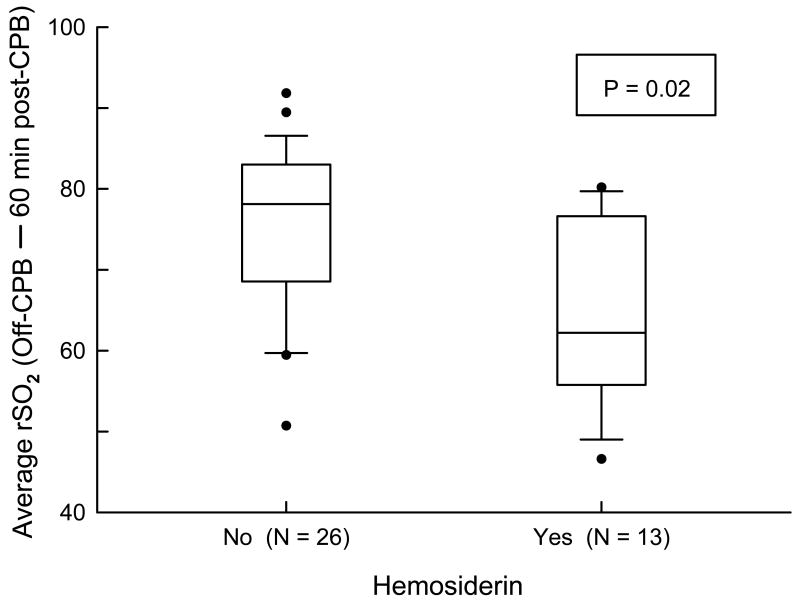
Of 104 infants undergoing biventricular repair without aortic arch reconstruction, 89 (86%) returned for neurodevelopmental testing at 1 year of age. The primary near-infrared spectroscopy variable was the integrated rSo(2) (area under the curve) for rSo(2) <or=45%; secondary variables were the average and minimum rSo(2) by perfusion phase and at specific time points. Psychomotor and mental development indexes of the Bayley scales, head circumference, neurological examination, and abnormalities on brain magnetic resonance imaging did not differ between subjects according to a threshold level for rSo(2) of 45%. Lower Psychomotor Development Index scores were modestly associated with lower average (r=0.23, P=0.03) and minimum (r=0.22, P=0.04) rSo(2) during the 60-minute period after cardiopulmonary bypass but not with other perfusion phases. Hemosiderin foci on brain magnetic resonance imaging were associated with lower average rSo(2) from postinduction to 60 minutes post cardiopulmonary bypass (71+/-10% versus 78+/-6%, P=0.01) and with lower average rSO(2) during the rewarming phase (72+/-12% versus 83+/-9%, P=.003) and during the 60-minute period following cardiopulmonary bypass (65+/-11% versus 75+/-10%, P=0.009). In regression analyses that adjusted for age <or=30 days, Psychomotor Development Index score (P=0.02) and brain hemosiderin (P=0.04) remained significantly associated with rSo(2) during the 60-minute period following cardiopulmonary bypass.
Perioperative periods of diminished cerebral oxygen delivery, as indicated by rSo(2), are associated with 1-year Psychomotor Development Index and brain magnetic resonance imaging abnormalities among infants undergoing reparative heart surgery. Clinical Trial Registration- URL: http://clinicaltrials.gov. Unique identifier: NCT00006183.
近红外光谱脑氧饱和度监测(rSo(2))在许多中心已成为常规监测手段,但尚无研究报告术中近红外光谱与心脏手术后长期神经发育结局之间的关系。
在 104 例接受双心室修复而未行主动脉弓重建的婴儿中,89 例(86%)在 1 岁时接受神经发育测试。主要的近红外光谱变量是 rSo(2)<或=45%时的整合 rSo(2)(曲线下面积);次要变量是灌注期和特定时间点的平均 rSo(2)和最小 rSo(2)。根据 rSo(2)的 45%阈值水平,根据 rSo(2)的 45%阈值水平,Bayley 量表的精神运动和智力发育指数、头围、神经检查和脑磁共振成像异常在受试者之间无差异。心肺转流术后 60 分钟内,较低的精神运动发育指数评分与较低的平均 rSo(2)(r=0.23,P=0.03)和最小 rSo(2)(r=0.22,P=0.04)呈中度相关,但与其他灌注期无关。脑磁共振成像上的含铁血黄素灶与心肺转流后诱导至 60 分钟之间的平均 rSo(2)降低(71+/-10%比 78+/-6%,P=0.01)和复温期(72+/-12%比 83+/-9%,P=0.003)以及心肺转流后 60 分钟内的平均 rSO(2)降低(65+/-11%比 75+/-10%,P=0.009)有关。在调整了年龄<或=30 天的回归分析中,精神运动发育指数评分(P=0.02)和脑含铁血黄素(P=0.04)与心肺转流后 60 分钟内的 rSo(2)仍显著相关。
rSo(2)表明,围手术期脑氧输送减少与接受心脏修复手术的婴儿 1 岁时的精神运动发育指数和脑磁共振成像异常有关。
临床试验注册- URL:http://clinicaltrials.gov。独特标识符:NCT00006183。