Cognitive Neuroscience Group, Department of Psychology, University of Amsterdam, Amsterdam, The Netherlands.
PLoS One. 2010 Jul 9;5(7):e11508. doi: 10.1371/journal.pone.0011508.
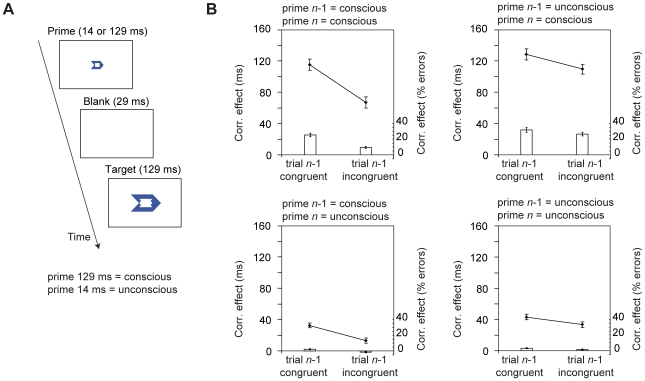
In conflict tasks such as the Stroop, the Eriksen flanker or the Simon task, it is generally observed that the detection of conflict in the current trial reduces the impact of conflicting information in the subsequent trial; a phenomenon termed conflict adaptation. This higher-order cognitive control function has been assumed to be restricted to cases where conflict is experienced consciously. In the present experiment we manipulated the awareness of conflict-inducing stimuli in a metacontrast masking paradigm to directly test this assumption. Conflicting response tendencies were elicited either consciously (through primes that were weakly masked) or unconsciously (strongly masked primes). We demonstrate trial-by-trial conflict adaptation effects after conscious as well as unconscious conflict, which could not be explained by direct stimulus/response repetitions. These findings show that unconscious information can have a longer-lasting influence on our behavior than previously thought and further stretch the functional boundaries of unconscious cognition.
在冲突任务(如 Stroop、Eriksen 侧翼或 Simon 任务)中,通常观察到当前试验中冲突的检测会降低后续试验中冲突信息的影响;这种现象称为冲突适应。这种更高阶的认知控制功能被认为仅限于经历有意识冲突的情况。在本实验中,我们在反效范式中操纵了冲突诱发刺激的意识,以直接检验这一假设。通过弱掩蔽的启动刺激来有意识地(即通过弱掩蔽的启动刺激)或无意识地(即通过强掩蔽的启动刺激)引发冲突的反应倾向。我们在有意识和无意识冲突后都发现了逐次的冲突适应效应,这不能用直接的刺激/反应重复来解释。这些发现表明,无意识信息对我们的行为的影响比以前认为的要持久,进一步拓展了无意识认知的功能边界。