Division of Obstetrics and Gynaecology, Department of Clinical and Experimental Medicine, Faculty of Health Sciences, Linköping University, SE-581 85 Linköping, Sweden.
Reprod Health. 2010 Jul 22;7:18. doi: 10.1186/1742-4755-7-18.
During the last 20 years the rate of CS has increased in Sweden as it has in many other countries. The proportion of pregnant women suffering from a high BMI has also increased rapidly during the same time period. It would therefore be of interest to study both how and if these two observations are related to each other. The aim was therefore to study trends in mode of caesarean section (CS) and instrumental deliveries among women in three BMI groups over a time span of almost 25 years with special focus on the observed body weight of pregnant women.
The design is a retrospective cohort study using medical records of consecutively delivered women at two delivery wards in South East Sweden during the years 1978, 1986, 1992, 1997 and 2001.
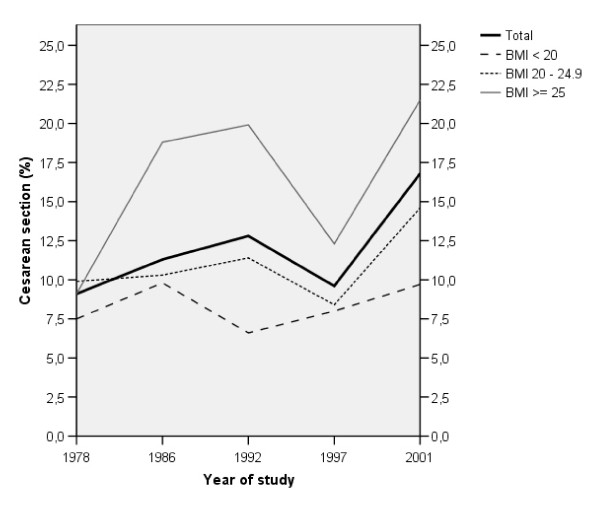
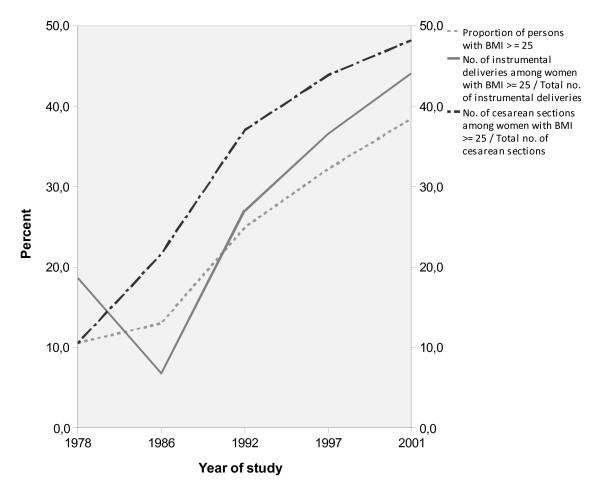
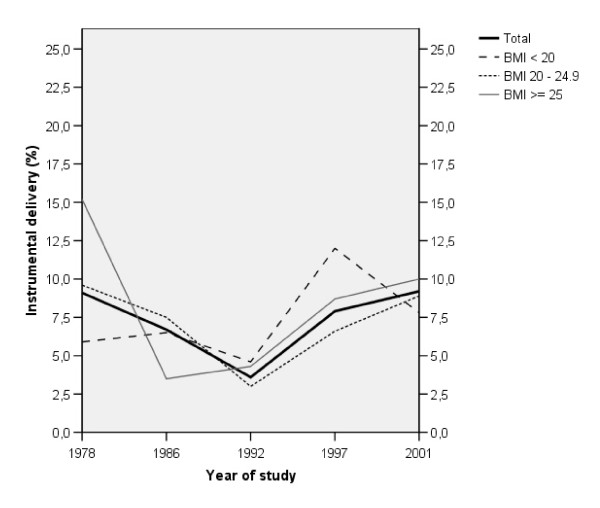
No significant time-trends were found for CS and instrumental delivery within each BMI-group for the time period studied. The proportion of women with BMI >/= 25 delivered by means of CS or instrumental delivery increased quite dramatically from 1978 to 2001 (chi2 test for trend; p < 0.001 for both CS and instrumental deliveries). The mean birth weight in relation to BMI and year of study among women delivered by means of CS decreased, a trend that was most evident between 1997 and 2001 (F-test; p = 0.005, p = 0.004, and p = 0.003 for BMI < 20, 20-24.9, and >/= 25, respectively).
Overweight and obese pregnant women constitute a rapidly growing proportion of the total number of CS and instrumental deliveries. Planning and allocation of health resources must be adjusted to this fact and its implications.
在过去的 20 年中,瑞典和许多其他国家一样,剖宫产率有所上升。同期,BMI 较高的孕妇比例也迅速增加。因此,研究这两种观察结果之间的关系及其变化方式将很有意义。目的是研究近 25 年来,三个 BMI 组中剖宫产和器械分娩的模式趋势,特别关注孕妇的体重。
该设计是一项回顾性队列研究,使用了瑞典东南部两个分娩病房的连续分娩妇女的医疗记录,研究时间为 1978 年、1986 年、1992 年、1997 年和 2001 年。
在研究期间,每个 BMI 组内的剖宫产和器械分娩均未发现明显的时间趋势。1978 年至 2001 年间,BMI≥25 的妇女剖宫产和器械分娩的比例急剧增加(趋势检验;剖宫产和器械分娩均 p<0.001)。剖宫产分娩的妇女中,与 BMI 和研究年份相关的出生体重呈下降趋势,这一趋势在 1997 年至 2001 年间最为明显(F 检验;BMI<20、20-24.9 和≥25 的 p 值分别为 0.005、0.004 和 0.003)。
超重和肥胖孕妇在剖宫产和器械分娩总数中所占比例呈快速增长趋势。必须根据这一事实及其影响来规划和分配卫生资源。