Intensive Care and Transplantation Unit, Department of Anaesthesiology and Critical Care, University Saint Eloi Hospital, 80 avenue Augustin Fliche, University of Montpellier I, F-34295 Montpellier Cedex 5, France.
Crit Care. 2010;14(4):R137. doi: 10.1186/cc9193. Epub 2010 Jul 21.
To examine the effects of positive end-expiratory pressure (PEEP) on intra-abdominal pressure (IAP) in patients with acute lung injury (ALI).
Thirty sedated and mechanically ventilated patients with ALI or acute respiratory distress syndrome (ARDS) admitted to a sixteen-bed surgical medical ICU were included. All patients were studied with sequentially increasing PEEP (0, 6 and 12 cmH2O) during a PEEP-trial.
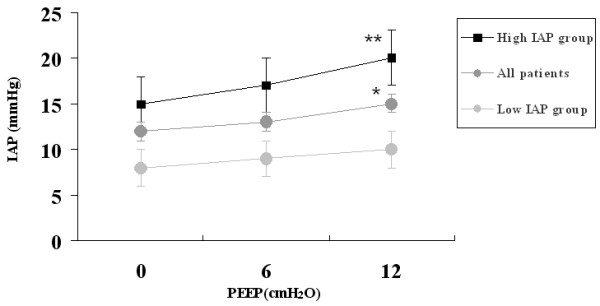
Age was 55 ± 17 years, weight was 70 ± 17 kg, SAPS II was 44 ± 14 and PaO2/FIO2 was 192 ± 53 mmHg. The IAP was 12 ± 5 mmHg at PEEP 0 (zero end-expiratory pressure, ZEEP), 13 ± 5 mmHg at PEEP 6 and 15 ± 6 mmHg at PEEP 12 (P < 0.05 vs ZEEP). In the patients with intra-abdominal hypertension defined as IAP ≥ 12 mmHg (n = 15), IAP significantly increased from 15 ± 3 mmHg at ZEEP to 20 ± 3 mmHg at PEEP 12 (P < 0.01). Whereas in the patients with IAP < 12 mmHg (n = 15), IAP did not significantly change from ZEEP to PEEP 12 (8 ± 2 vs 10 ± 3 mmHg). In the 13 patients in whom cardiac output was measured, increase in PEEP from 0 to 12 cmH2O did not significantly change cardiac output, nor in the 8 out of 15 patients of the high-IAP group. The observed effects were similar in both ALI (n = 17) and ARDS (n = 13) patients.
PEEP is a contributing factor that impacts IAP values. It seems necessary to take into account the level of PEEP whilst interpreting IAP values in patients under mechanical ventilation.
研究旨在探讨呼气末正压(PEEP)对急性肺损伤(ALI)患者腹腔内压(IAP)的影响。
本研究纳入了 30 名接受镇静和机械通气的 ALI 或急性呼吸窘迫综合征(ARDS)患者,这些患者均被收住在一个有 16 张床位的外科内科重症监护病房。所有患者均在接受 PEEP 试验期间接受了依次递增的 PEEP(0、6 和 12 cmH2O)。
患者年龄为 55 ± 17 岁,体重为 70 ± 17 kg,SAPS II 为 44 ± 14,PaO2/FIO2 为 192 ± 53 mmHg。在 PEEP 为 0 时(零呼气末正压,ZEEP),IAP 为 12 ± 5 mmHg,在 PEEP 为 6 时为 13 ± 5 mmHg,在 PEEP 为 12 时为 15 ± 6 mmHg(与 ZEEP 相比,P < 0.05)。在 IAP≥12mmHg 的患者中(n=15),IAP 从 ZEEP 时的 15 ± 3mmHg 显著增加至 PEEP 12 时的 20 ± 3mmHg(P<0.01)。而在 IAP<12mmHg 的患者中(n=15),IAP 从 ZEEP 至 PEEP 12 时并未显著变化(8 ± 2mmHg 与 10 ± 3mmHg)。在测量心输出量的 13 名患者中,从 0 增加到 12cmH2O 的 PEEP 并未显著改变心输出量,在高 IAP 组的 8 名患者中也是如此。在 ALI(n=17)和 ARDS(n=13)患者中,观察到的影响相似。
PEEP 是影响 IAP 值的一个因素。在对机械通气患者的 IAP 值进行解释时,似乎有必要考虑 PEEP 的水平。