Division of Epidemiology, Human Genetics, and Environmental Sciences, University of Texas Health Sciences Center, Houston, Houston, Texas, USA.
Diabetes Care. 2010 Dec;33(12):2684-91. doi: 10.2337/dc10-1150. Epub 2010 Aug 6.
Whole-grain foods are touted for multiple health benefits, including enhancing insulin sensitivity and reducing type 2 diabetes risk. Recent genome-wide association studies (GWAS) have identified several single nucleotide polymorphisms (SNPs) associated with fasting glucose and insulin concentrations in individuals free of diabetes. We tested the hypothesis that whole-grain food intake and genetic variation interact to influence concentrations of fasting glucose and insulin.
Via meta-analysis of data from 14 cohorts comprising ∼ 48,000 participants of European descent, we studied interactions of whole-grain intake with loci previously associated in GWAS with fasting glucose (16 loci) and/or insulin (2 loci) concentrations. For tests of interaction, we considered a P value <0.0028 (0.05 of 18 tests) as statistically significant.
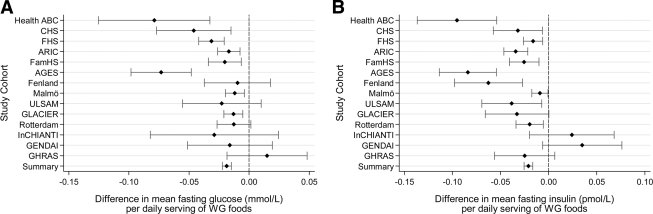
Greater whole-grain food intake was associated with lower fasting glucose and insulin concentrations independent of demographics, other dietary and lifestyle factors, and BMI (β [95% CI] per 1-serving-greater whole-grain intake: -0.009 mmol/l glucose [-0.013 to -0.005], P < 0.0001 and -0.011 pmol/l [ln] insulin [-0.015 to -0.007], P = 0.0003). No interactions met our multiple testing-adjusted statistical significance threshold. The strongest SNP interaction with whole-grain intake was rs780094 (GCKR) for fasting insulin (P = 0.006), where greater whole-grain intake was associated with a smaller reduction in fasting insulin concentrations in those with the insulin-raising allele.
Our results support the favorable association of whole-grain intake with fasting glucose and insulin and suggest a potential interaction between variation in GCKR and whole-grain intake in influencing fasting insulin concentrations.
全谷物食品因其多种健康益处而备受推崇,包括提高胰岛素敏感性和降低 2 型糖尿病风险。最近的全基因组关联研究(GWAS)已经确定了几个与非糖尿病个体空腹血糖和胰岛素浓度相关的单核苷酸多态性(SNP)。我们检验了这样一个假设,即全谷物食物的摄入和遗传变异相互作用,从而影响空腹血糖和胰岛素的浓度。
通过对来自 14 个欧洲血统队列的 48000 多名参与者的数据进行荟萃分析,我们研究了全谷物摄入量与 GWAS 中先前与空腹血糖(16 个位点)和/或胰岛素(2 个位点)浓度相关的位点之间的相互作用。对于交互作用的检验,我们认为 P 值<0.0028(18 次检验中的 0.05)具有统计学意义。
在不考虑人口统计学、其他饮食和生活方式因素以及 BMI 的情况下,更多的全谷物食物摄入与较低的空腹血糖和胰岛素浓度相关(每增加一份全谷物摄入量的β[95%CI]:-0.009mmol/l 葡萄糖[-0.013 至-0.005],P<0.0001 和 -0.011pmol/l[ln]胰岛素[-0.015 至-0.007],P=0.0003)。没有交互作用达到我们的多重测试调整后的统计学显著阈值。与全谷物摄入量的最强 SNP 相互作用是 rs780094(GCKR)与空腹胰岛素(P=0.006),在携带升高胰岛素等位基因的个体中,更多的全谷物摄入与空腹胰岛素浓度的降低幅度较小相关。
我们的结果支持全谷物摄入与空腹血糖和胰岛素之间的有利关联,并提示 GCKR 变异与全谷物摄入在影响空腹胰岛素浓度方面可能存在相互作用。