Omar Ayman I, Mason Warren P
Department of Medicine, Princess Margaret Hospital and the University of Toronto, Toronto, Ontario, Canada;
Core Evid. 2010 Jun 15;4:93-111. doi: 10.2147/ce.s6010.
Malignant gliomas are a heterogeneous group of primary central nervous system neoplasms that represent less than 2% of all cancers yet carry a significant burden to society. They are frequently associated with considerable and progressive neurological disability and are ultimately intractable to all forms of treatment. Temozolomide (TMZ) is a new second generation DNA alkylating agent that has become part of malignant astrocytoma management paradigms because of its proven efficacy, ease of administration, and favorable toxicity profile.
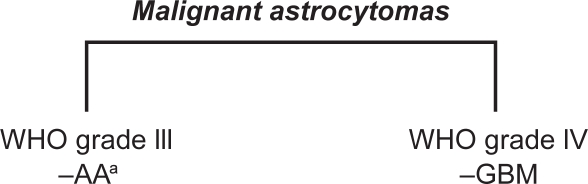
To review the role of TMZ in the management of malignant astrocytomas (World Health Organization grades III and IV) including newly diagnosed (n) and recurrent (r) anaplastic astrocytomas (AA) and glioblastomas.
A series of pivotal clinical trials have established a role for TMZ in the treatment of malignant astrocytomas. A large phase II trial examining the role of TMZ in rAA showed a response rate of 35%, and a 6-month progression-free survival of 46%. This led to the accelerated approval of TMZ by the FDA and the EU for the treatment of rAA. Evidence for a role of TMZ in nAA is currently limited but research is ongoing in this area. The role of TMZ in the management of glioblastoma at the time of recurrence (rGBM) is less impressive but evidence for its activity was demonstrated in two large phase II trials that led to the approval of TMZ for this indication in Europe and Canada but not in the US. A recent large prospective randomized phase III trial showed that the addition of TMZ during and after radiation therapy (RT) in newly diagnosed (nGBM) patients prolonged median overall survival by 2.5 months; perhaps more importantly, the 2-year survival rate for patients receiving TMZ and RT was 26% compared with 10% for those receiving RT alone. Concurrent TMZ with RT followed by adjuvant TMZ has become the standard of care for nGBM patients. Based on the evidence presented in this trial, TMZ received approval from the FDA and the EU for patients with nGBM in 2005.
THERE IS EVIDENCE TO SUPPORT THE USE OF TMZ FOR THE FOLLOWING DISEASES IN THE ORDER OF MOST TO LEAST CONVINCING: nGBM, rAA, rGBM, and nAA. This order may quickly change as more trials are being designed and implemented, particularly with novel TMZ dosing schedules.
恶性胶质瘤是原发性中枢神经系统肿瘤的异质性群体,在所有癌症中所占比例不到2%,但给社会带来了沉重负担。它们常伴有严重且进行性的神经功能障碍,最终对所有治疗形式都难以治愈。替莫唑胺(TMZ)是一种新型第二代DNA烷化剂,因其已证实的疗效、易于给药和良好的毒性特征,已成为恶性星形细胞瘤治疗模式的一部分。
综述TMZ在恶性星形细胞瘤(世界卫生组织III级和IV级)管理中的作用,包括新诊断(n)和复发(r)的间变性星形细胞瘤(AA)和胶质母细胞瘤。
一系列关键临床试验确立了TMZ在恶性星形细胞瘤治疗中的作用。一项大型II期试验研究了TMZ在rAA中的作用,显示缓解率为35%,6个月无进展生存率为46%。这导致FDA和欧盟加速批准TMZ用于治疗rAA。目前TMZ在nAA中的作用证据有限,但该领域的研究正在进行。TMZ在复发性胶质母细胞瘤(rGBM)管理中的作用不太显著,但在两项大型II期试验中证明了其活性,这导致TMZ在欧洲和加拿大获得该适应症的批准,但在美国未获批准。最近一项大型前瞻性随机III期试验表明,在新诊断的(nGBM)患者放疗期间及放疗后添加TMZ可使中位总生存期延长2.5个月;也许更重要的是,接受TMZ和放疗的患者2年生存率为26%,而仅接受放疗的患者为10%。同步TMZ与放疗后序贯辅助TMZ已成为nGBM患者的标准治疗方案。基于该试验提供的证据,TMZ于2005年获得FDA和欧盟对nGBM患者的批准。
有证据支持按以下疾病顺序使用TMZ,从最有说服力到最缺乏说服力:nGBM、rAA、rGBM和nAA。随着更多试验的设计和实施,特别是采用新型TMZ给药方案,这个顺序可能会迅速改变。