Department of Epidemiology and Biostatistics, School of Public Health, Imperial College, London W2 1PG, United Kingdom.
J Proteome Res. 2010 Sep 3;9(9):4620-7. doi: 10.1021/pr1003449.
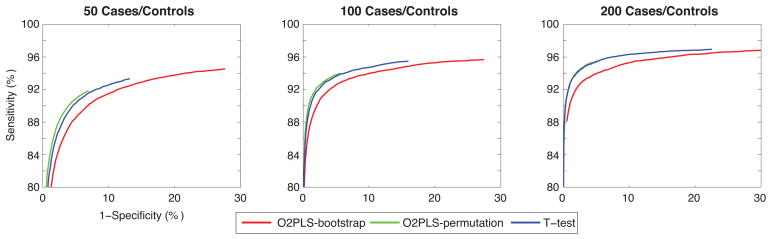
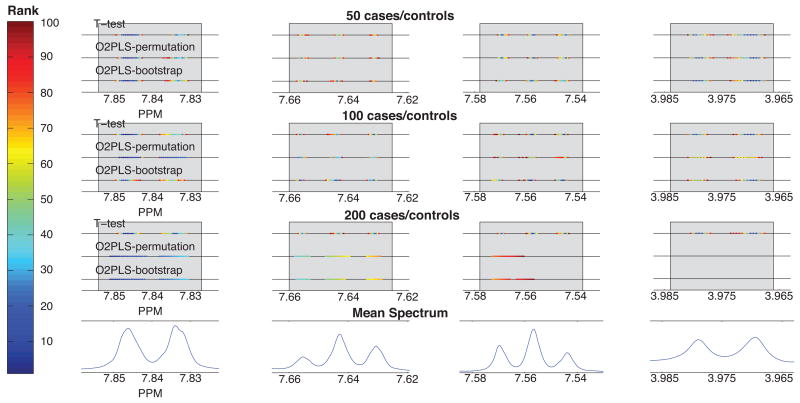
High throughput metabolic profiling via the metabolome-wide association study (MWAS) is a powerful new approach to identify biomarkers of disease risk, but there are methodological challenges: high dimensionality, high level of collinearity, the existence of peak overlap within metabolic spectral data, multiple testing, and selection of a suitable significance threshold. We define the metabolome-wide significance level (MWSL) as the threshold required to control the family wise error rate through a permutation approach. We used 1H NMR spectroscopic profiles of 24 h urinary collections from the INTERMAP study. Our results show that the MWSL primarily depends on sample size and spectral resolution. The MWSL estimates can be used to guide selection of discriminatory biomarkers in MWA studies. In a simulation study, we compare statistical performance of the MWSL approach to two variants of orthogonal partial least-squares (OPLS) method with respect to statistical power, false positive rate and correspondence of ranking of the most significant spectral variables. Our results show that the MWSL approach as estimated by the univariate t test is not outperformed by OPLS and offers a fast and simple method to detect disease-related discriminatory features in human NMR urinary metabolic profiles.
通过代谢组学全关联研究(MWAS)进行高通量代谢组学分析是一种识别疾病风险生物标志物的强大新方法,但存在一些方法学上的挑战:高维度、高度的共线性、代谢谱数据中峰重叠的存在、多重检验以及选择合适的显著性阈值。我们将代谢组学全关联研究的显著性水平(MWSL)定义为通过置换方法控制总体错误率所需的阈值。我们使用 INTERMAP 研究中 24 小时尿液采集的 1H NMR 波谱图谱。我们的结果表明,MWSL 主要取决于样本量和光谱分辨率。MWSL 估计值可用于指导 MWA 研究中判别性生物标志物的选择。在一项模拟研究中,我们比较了 MWSL 方法与两种正交偏最小二乘法(OPLS)变体在统计功效、假阳性率和最显著光谱变量排序的一致性方面的统计性能。我们的结果表明,由单变量 t 检验估计的 MWSL 方法并不优于 OPLS,并且为检测人类 NMR 尿液代谢谱中与疾病相关的判别特征提供了一种快速简单的方法。