Prostate Cancer Discovery and Development Program, Department of Cancer Biology, University of Massachusetts Medical School, Worcester, MA 01605, U.S.A.
Biochem J. 2010 Sep 1;430(2):199-205. doi: 10.1042/BJ20100814.
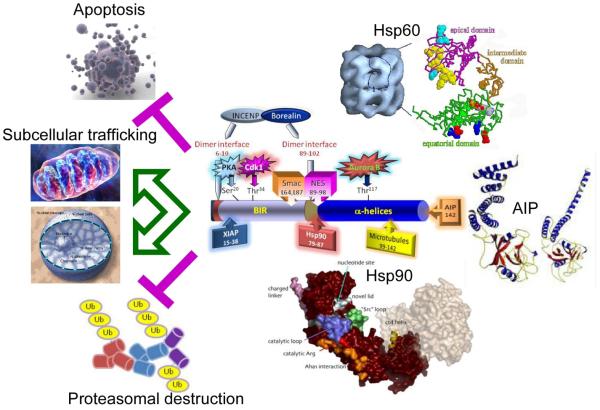
From the realization that cell number homoeostasis is fundamental to the biology of all metazoans, and that deregulation of this process leads to human diseases, enormous interest has been devoted over the last two decades to map the requirements of cell death and cell survival. This effort has led to tangible progress, and we can now chart with reasonable accuracy complex signalling circuitries controlling cell-fate decisions. Some of this knowledge has translated into novel therapeutics, and the outcome of these strategies, especially in cancer, is eagerly awaited. However, the function of cell-death modifiers have considerably broadened over the last few years, and these molecules are increasingly recognized as arbiters of cellular homoeostasis, from cell division, to intracellular signalling to cellular adaptation. This panoply of functions is best exemplified by members of the IAP (inhibitor of apoptosis) gene family, molecules originally narrowly defined as endogenous caspase inhibitors, but now firmly positioned at the crossroads of multiple normal and transformed cellular responses.
从认识到细胞数量的动态平衡是所有后生动物生物学的基础,以及这种过程的失调会导致人类疾病开始,在过去的二十年中,人们投入了巨大的兴趣来绘制细胞死亡和细胞存活的要求图。这一努力取得了切实的进展,我们现在可以相当准确地绘制出控制细胞命运决定的复杂信号转导通路图。其中一些知识已经转化为新的治疗方法,这些策略的结果,特别是在癌症方面,正在急切等待中。然而,细胞死亡调节剂的功能在过去几年中已经大大扩展,这些分子越来越被认为是细胞动态平衡的仲裁者,从细胞分裂到细胞内信号传递再到细胞适应。IAP(凋亡抑制剂)基因家族的成员就是最好的例证,这些分子最初被狭义地定义为内源性半胱天冬酶抑制剂,但现在已经牢牢地处于多种正常和转化细胞反应的交汇点。