Department of Biomedical Engineering, Ben-Gurion University of the Negev, Beer Sheva, Israel.
PLoS One. 2010 Aug 11;5(8):e12128. doi: 10.1371/journal.pone.0012128.
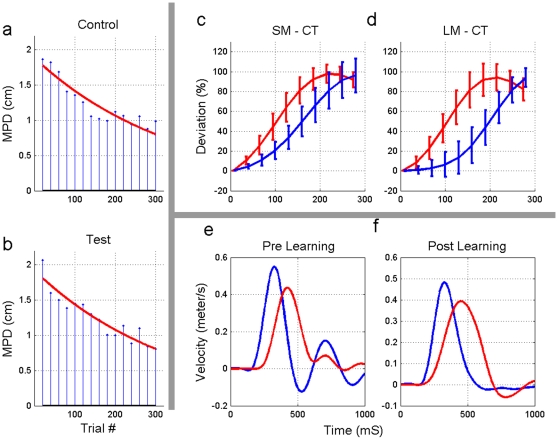
Adaptation to deterministic force perturbations during reaching movements was extensively studied in the last few decades. Here, we use this methodology to explore the ability of the brain to adapt to a delayed velocity-dependent force field. Two groups of subjects preformed a standard reaching experiment under a velocity dependent force field. The force was either immediately proportional to the current velocity (Control) or lagged it by 50 ms (Test). The results demonstrate clear adaptation to the delayed force perturbations. Deviations from a straight line during catch trials were shifted in time compared to post-adaptation to a non-delayed velocity dependent field (Control), indicating expectation to the delayed force field. Adaptation to force fields is considered to be a process in which the motor system predicts the forces to be expected based on the state that a limb will assume in response to motor commands. This study demonstrates for the first time that the temporal window of this prediction needs not to be fixed. This is relevant to the ability of the adaptive mechanisms to compensate for variability in the transmission of information across the sensory-motor system.
在过去的几十年中,人们对在到达运动期间适应确定性力扰动进行了广泛的研究。在这里,我们使用这种方法来探索大脑适应延迟速度相关力场的能力。两组受试者在速度相关力场下进行了标准的到达实验。力要么与当前速度成正比(Control),要么滞后 50 毫秒(Test)。结果表明,对延迟力扰动有明显的适应。与适应后非延迟速度相关场(Control)相比,在捕捉试验期间偏离直线的时间发生了变化,这表明对延迟力场的预期。力场的适应被认为是一个过程,其中运动系统基于肢体将根据对运动指令的响应而采取的状态来预测预期的力。这项研究首次表明,这种预测的时间窗口不需要固定。这与自适应机制补偿感觉运动系统信息传输变异性的能力有关。