College of Life Sciences, University of Dundee, Dundee, DD1 5EH, Scotland, UK.
Trends Cell Biol. 2010 Oct;20(10):593-600. doi: 10.1016/j.tcb.2010.07.001. Epub 2010 Aug 18.
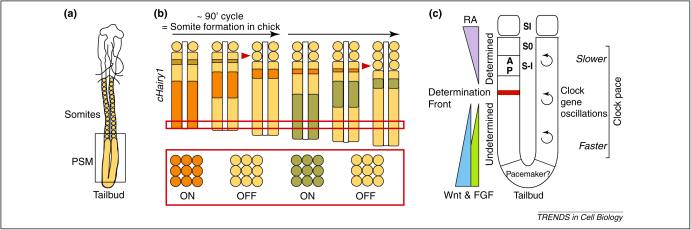
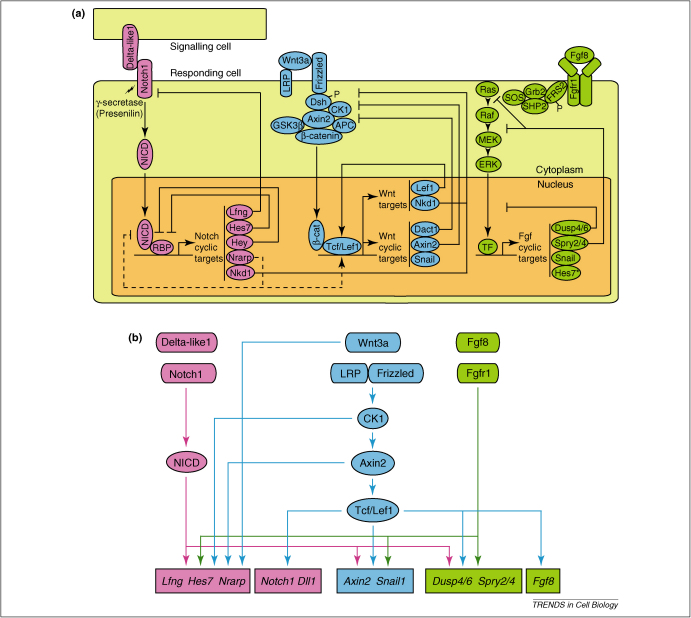
The vertebrate segmentation clock is a molecular oscillator that regulates the periodicity of somite formation. Three signalling pathways have been proposed to underlie the molecular mechanism of the oscillator, namely the Notch, Wnt and Fgf pathways. Characterizing the roles and hierarchy of these three pathways in the oscillator mechanism is currently the focus of intense research. Recent publications report the first identification of a molecular mechanism involved in the regulation of the pace of this oscillator. We review these and other recent findings regarding the interaction between the three pathways in the oscillator mechanism that have significantly expanded our understanding of the segmentation clock.
脊椎动物分节时钟是一个分子振荡器,调节体节形成的周期性。有三种信号通路被提出作为振荡器的分子机制的基础,即 Notch、Wnt 和 Fgf 通路。目前,阐明这三种通路在振荡器机制中的作用和层次是研究的重点。最近的出版物报道了第一个涉及调节这个振荡器的节奏的分子机制的鉴定。我们回顾了这些和其他最近关于振荡器机制中三种通路相互作用的发现,这些发现极大地扩展了我们对分节时钟的理解。