Center for Integrative Medicine, University Witten/Herdecke Germany, Gerhard-Kienle-Weg 4, 58313 Herdecke, Germany.
BMC Public Health. 2010 Aug 20;10:507. doi: 10.1186/1471-2458-10-507.
We examined which adaptive coping strategies, referring to the concept of 'locus of disease control', were of relevance for patients with chronic pain conditions, and how they were interconnected with patients' life satisfaction and interpretation of disease.
In a multicenter cross-sectional anonymous survey with the AKU questionnaire, we enrolled 579 patients (mean age 54 ± 14 years) with various chronic pain conditions.
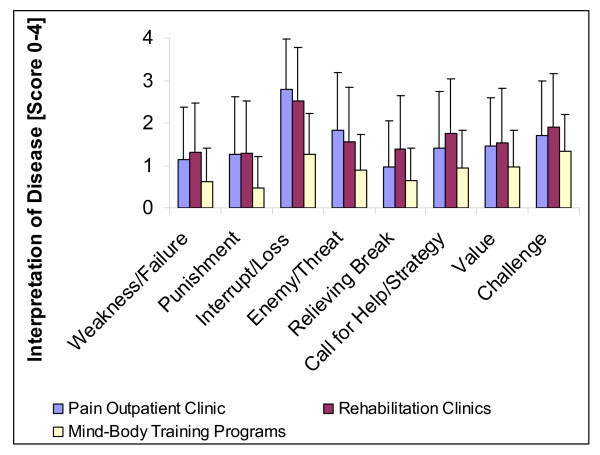
Disease as an adverse interruption of life was the prevalent interpretation of chronic pain conditions. As a consequence, patients relied on external powerful sources to control their disease (i.e., Trust in Medical Help; Search for Information and Alternative Help), but also on internal powers and virtues (i.e., Conscious Way of Living; Positive Attitudes). In contrast, Trust in Divine Help as an external transcendent source and Reappraisal: Illness as Chance as an internal (cognitive) strategy were valued moderately. Regression analyses indicated that Positive Attitudes and higher age were significant predictors of patients' life satisfaction, but none of the other adaptive coping strategies. While the adaptive coping strategies were not associated with negative interpretations of disease, the cognitive reappraisal attitude was of significant relevance for positive interpretations such as value and challenge.
The experience of illness may enhance intensity and depth of life, and thus one may explain the association between internal adaptive coping strategies (particularly Reappraisal) and positive interpretations of disease. To restore a sense of self-control over pain (and thus congruence with the situation), and the conviction that one is not necessarily disabled by disease, is a major task in patient care. In the context of health services research, apart from effective pain management, a comprehensive approach is needed which enhances the psycho-spiritual well-being of patients.
我们研究了哪些适应应对策略与“疾病控制的位置”这一概念有关,这些策略对慢性疼痛患者有何影响,以及它们与患者的生活满意度和对疾病的解读如何相互关联。
我们采用 AKU 问卷进行了一项多中心、横断面、匿名调查,共纳入了 579 名患有各种慢性疼痛的患者(平均年龄 54±14 岁)。
将疾病视为对生活的不利干扰是慢性疼痛状况的普遍解读。因此,患者依赖外部强大的力量来控制自己的疾病(即,信任医疗帮助;寻找信息和替代帮助),但也依赖内在的力量和美德(即,有意识的生活方式;积极的态度)。相比之下,对作为外部超越力量的神圣信任以及将疾病视为机遇的重新评估作为内在(认知)策略的认可度适中。回归分析表明,积极的态度和较高的年龄是患者生活满意度的重要预测因素,但其他适应应对策略则不是。虽然适应应对策略与疾病的负面解读无关,但认知再评估态度与疾病的积极解读(如价值和挑战)密切相关。
疾病的体验可能会增强生命的强度和深度,因此可以解释内在适应应对策略(特别是重新评估)与对疾病的积极解读之间的关联。恢复对疼痛的自我控制感(从而与现状保持一致),并相信疾病不一定使人残疾,是患者护理的主要任务。在卫生服务研究的背景下,除了有效的疼痛管理外,还需要采取综合方法来增强患者的心理-精神幸福感。