Department of Psychology.
Neuropsychology. 2010 Sep;24(5):547-562. doi: 10.1037/a0019246.
The general goal of this study was to advance our understanding of Type 2 diabetes (T2D)-cognition relationships in older adults by linking and testing comprehensive sets of potential moderators, potential mediators, and multiple cognitive outcomes.
We identified in the literature 13 health-related (but T2D-distal) potential covariates, representing four informal domains (i.e., biological vitality, personal affect, subjective health, lifestyle activities). Cross-sectional data from the Victoria Longitudinal Study (age range = 53-90 years; n = 41 T2D and n = 458 control participants) were used. We first examined whether any of the 13 potential covariates influenced T2D-cognition associations, as measured by a comprehensive neuropsychological battery (15 measures). Next, using standard regression-based moderator and mediator analyses, we systematically tested whether the identified covariates would significantly alter observed T2D-cognition relationships.
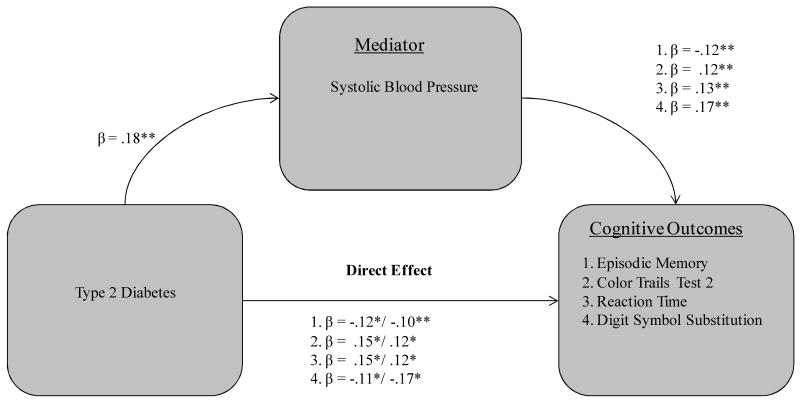
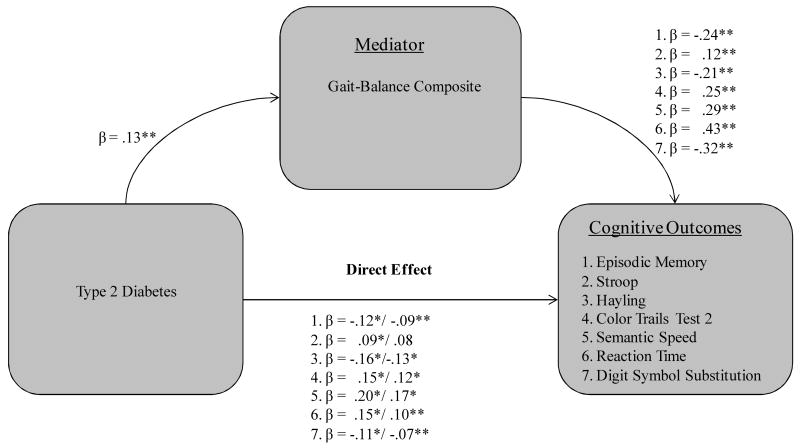
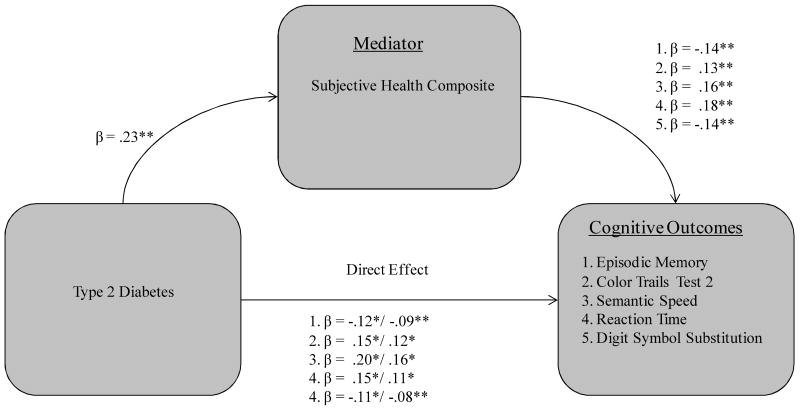
Six potential covariates were found to be sensitive to T2D associations with performance on seven cognitive measures. Three factors (systolic blood pressure, gait-balance composite, subjective health) were significant mediators. Each mediated multiple cognitive outcomes, especially measures of neurocognitive speed, executive functioning, and episodic memory.
Our findings offer a relatively comprehensive perspective of T2D-related cognitive deficits, comorbidities, and modulating influences. The implications for future research reach across several fields of study and application. These include (1) neuropsychological research on neural and biological bases of T2D-related cognitive decline, (2) clinical research on intervention and treatment strategies, and (3) larger-scale longitudinal studies examining the potential multilateral and dynamic relationships among T2D status, related comorbidities, and cognitive outcomes.
本研究的总体目标是通过链接和测试潜在的综合调节因素、潜在的中介因素和多种认知结果,深入了解老年人 2 型糖尿病(T2D)与认知的关系。
我们在文献中确定了 13 种与健康相关(但与 T2D 无关)的潜在协变量,代表四个非正式领域(即生物活力、个人情感、主观健康、生活方式活动)。使用来自维多利亚纵向研究(年龄范围为 53-90 岁;n=41 例 T2D 和 n=458 例对照参与者)的横断面数据。我们首先检查了 13 种潜在协变量中的任何一种是否会影响 T2D 与认知的关联,该关联通过综合神经心理学测试(15 项测试)来衡量。接下来,使用基于标准回归的调节和中介分析,我们系统地测试了所确定的协变量是否会显著改变观察到的 T2D 与认知的关系。
有 6 种潜在的协变量与认知表现呈 T2D 相关,涉及 7 项认知测试。三个因素(收缩压、步态-平衡综合、主观健康)是显著的中介因素。每个因素都介导了多种认知结果,尤其是神经认知速度、执行功能和情景记忆的测量结果。
我们的研究结果提供了一种相对全面的视角,用于研究 T2D 相关的认知缺陷、合并症和调节影响。这对未来的研究具有跨多个研究领域和应用领域的意义。这些包括(1)神经心理学研究 T2D 相关认知衰退的神经和生物学基础,(2)临床研究干预和治疗策略,以及(3)更大规模的纵向研究,以检查 T2D 状态、相关合并症和认知结果之间的潜在多边和动态关系。