Centers for Immunology & Microbial Disease, Albany Medical College, Albany, NY 12208, United States.
Respir Physiol Neurobiol. 2010 Dec 31;174(3):299-306. doi: 10.1016/j.resp.2010.08.019. Epub 2010 Sep 8.
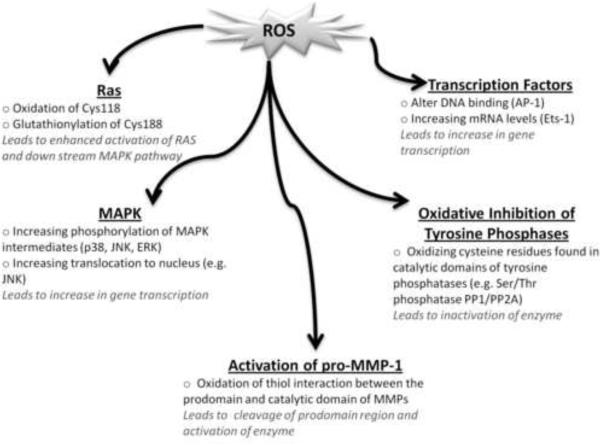
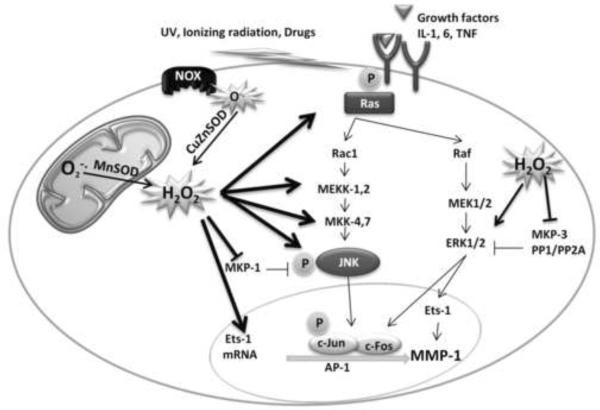
Many degenerative disease processes associated with aging result from enhanced extracellular matrix (ECM) breakdown. Concomitant with aberrant matrix destruction are alterations in levels of reactive oxygen species (ROS) generating and detoxification systems. ROS function as second messengers due to their ability to react with wide range of biomolecules resulting in modification of an array of signaling networks. ROS can activate upstream kinases (MKK) responsible for MAPK activation and restrict the activity of their inhibitory phosphatases. Here we focus on the redox-sensitive signaling components that control the expression of MMP-1, which is largely responsible for maintaining ECM homeostasis. Numerous disease processes are associated with shifts in steady state ROS levels that influence overall ECM degradation. This review highlights the redox-sensitive regulatory signals that control the expression of the primary initiating protease MMP-1 and provides strong rational for the use of antioxidant based therapies for treatment of degenerative disorders associated with aberrant matrix destruction.
许多与衰老相关的退行性疾病过程是由于细胞外基质(ECM)分解增强所致。伴随着异常基质破坏的是活性氧(ROS)生成和解毒系统水平的改变。ROS 作为第二信使发挥作用,因为它们能够与广泛的生物分子反应,从而修饰一系列信号网络。ROS 可以激活负责 MAPK 激活的上游激酶(MKK),并限制其抑制性磷酸酶的活性。在这里,我们重点介绍控制 MMP-1 表达的氧化还原敏感信号成分,MMP-1 在很大程度上负责维持 ECM 的动态平衡。许多疾病过程都与稳态 ROS 水平的变化有关,这些变化会影响整体 ECM 的降解。本综述强调了控制主要起始蛋白酶 MMP-1 表达的氧化还原敏感调节信号,并为使用基于抗氧化剂的治疗方法治疗与异常基质破坏相关的退行性疾病提供了有力的依据。