Swiss Tropical and Public Health Institute, Basel, Switzerland.
PLoS One. 2010 Aug 17;5(8):e12205. doi: 10.1371/journal.pone.0012205.
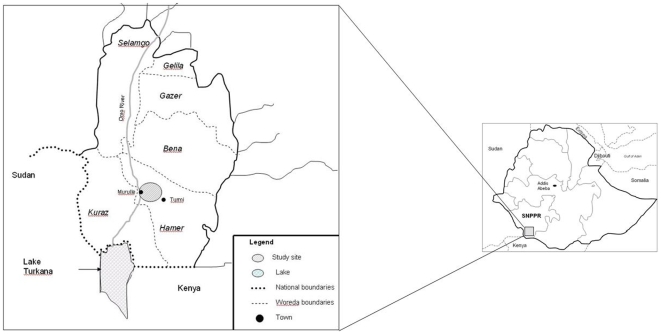
Bovine tuberculosis (BTB) is endemic in cattle in the Ethiopian Highlands but no studies have been done so far in pastoralists in South Omo. This study assessed the prevalence of bovine tuberculosis (BTB) at an intensive interface of livestock, wildlife and pastoralists in Hamer Woreda (South Omo), Ethiopia. A cross-sectional survey including a comparative intradermal skin testing (CIDT) was conducted in 499 zebu cattle and 186 goats in 12 settlements. Sputum samples from 26 symptomatic livestock owners were cultured for TB. Fifty-one wildlife samples from 13 different species were also collected in the same area and tested with serological (lateral flow assay) and bacteriological (culture of lymph nodes) techniques. Individual BTB prevalence in cattle was 0.8% (CI: 0.3%-2%) with the >4 mm cut-off and 3.4% (CI: 2.1%-5.4%) with the >2 mm cut-off. Herd prevalence was 33.3% and 83% when using the >4 and the >2 mm cut-off respectively. There was no correlation between age, sex, body condition and positive reactors upon univariate analysis. None of the goats were reactors for BTB. Acid fast bacilli (AFB) were detected in 50% of the wildlife cultures, 79.2% of which were identified as Mycobacterium terrae complex. No M. bovis was detected. Twenty-seven percent of tested wildlife were sero-positive. Four sputum cultures (15.4%) yielded AFB positive colonies among which one was M. tuberculosis and 3 non-tuberculous mycobacteria (NTM). The prevalence of M. avium-complex (MAC) was 4.2% in wildlife, 2.5% in cattle and 0.5% in goats. In conclusion, individual BTB prevalence was low, but herd prevalence high in cattle and BTB was not detected in goats, wildlife and humans despite an intensive contact interface. On the contrary, NTMs were highly prevalent and some Mycobacterium spp were more prevalent in specific species. The role of NTMs in livestock and co-infection with BTB need further research.
牛型结核(BTB)在埃塞俄比亚高地的牛群中流行,但迄今为止,在南奥莫的牧民中尚未进行过研究。本研究评估了埃塞俄比亚南奥莫哈默沃雷达(Hamer Woreda)牲畜、野生动物和牧民密集接触地区牛型结核(BTB)的流行情况。在 12 个定居点,对 499 头瘤牛和 186 只山羊进行了横断面调查,包括比较皮内皮肤试验(CIDT)。对 26 名有症状的牲畜主人的痰液样本进行了结核培养。在同一地区还收集了来自 13 个不同物种的 51 个野生动物样本,并使用血清学(横向流动分析)和细菌学(淋巴结培养)技术进行了检测。牛个体 BTB 的患病率为 0.8%(95%CI:0.3%-2%),>4mm 截断值为 3.4%(95%CI:2.1%-5.4%)。>4mm 和>2mm 截断值时,畜群患病率分别为 33.3%和 83%。单变量分析时,年龄、性别、身体状况与阳性反应者之间无相关性。没有一只山羊对 BTB 呈反应。50%的野生动物培养物中检测到抗酸杆菌(AFB),其中 79.2%被鉴定为 terrae 复合菌群。未检测到牛分枝杆菌。27%的检测野生动物呈血清阳性。4 份痰液培养物(15.4%)中分离出 AFB 阳性菌落,其中 1 株为结核分枝杆菌,3 株为非结核分枝杆菌(NTM)。野生动物中 M. avium-complex(MAC)的患病率为 4.2%,牛为 2.5%,山羊为 0.5%。总之,牛个体 BTB 的患病率较低,但畜群患病率较高,尽管有密集的接触界面,但在山羊、野生动物和人类中并未检测到 BTB。相反,NTM 高度流行,某些分枝杆菌属在特定物种中更为流行。NTM 在牲畜中的作用以及与 BTB 的合并感染需要进一步研究。