
膝关节弯曲会影响胫骨假体周围骨密度的测量。建议制定可重复的临床扫描方案。
Knee flexion influences periprosthetic BMD measurement in the tibia. Suggestions for a reproducible clinical scan protocol.
机构信息
Department of Orthopaedics, Aarhus University Hospital, Denmark.
出版信息
Acta Orthop. 2010 Aug;81(4):463-70. doi: 10.3109/17453674.2010.501746.
BACKGROUND AND PURPOSE
The quality and quantity of bone is important for the success of joint prostheses and may be monitored by dual energy X-ray absorptiometry (DXA). Available protocols suggest that the knee should be positioned in full extension. This is not possible for most patients in the first days after surgery; however, deficits in extension normalize with rehabilitation. Individual knee flexion between the baseline and follow-up investigations may therefore be different. We investigated the sensitivity of bone mineral density (BMD) measurements to knee flexion in a phantom study and in patients. We suggest a protocol for clinical use.
METHODS
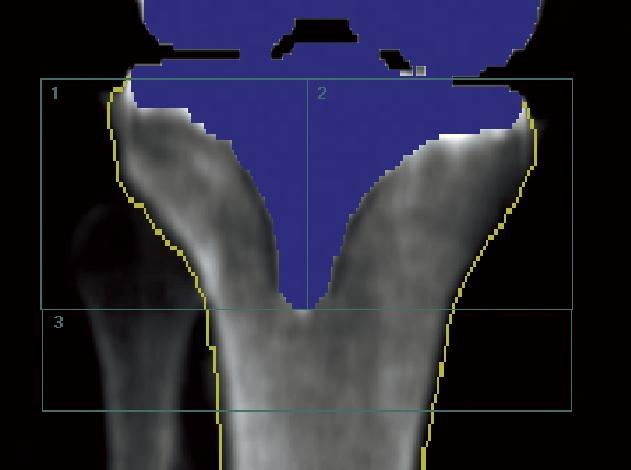
2 phantom tibial bones with tibia components were secured in a clamp and BMD measurements were repeated 5 times at every 5 degrees change in flexion from 0 degrees to 20 degrees. For clinical use, a soft foam positioner was produced, in which the lower leg could be placed in neutral rotation and with the knee in approximately 25 degrees of flexion. The clinical repeatability was tested with double examinations in 38 patients. We investigated 3 regions of interest (ROIs) below the tibial plateau.
RESULTS
In the phantom study, just 5 degrees of flexion was found to change the measured mean BMD. The reproducibility of clinical measurements (coefficient of variation) in the 3 ROIs assessed ranged from 1.8% to 3.7% for the anteroposterior scans, and from 3.4% to 6.2% for the lateral scans.
INTERPRETATION
Knee flexion does affect the measured periprosthetic tibial BMD, and knee flexion should be the same at all clinical follow-ups. The protocol and soft foam positioner that we suggest permit precise and reliable assessment of BMD in the proximal tibia and they can be used in clinical work.
背景与目的
骨骼的质量和数量对于关节假体的成功至关重要,可通过双能 X 射线吸收法(DXA)进行监测。现有的方案建议膝关节应置于完全伸展的位置。但对于术后最初几天的大多数患者来说,这是不可能的;然而,随着康复,伸展不足会得到纠正。因此,在基线和随访检查之间,每个膝关节的弯曲度可能会有所不同。我们通过在体模和患者中进行研究,来调查骨密度(BMD)测量值对膝关节弯曲的敏感性。我们提出了一种用于临床应用的方案。
方法
将 2 个带有胫骨组件的胫骨体模固定在夹具中,在从 0 度到 20 度的每 5 度弯曲变化下,重复 BMD 测量 5 次。为了临床应用,我们制作了一个柔软的泡沫定位器,可将小腿放在中立旋转位置,并将膝关节置于大约 25 度的弯曲位置。我们在 38 例患者中进行了两次重复检查以测试临床重复性。我们研究了胫骨平台以下的 3 个感兴趣区域(ROI)。
结果
在体模研究中,仅 5 度的弯曲就会改变测量的平均 BMD。在 3 个 ROI 中,前后扫描的临床测量(变异系数)的可重复性范围为 1.8%至 3.7%,而外侧扫描的可重复性范围为 3.4%至 6.2%。
解释
膝关节弯曲确实会影响测量的假体周围胫骨 BMD,所有临床随访时都应保持相同的膝关节弯曲度。我们建议的方案和柔软的泡沫定位器可精确、可靠地评估胫骨近端的 BMD,可用于临床工作。



 Zotero 插件