School of Social Work, Columbia University, New York, NY 10027, USA.
Dev Psychol. 2010 Sep;46(5):1245-67. doi: 10.1037/a0020178.
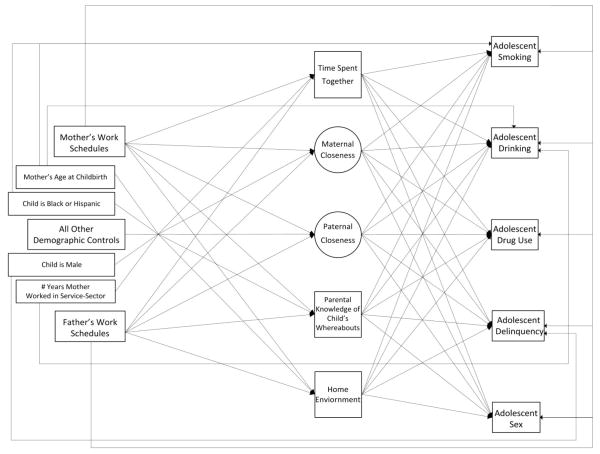
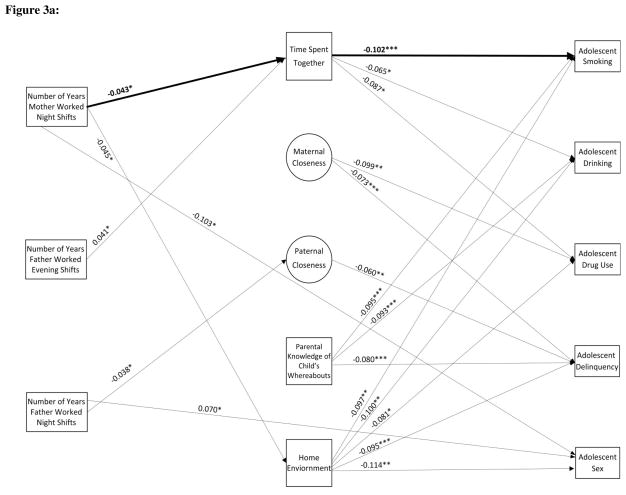
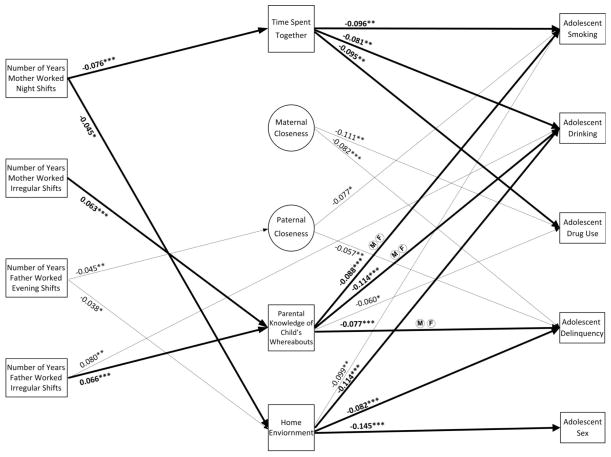
Using a large contemporary data set (the National Longitudinal Survey of Youth-Child Supplement), the authors examined the effects of parental work schedules on adolescent risky behaviors at age 13 or 14 and the mechanisms that might explain them. Structural equation modeling suggests mothers who worked more often at night spent significantly less time with children and had lower quality home environments, and these mediators were significantly linked to adolescent risky behaviors. Similar effects were not found for evening work schedules, while other types of maternal and paternal nonstandard work schedules were linked to higher parental knowledge of children's whereabouts, which led to lower levels of adolescent risky behaviors. Subgroup analyses revealed that boys, those in families with low incomes, and those whose mothers never worked at professional jobs may particularly be affected by mothers working at nights, due to spending less time together, having a lower degree of maternal closeness, and experiencing lower quality home environments. In addition, the effects of maternal night shifts were particularly pronounced if children were in the preschool or middle-childhood years when their mothers worked those schedules. Implications and avenues for future research are discussed.
利用一个大型当代数据集(国家青年-儿童补充纵向调查),作者研究了父母工作时间表对 13 或 14 岁青少年危险行为的影响,以及可能解释这些影响的机制。结构方程模型表明,经常上夜班的母亲与孩子共度的时间明显减少,家庭环境质量也较低,这些中介因素与青少年的危险行为显著相关。对于晚上的工作时间表则没有发现类似的影响,而其他类型的母亲和父亲非标准工作时间表与父母对孩子行踪的了解程度更高有关,这导致青少年的危险行为水平较低。亚组分析表明,男孩、收入较低家庭的孩子以及母亲从未从事过专业工作的孩子,由于在一起的时间较少、母子关系较疏远以及家庭环境质量较低,可能特别受到母亲上夜班的影响。此外,如果孩子在母亲上夜班的幼儿期或小学期,母亲的夜班对孩子的影响尤其明显。文章讨论了其意义和未来研究的方向。