Kawashima Motoko, Kawashima Shinichi, Dogru Murat, Inoue Makoto, Shimazaki Jun
Department of Ophthalmology, Tokyo Dental College, Chiba, Japan.
Clin Ophthalmol. 2010 Aug 19;4:895-8. doi: 10.2147/opth.s12435.
Severe ocular trauma requires emergency surgery, and a fresh corneal graft may not always be available. We describe a case of perforating eye injury with corneal opacity, suspected endophthalmitis, and an intraocular foreign body. The patient was successfully treated with a two-step procedure comprising endoscopy-guided vitrectomy followed by corneal transplantation. This surgical technique offers a good option to vitrectomy with simultaneous keratoplasty in emergency cases where no graft is immediately available and there is the possibility of infection due to the presence of a foreign body.
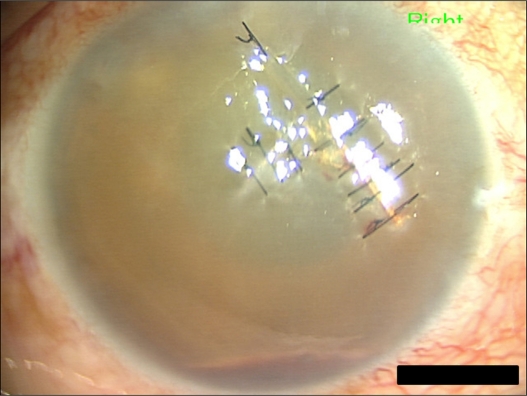
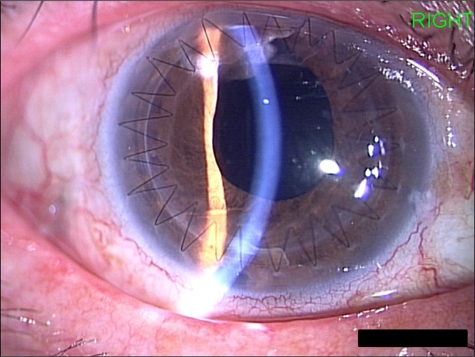
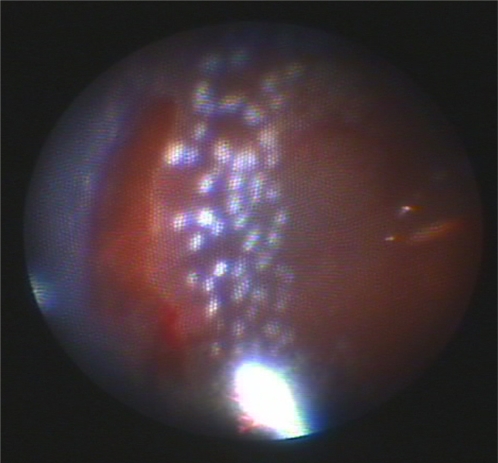
A 55-year-old Japanese woman was referred to our hospital with a perforating corneal and lens injury sustained with a muddy ferrous rod. Primary corneal sutures and lensectomy were performed immediately. Vitreoretinal surgery was required due to suspected endophthalmitis, vitreous hemorrhage, retinal detachment, dialysis and necrosis of the peripheral retina. Instead of conventional vitrectomy, endoscopy-guided vitreous surgery was performed with the Solid Fiber Catheter AS-611 (FiberTech, Tokyo, Japan) due to the presence of corneal opacity and the unavailability of a donor cornea. The retina was successfully attached with the aid of a silicon oil tamponade. Following removal of the silicon oil at 3 months after surgery, penetrating keratoplasty and intraocular lens implantation with ciliary sulcus suture fixation were performed. At 6 months after penetrating keratoplasty, the graft remained clear and visual acuity was 20/40.
Primary endoscopic surgery for vitreoretinal complications in eyes with perforating injury performed prior to penetrating keratoplasty appears to be advantageous in terms of avoiding damage to the corneal endothelium.
严重的眼外伤需要紧急手术,但新鲜的角膜移植物并非总是可得。我们描述了一例伴有角膜混浊、疑似眼内炎和眼内异物的穿孔性眼外伤病例。该患者通过两步手术成功治疗,第一步是内镜引导下玻璃体切除术,随后进行角膜移植。这种手术技术为紧急情况下无法立即获得移植物且因异物存在有感染可能性的病例提供了一种优于同期进行角膜移植的玻璃体切除术的选择。
一名55岁的日本女性因被生锈的铁棒击中导致角膜和晶状体穿孔伤被转诊至我院。立即进行了一期角膜缝合和晶状体切除术。由于疑似眼内炎、玻璃体出血、视网膜脱离、视网膜周边部透析和坏死,需要进行玻璃体视网膜手术。由于存在角膜混浊且无法获得供体角膜,因此使用Solid Fiber Catheter AS - 611(日本东京FiberTech公司)进行了内镜引导下玻璃体手术,而非传统的玻璃体切除术。借助硅油填塞成功使视网膜复位。术后3个月取出硅油后,进行了穿透性角膜移植术和睫状沟缝线固定的人工晶状体植入术。穿透性角膜移植术后6个月,移植片保持透明,视力为20/40。
在穿透性角膜移植术前对穿孔伤眼的玻璃体视网膜并发症进行一期内镜手术,在避免损伤角膜内皮方面似乎具有优势。