Department of Gynecology and Obstetrics, Botucatu Medical School São Paulo State University-UNESP Sao Paulo, Brazil.
Reprod Biol Endocrinol. 2010 Sep 8;8:107. doi: 10.1186/1477-7827-8-107.
The effects of gonadotrophin-releasing hormone agonist (GnRH-a) administered in the luteal phase remains controversial. This meta-analysis aimed to evaluate the effect of the administration of a single-dose of GnRH-a in the luteal phase on ICSI clinical outcomes.
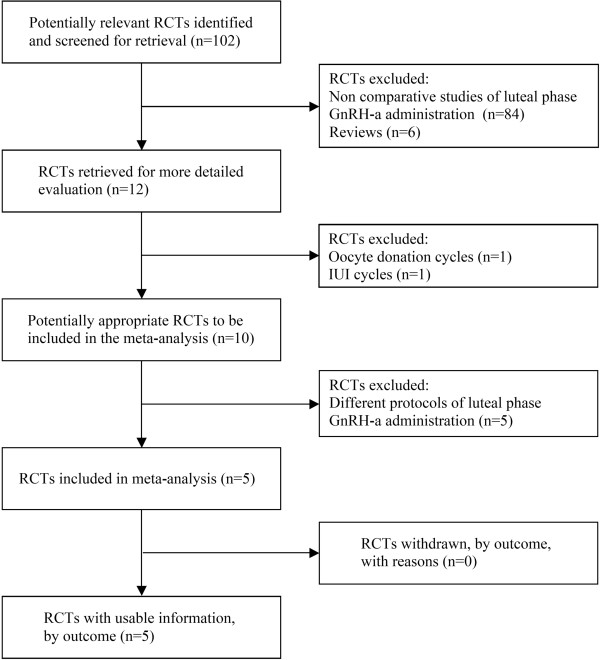
The research strategy included the online search of databases. Only randomized studies were included. The outcomes analyzed were implantation rate, clinical pregnancy rate (CPR) per transfer and ongoing pregnancy rate. The fixed effects model was used for odds ratio. In all trials, a single dose of GnRH-a was administered at day 5/6 after ICSI procedures.
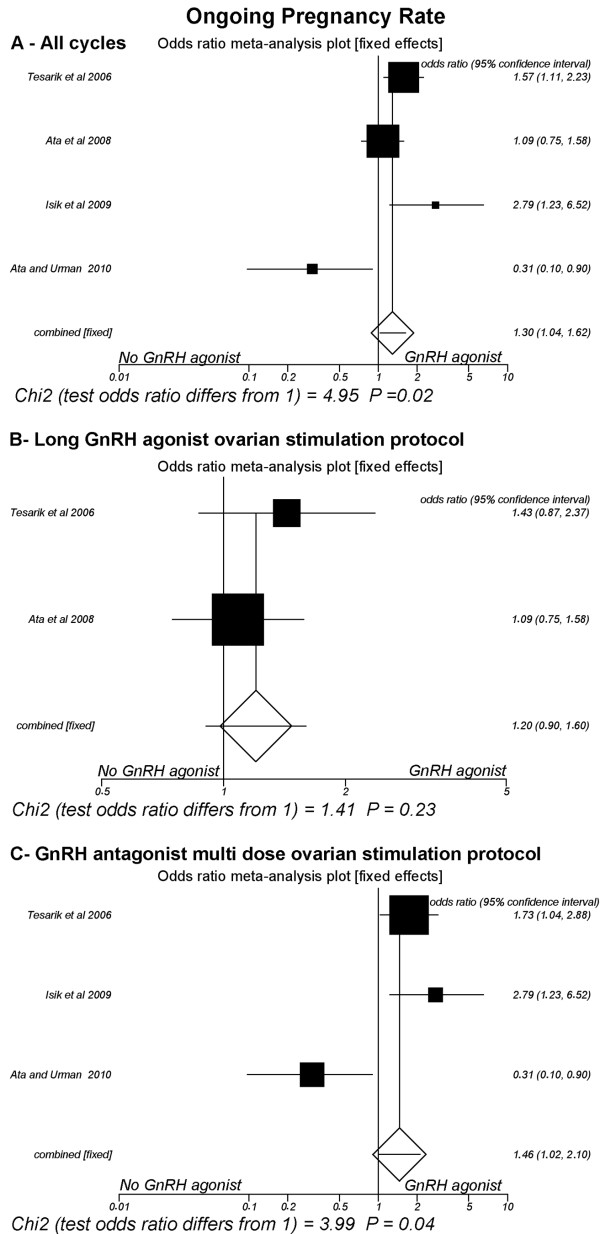
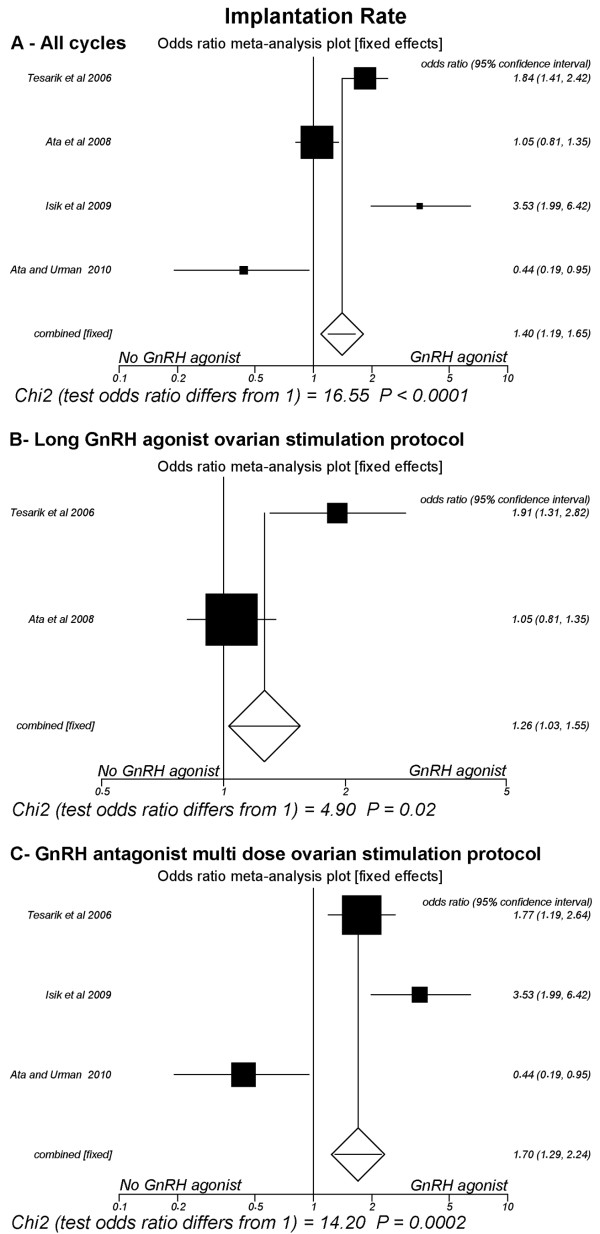
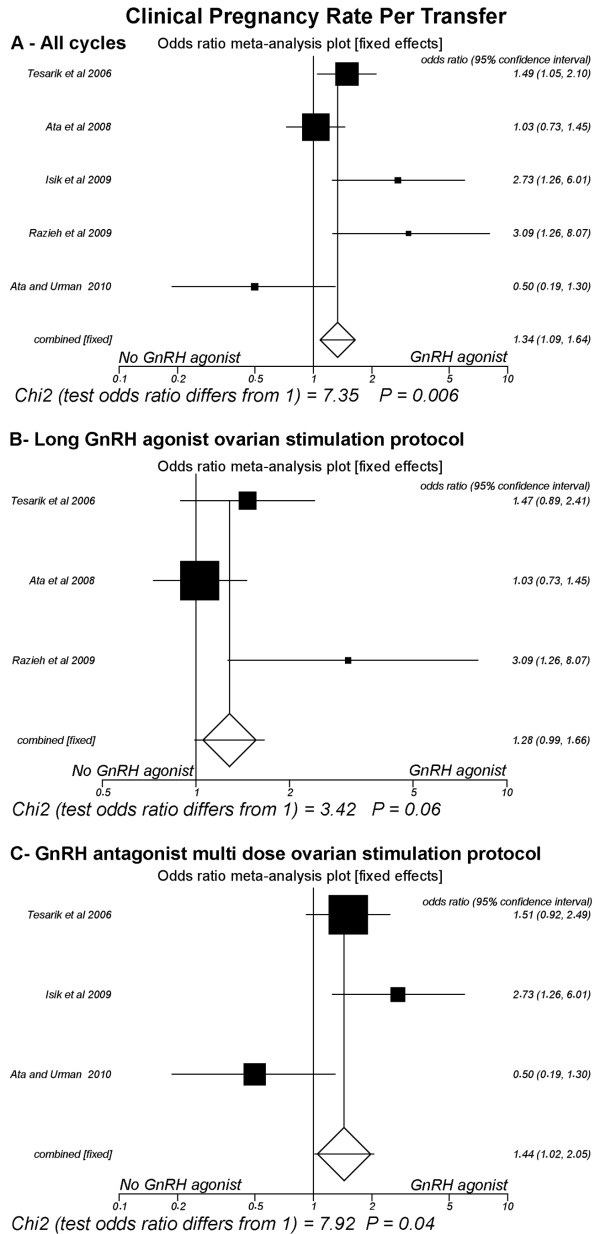
All cycles presented statistically significantly higher rates of implantation (P<0.0001), CPR per transfer (P=0.006) and ongoing pregnancy (P=0.02) in the group that received luteal-phase GnRH-a administration than in the control group (without luteal-phase-GnRH-a administration). When meta-analysis was carried out only in trials that had used long GnRH-a ovarian stimulation protocol, CPR per transfer (P=0.06) and ongoing pregnancy (P=0.23) rates were not significantly different between the groups, but implantation rate was significant higher (P=0.02) in the group that received luteal-phase-GnRH-a administration. On the other hand, the results from trials that had used GnRH antagonist multi-dose ovarian stimulation protocol showed statistically significantly higher implantation (P=0.0002), CPR per transfer (P=0.04) and ongoing pregnancy rate (P=0.04) in the luteal-phase-GnRH-a administration group. The majority of the results presented heterogeneity.
These findings demonstrate that the luteal-phase single-dose GnRH-a administration can increase implantation rate in all cycles and CPR per transfer and ongoing pregnancy rate in cycles with GnRH antagonist ovarian stimulation protocol. Nevertheless, by considering the heterogeneity between the trials, it seems premature to recommend the use of GnRH-a in the luteal phase. Additional randomized controlled trials are necessary before evidence-based recommendations can be provided.
黄体期给予促性腺激素释放激素激动剂(GnRH-a)的效果仍存在争议。本荟萃分析旨在评估黄体期单次给予 GnRH-a 对卵胞浆内单精子注射(ICSI)临床结局的影响。
研究策略包括在线搜索数据库。仅纳入随机对照研究。分析的结局包括着床率、每个移植周期的临床妊娠率(CPR)和持续妊娠率。采用固定效应模型进行优势比分析。所有试验中,ICSI 术后第 5/6 天给予单次 GnRH-a。
接受黄体期 GnRH-a 给药组的着床率(P<0.0001)、每个移植周期的 CPR(P=0.006)和持续妊娠率(P=0.02)均显著高于对照组(未给予黄体期 GnRH-a 给药)。当仅对使用长 GnRH-a 卵巢刺激方案的试验进行荟萃分析时,每个移植周期的 CPR(P=0.06)和持续妊娠率(P=0.23)在两组间无显著差异,但黄体期 GnRH-a 给药组的着床率显著升高(P=0.02)。另一方面,使用 GnRH 拮抗剂多剂量卵巢刺激方案的试验结果显示,黄体期 GnRH-a 给药组的着床率(P=0.0002)、每个移植周期的 CPR(P=0.04)和持续妊娠率(P=0.04)均显著升高。大多数结果存在异质性。
这些发现表明,黄体期单次 GnRH-a 给药可提高所有周期的着床率以及 GnRH 拮抗剂卵巢刺激方案周期的每个移植周期 CPR 和持续妊娠率。然而,考虑到试验之间的异质性,目前推荐黄体期使用 GnRH-a 还为时过早。需要更多的随机对照试验来提供循证推荐。