Department of Biomolecular Chemistry, University of Wisconsin School of Medicine and Public Health, 550 Medical Science Center, 1300 University Avenue, Madison, WI 53706-1532, USA.
Structure. 2010 Sep 8;18(9):1149-58. doi: 10.1016/j.str.2010.06.009.
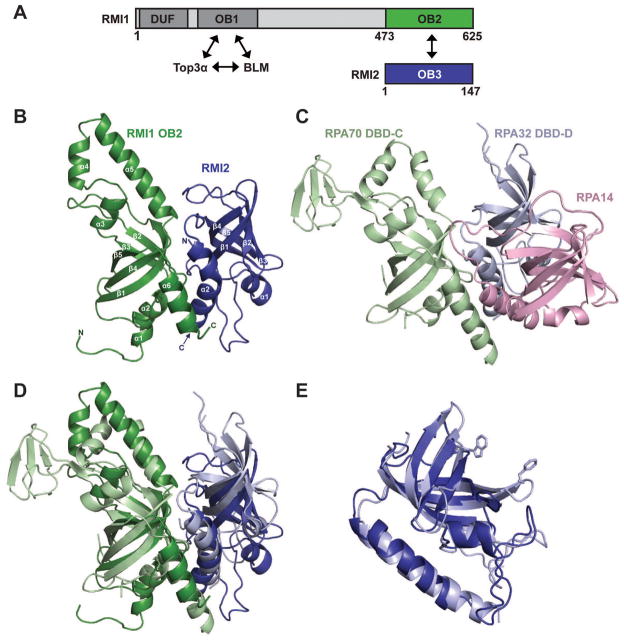
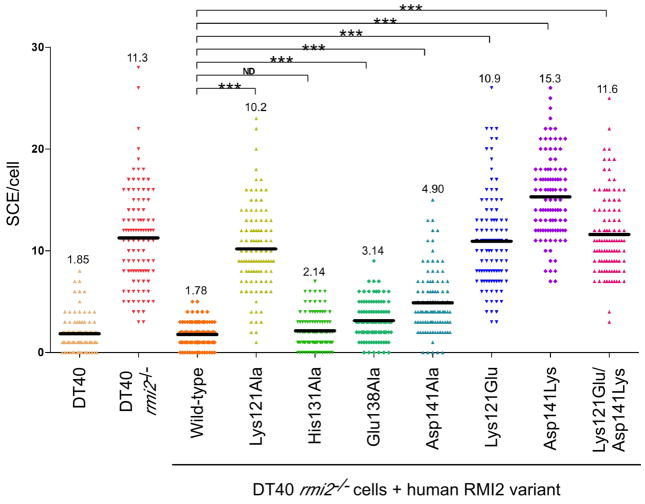
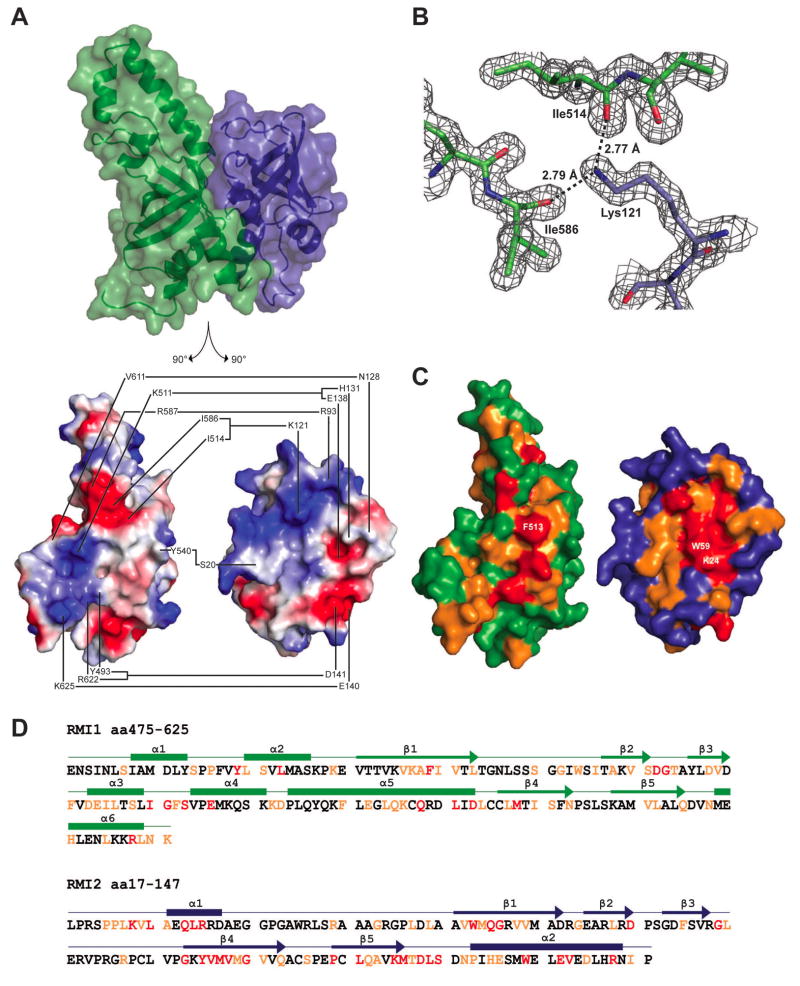
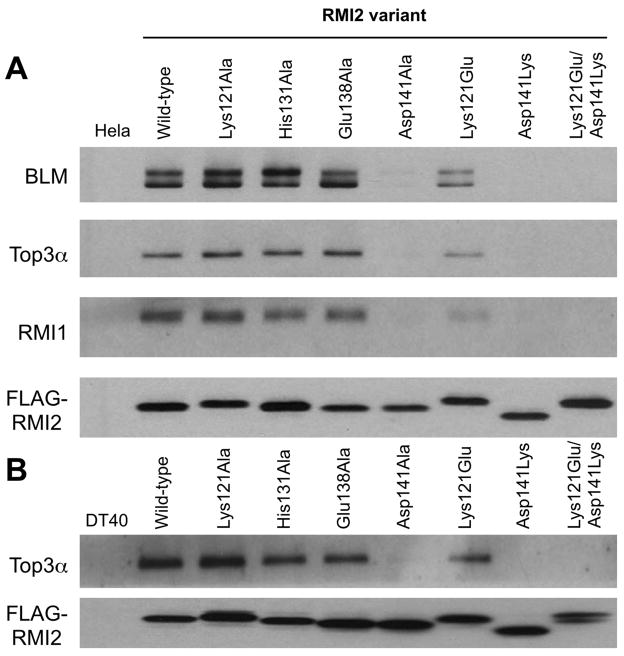
BLM, the protein product of the gene mutated in Bloom syndrome, is one of five human RecQ helicases. It functions to separate double Holliday junction DNA without genetic exchange as a component of the "dissolvasome," which also includes topoisomerase IIIα and the RMI (RecQ-mediated genome instability) subcomplex (RMI1 and RMI2). We describe the crystal structure of the RMI core complex, comprising RMI2 and the C-terminal OB domain of RMI1. The overall RMI core structure strongly resembles two-thirds of the trimerization core of the eukaryotic single-stranded DNA-binding protein, Replication Protein A. Immunoprecipitation experiments with RMI2 variants confirm key interactions that stabilize the RMI core interface. Disruption of this interface leads to a dramatic increase in cellular sister chromatid exchange events similar to that seen in BLM-deficient cells. The RMI core interface is therefore crucial for BLM dissolvasome assembly and may have additional cellular roles as a docking hub for other proteins.
BLM 是布卢姆综合征基因突变的蛋白产物,是五种人类 RecQ 解旋酶之一。它作为“解旋酶体”的一个组成部分,在没有遗传交换的情况下分离双链 Holliday 连接 DNA,该解旋酶体还包括拓扑异构酶 IIIα 和 RMI(RecQ 介导的基因组不稳定性)亚复合物(RMI1 和 RMI2)。我们描述了 RMI 核心复合物的晶体结构,该复合物由 RMI2 和 RMI1 的 C 端 OB 结构域组成。整体 RMI 核心结构与真核单链 DNA 结合蛋白复制蛋白 A 的三聚体核心的三分之二非常相似。使用 RMI2 变体进行的免疫沉淀实验证实了稳定 RMI 核心界面的关键相互作用。破坏该界面会导致细胞姐妹染色单体交换事件显著增加,类似于 BLM 缺陷细胞中观察到的情况。因此,RMI 核心界面对于 BLM 解旋酶体组装至关重要,并且可能作为其他蛋白质的对接中心在细胞中具有额外的作用。