Department of Physical Medicine and Rehabilitation, Northwestern University and Rehabilitation Institute of Chicago, Chicago, Illinois, United States of America.
PLoS One. 2010 Sep 10;5(9):e12686. doi: 10.1371/journal.pone.0012686.
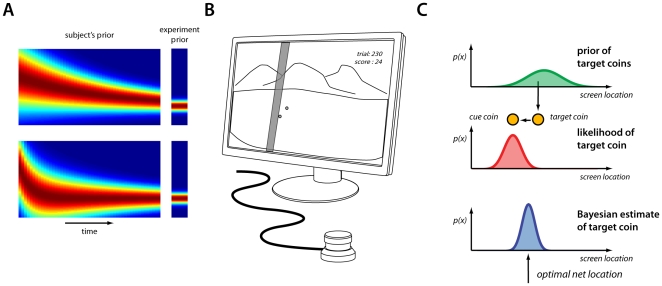
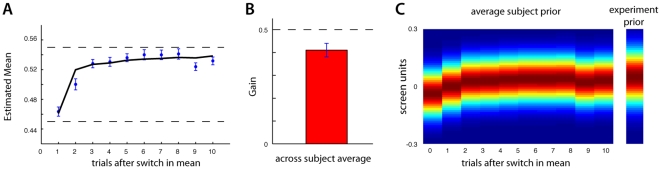
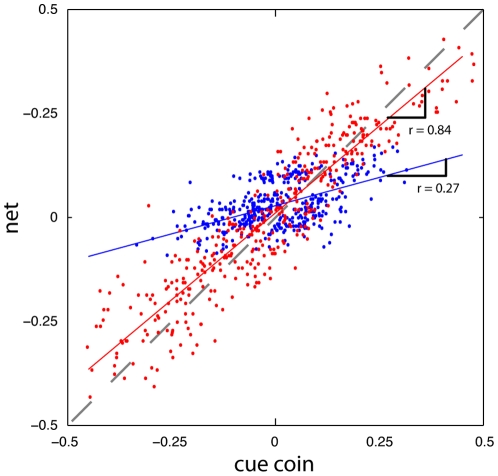
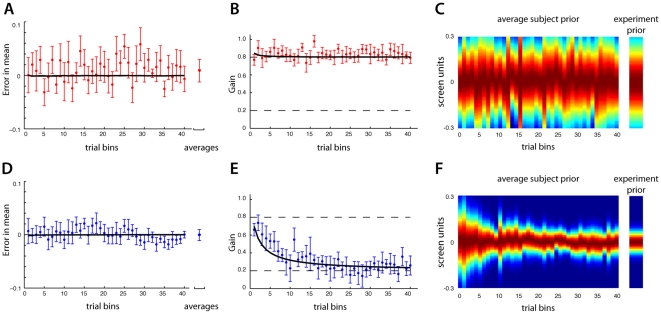
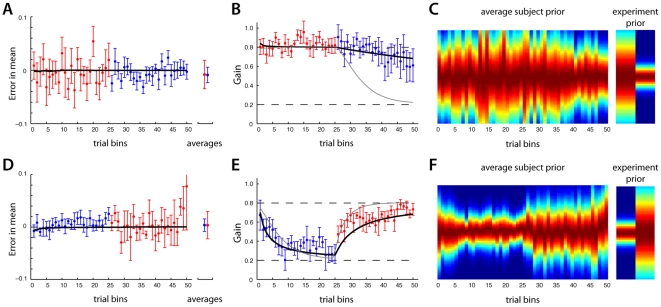
Our nervous system continuously combines new information from our senses with information it has acquired throughout life. Numerous studies have found that human subjects manage this by integrating their observations with their previous experience (priors) in a way that is close to the statistical optimum. However, little is known about the way the nervous system acquires or learns priors. Here we present results from experiments where the underlying distribution of target locations in an estimation task was switched, manipulating the prior subjects should use. Our experimental design allowed us to measure a subject's evolving prior while they learned. We confirm that through extensive practice subjects learn the correct prior for the task. We found that subjects can rapidly learn the mean of a new prior while the variance is learned more slowly and with a variable learning rate. In addition, we found that a Bayesian inference model could predict the time course of the observed learning while offering an intuitive explanation for the findings. The evidence suggests the nervous system continuously updates its priors to enable efficient behavior.
我们的神经系统不断将来自感官的新信息与一生中获得的信息相结合。许多研究发现,人类通过将观察结果与先前的经验(先验)整合在一起,以接近统计最优的方式来实现这一点。然而,对于神经系统如何获得或学习先验的方式知之甚少。在这里,我们展示了一些实验的结果,这些实验中,在一个估计任务中,目标位置的基础分布被改变,从而操纵了受试者应该使用的先验。我们的实验设计允许我们在受试者学习的过程中测量他们不断变化的先验。我们证实,通过大量的练习,受试者可以学习到任务的正确先验。我们发现,受试者可以快速学习新先验的均值,而方差的学习速度较慢,并且学习率是可变的。此外,我们发现,贝叶斯推理模型可以预测观察到的学习过程,同时为这些发现提供了直观的解释。这些证据表明,神经系统不断更新其先验,以实现高效的行为。