Centre for Behaviour and Evolution, Institute of Neuroscience, Newcastle University, Newcastle, United Kingdom.
PLoS One. 2010 Sep 15;5(9):e12690. doi: 10.1371/journal.pone.0012690.
There is striking social variation in the timing of the onset of childbearing in contemporary England, with the mean age at first motherhood about 8 years earlier in the most deprived compared to the least deprived neighbourhoods. However, relatively little is known about how these social differences in reproductive schedule develop in childhood.
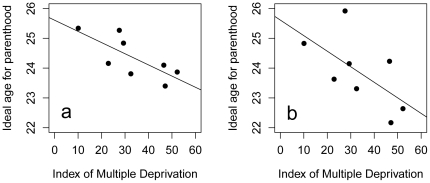
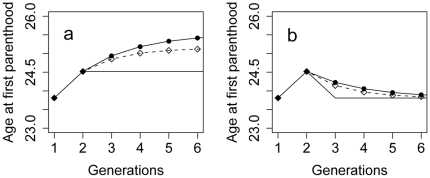
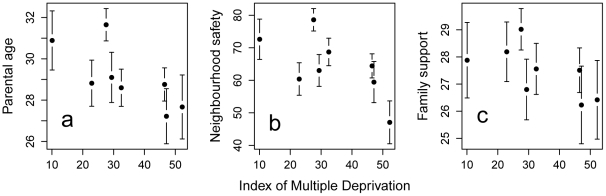
METHODOLOGY/PRINCIPAL FINDINGS: We studied the development of differences in reproductive schedules, using a cross-sectional survey over 1000 school students aged 9-15 in the metropolitan borough of North Tyneside. Students from more deprived neighbourhoods had earlier ideal ages for parenthood than those from more affluent ones, and these differences were fully apparent by age 11. We found evidence consistent with three mechanisms playing a role in maintaining the socioeconomic gradient. These were: vertical intergenerational transmission (students whose own parents were younger at their birth wanted children younger); oblique intergenerational transmission (students in neighbourhoods where parents were younger in general wanted children earlier); and low parental investment (students who did not feel emotionally supported by their own parents wanted children at a younger age).
CONCLUSIONS/SIGNIFICANCE: Our results shed some light on the proximate factors which may be involved in maintaining early childbearing in disadvantaged communities. They help understand why educational initiatives aimed at adolescents tend to have no effect, whereas improving the well-being of poor families with young children may do so. Our results also suggest that there will be considerable intergenerational inertia in the response of reproductive schedules to changing socioecological conditions.
在当代英格兰,生育年龄的起始存在显著的社会差异,与最贫困社区相比,最富裕社区的女性初育年龄平均提前了约 8 年。然而,对于这些生殖计划的社会差异如何在童年时期发展,人们知之甚少。
方法/主要发现:我们通过对北泰恩赛德都会区 1000 多名 9-15 岁学生进行的横断面调查,研究了生殖计划差异的发展。来自较贫困社区的学生比来自较富裕社区的学生更早地期望为人父母,而到 11 岁时,这种差异就完全显现出来了。我们发现有证据表明有三种机制在维持社会经济梯度中发挥作用。这些机制包括:垂直代际传递(自己父母生育时年龄较小的学生希望自己的孩子更早生育);斜向代际传递(父母普遍较年轻的社区的学生希望更早生育);以及低父母投资(自己的父母在情感上不支持的学生希望更早生育)。
结论/意义:我们的研究结果揭示了维持弱势社区中早育的一些近期因素。它们有助于理解为什么针对青少年的教育举措往往没有效果,而改善有年幼子女的贫困家庭的福利可能会有效果。我们的研究结果还表明,在生殖计划对社会生态环境变化的反应方面,代际惯性会相当大。