Department of Health Sciences, Lund University, Lund, Sweden.
BMC Neurol. 2010 Sep 23;10:85. doi: 10.1186/1471-2377-10-85.
The Freezing of Gait Questionnaire (FOGQ) was developed in response to the difficulties of observing and quantifying freezing of gait (FOG) clinically as well as in laboratory settings. However, as the FOGQ is a clinician-administered patient-reported rating scale it cannot be used in postal surveys. Here we report the development and measurement properties of a self-administered version of the FOGQ (FOGQsa).
A clinical sample and a postal survey sample of non-demented people with Parkinson's disease (PD; total n = 225) completed the FOGQsa and questionnaires concerning physical functioning (PF) and fall-related self efficacy (FES). Additional questions (No/Yes) regarded previous falls and whether they were afraid of falling. The clinical sample was also assessed with the Unified PD Rating Scale (UPDRS). Thirty-five participants completed FOGQsa and were also assessed with the original version (FOGQ) in a clinical interview.
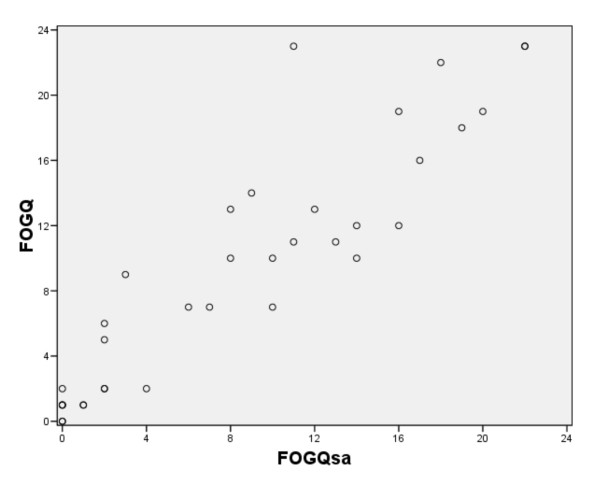
There were no differences (P = 0.12) between FOGQ (median, 10; q1-q3, 2-14) and FOGQsa (median, 8; 2-14) scores. The Spearman (rs) and intra-class correlations between the two were 0.92 and 0.91 (95% CI, 0.82-0.95), respectively. For FOGQsa, corrected item-total correlations ranged between 0.68-0.89. Reliability was 0.93 (95% CI, 0.91-0.94). FOGQsa scores correlated strongest with UPDRS Item 14 (Freezing; rs, 0.76) and with FES (rs, -0.74). The weakest correlation was found with age (rs, 0.14). Fallers scored significantly (p < 0.001) higher on FOGQsa compared to non-fallers, median scores 8 (q1-q3, 4-14) versus 2 (0-7). Those expressing a fear of falling scored higher (p < 0.001) than those who did not, median scores 2 (0-7) versus 6 (2-14).
The present findings indicate that the FOGQsa is as reliable and valid as the original interview administered FOGQ version. This has important clinical implications when investigating FOG in large scale studies.
为了克服在临床和实验室环境中观察和量化冻结步态(FOG)的困难,开发了冻结步态问卷(FOGQ)。然而,由于 FOGQ 是一种由临床医生管理的患者报告的评分量表,因此不能用于邮寄调查。在此,我们报告了一种自我管理的 FOGQ 版本(FOGQsa)的开发和测量特性。
临床样本和非痴呆帕金森病患者的邮寄调查样本(共 225 人)完成了 FOGQsa 以及有关身体功能(PF)和跌倒相关自我效能(FES)的问卷。其他问题(是/否)涉及以前的跌倒情况以及是否害怕跌倒。临床样本还接受了统一帕金森病评定量表(UPDRS)的评估。35 名参与者完成了 FOGQsa 并在临床访谈中还接受了原始版本(FOGQ)的评估。
FOGQ(中位数,10;q1-q3,2-14)和 FOGQsa(中位数,8;2-14)得分之间没有差异(P = 0.12)。两个评分之间的Spearman(rs)和内部一致性相关系数分别为 0.92 和 0.91(95%置信区间,0.82-0.95)。对于 FOGQsa,校正后的项目-总分相关性在 0.68-0.89 之间。信度为 0.93(95%置信区间,0.91-0.94)。FOGQsa 评分与 UPDRS 项目 14(冻结;rs,0.76)和 FES(rs,-0.74)相关性最强。与年龄的相关性最弱(rs,0.14)。与非跌倒者相比,跌倒者的 FOGQsa 评分明显更高(p <0.001),中位数评分 8(q1-q3,4-14)与 2(0-7)。表达对跌倒恐惧的人得分更高(p <0.001),中位数得分 2(0-7)与 6(2-14)。
目前的研究结果表明,FOGQsa 与原始访谈式管理的 FOGQ 版本一样可靠和有效。当在大规模研究中调查 FOG 时,这具有重要的临床意义。