Department of Pediatric Respiratory Sciences, Johns Hopkins University School of Medicine, Baltimore, 21287, USA.
J Nanobiotechnology. 2010 Sep 24;8:22. doi: 10.1186/1477-3155-8-22.
The mutation in the cystic fibrosis transmembrane conductance regulator (CFTR) gene results in CF. The most common mutation, ΔF508-CFTR, is a temperature-sensitive, trafficking mutant with reduced chloride transport and exaggerated immune response. The ΔF508-CFTR is misfolded, ubiquitinated, and prematurely degraded by proteasome mediated- degradation. We recently demonstrated that selective inhibition of proteasomal pathway by the FDA approved drug PS-341 (pyrazylcarbonyl-Phe-Leuboronate, a.k.a. Velcade or bortezomib) ameliorates the inflammatory pathophysiology of CF cells. This proteasomal drug is an extremely potent, stable, reversible and selective inhibitor of chymotryptic threonine protease-activity. The apprehension in considering the proteasome as a therapeutic target is that proteasome inhibitors may affect proteostasis and consecutive processes. The affect on multiple processes can be mitigated by nanoparticle mediated PS-341 lung-delivery resulting in favorable outcome observed in this study.
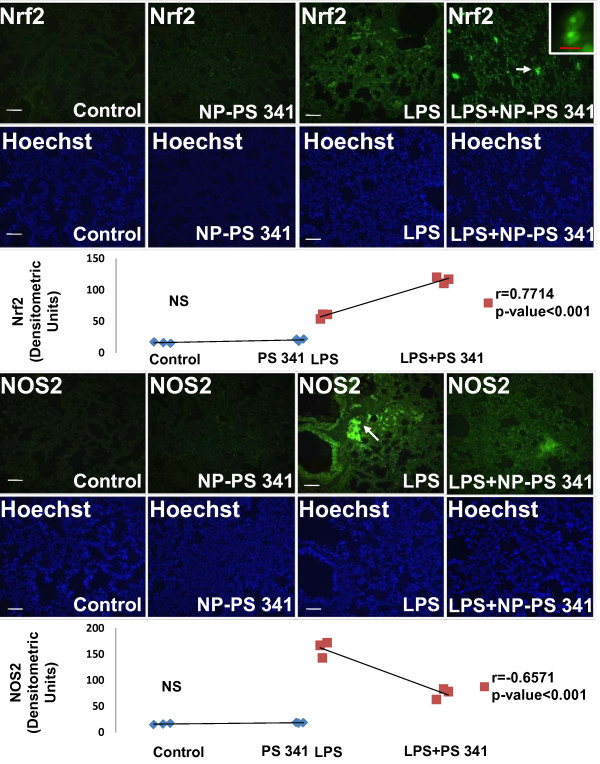
To overcome this challenge, we developed a nano-based approach that uses drug loaded biodegradable nanoparticle (PLGA-PEGPS-341) to provide controlled and sustained drug delivery. The in vitro release kinetics of drug from nanoparticle was quantified by proteasomal activity assay from days 1-7 that showed slow drug release from day 2-7 with maximum inhibition at day 7. For in vivo release kinetics and biodistribution, these drug-loaded nanoparticles were fluorescently labeled, and administered to C57BL6 mice by intranasal route. Whole-body optical imaging of the treated live animals demonstrates efficient delivery of particles to murine lungs, 24 hrs post treatment, followed by biodegradation and release over time, day 1-11. The efficacy of drug release in CF mice (Cftr-/-) lungs was determined by quantifying the changes in proteasomal activity (~2 fold decrease) and ability to rescue the Pseudomonas aeruginosa LPS (Pa-LPS) induced inflammation, which demonstrates the rescue of CF lung disease in murine model.
We have developed a novel drug delivery system to provide sustained delivery of CF "correctors" and "anti-inflammatories" to the lungs. Moreover, we demonstrate here the therapeutic efficacy of nano-based proteostasis-modulator to rescue Pa-LPS induced CF lung disease.
囊性纤维化跨膜电导调节因子(CFTR)基因突变导致 CF。最常见的突变,ΔF508-CFTR,是一种温度敏感的、运输突变体,氯离子转运减少,免疫反应夸大。ΔF508-CFTR 错误折叠、泛素化,并被蛋白酶体介导的降解过早降解。我们最近证明,通过 FDA 批准的药物 PS-341(吡唑基羰基-苯丙氨酰-亮氨酰硼酸,又名 Velcade 或硼替佐米)选择性抑制蛋白酶体途径,可改善 CF 细胞的炎症病理生理学。这种蛋白酶体药物是一种非常有效、稳定、可逆和选择性的糜蛋白酶苏氨酸蛋白酶活性抑制剂。考虑将蛋白酶体作为治疗靶点的担忧是,蛋白酶体抑制剂可能会影响蛋白质稳态和连续过程。通过纳米颗粒介导的 PS-341 肺部给药,可以减轻对多种过程的影响,从而在本研究中观察到有利的结果。
为了克服这一挑战,我们开发了一种基于纳米的方法,该方法使用载药可生物降解的纳米颗粒(PLGA-PEGPS-341)提供受控和持续的药物输送。通过从第 1 天到第 7 天的蛋白酶体活性测定来量化药物从纳米颗粒中的体外释放动力学,结果表明药物从第 2 天到第 7 天缓慢释放,第 7 天达到最大抑制。对于体内释放动力学和生物分布,这些载药纳米颗粒被荧光标记,并通过鼻腔途径给予 C57BL6 小鼠。治疗后活动物的全身光学成像显示,颗粒有效地递送到小鼠肺部,24 小时后,随着时间的推移,从第 1 天到第 11 天,颗粒逐渐生物降解和释放。通过定量测定蛋白酶体活性的变化(~2 倍降低)和拯救铜绿假单胞菌脂多糖(Pa-LPS)诱导的炎症的能力来确定 CF 小鼠(Cftr-/-)肺部药物释放的疗效,这表明在小鼠模型中拯救了 CF 肺部疾病。
我们开发了一种新的药物递送系统,为肺部提供持续的 CF“校正剂”和“抗炎药”输送。此外,我们在这里证明了基于纳米的蛋白质稳态调节剂治疗铜绿假单胞菌脂多糖(Pa-LPS)诱导的 CF 肺部疾病的疗效。