The Institute of Environmental Science and Research, National Centre for Biosecurity and Infectious Disease, Upper Hutt, New Zealand.
Emerg Infect Dis. 2010 Oct;16(10):1618-20. doi: 10.3201/eid1610.100116.
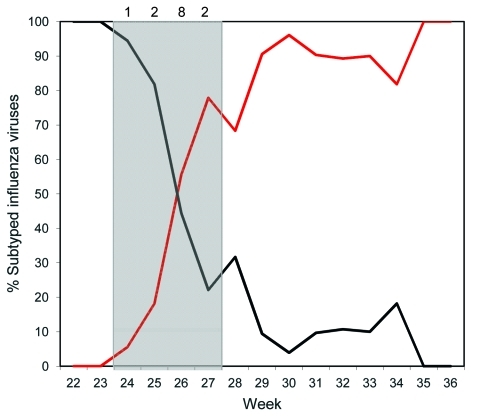
Co-infection with seasonal influenza A (H1N1) and pandemic (H1N1) 2009 could result in reassortant viruses that may acquire new characteristics of transmission, virulence, and oseltamivir susceptibility. Results from oseltamivir-sensitivity testing on viral culture suggested the possibility of co-infections with oseltamivir-resistant (seasonal A [H1N1]) and -susceptible (pandemic [H1N1] 2009) viruses.
季节性流感 A(H1N1)和大流行(H1N1)2009 的合并感染可能导致重配病毒,这些病毒可能获得传播、毒力和奥司他韦敏感性的新特征。病毒培养物的奥司他韦敏感性检测结果表明,可能存在对奥司他韦耐药(季节性 A [H1N1])和敏感(大流行 [H1N1] 2009)病毒的合并感染。