Wu Guorong, Wang Qian, Jia Hongjun, Shen Dinggang
Department of Radiology and BRIC, University of North Carolina at Chapel Hill, USA.
Med Image Comput Comput Assist Interv. 2010;13(Pt 2):684-91. doi: 10.1007/978-3-642-15745-5_84.
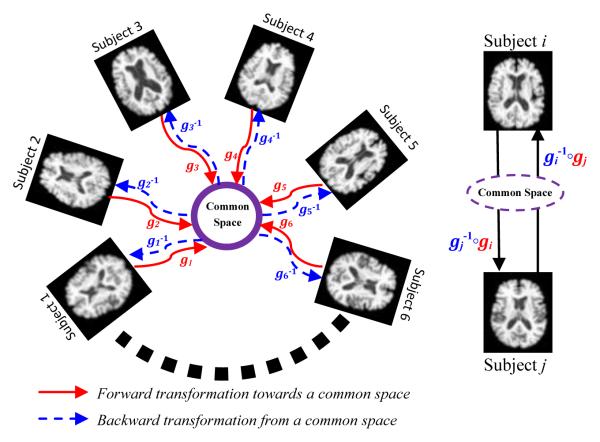
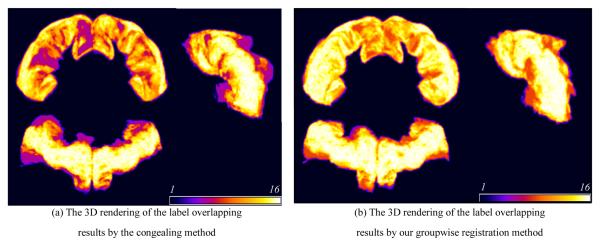
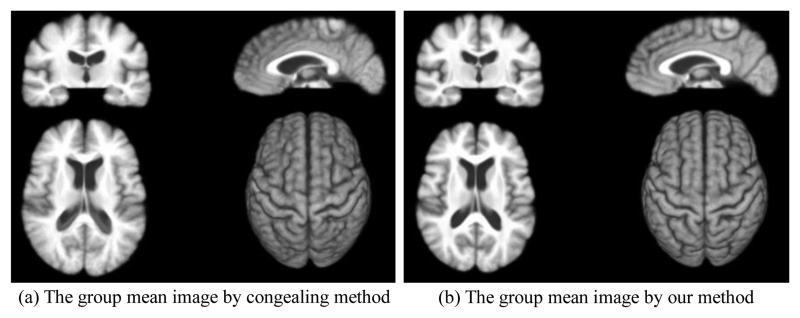
We present a novel feature-based groupwise registration method to simultaneously warp the subjects towards the common space. Due to the complexity of the groupwise registration, we resort to decoupling it into two easy-to-solve tasks, i.e., alternatively establishing the robust correspondences across different subjects and interpolating the dense deformation fields based on the detected sparse correspondences. Specifically, several novel strategies are proposed in the correspondence detection step. First, attribute vector, instead of intensity only, is used as a morphological signature to guide the anatomical correspondence detection among all subjects. Second, we detect correspondence only on the driving voxels with distinctive attribute vectors for avoiding the ambiguity in detecting correspondences for non-distinctive voxels. Third, soft correspondence assignment (allowing for adaptive detection of multiple correspondences in each subject) is also presented to help establish reliable correspondences across all subjects, which is particularly necessary in the beginning of groupwise registration. Based on the sparse correspondences detected on the driving voxels of each subject, thin-plate splines (TPS) are then used to propagate the correspondences on the driving voxels to the entire brain image for estimating the dense transformation for each subject. By iteratively repeating correspondence detection and dense transformation estimation, all the subjects will be aligned onto a common space simultaneously. Our groupwise registration algorithm has been extensively evaluated by 18 elderly brains, 16 NIREP, and 40 LONI data. In all experiments, our algorithm achieves more robust and accurate registration results, compared to a groupwise registration method and a pairwise registration method, respectively.
我们提出了一种新颖的基于特征的组内配准方法,用于同时将各受试者图像扭曲到公共空间。由于组内配准的复杂性,我们将其分解为两个易于解决的任务,即交替地在不同受试者之间建立稳健的对应关系,并基于检测到的稀疏对应关系对密集变形场进行插值。具体而言,在对应关系检测步骤中提出了几种新颖的策略。首先,使用属性向量而非仅强度作为形态特征,以指导所有受试者之间的解剖对应关系检测。其次,我们仅在具有独特属性向量的驱动体素上检测对应关系,以避免在检测非独特体素的对应关系时产生模糊性。第三,还提出了软对应关系分配(允许在每个受试者中自适应检测多个对应关系),以帮助在所有受试者之间建立可靠的对应关系,这在组内配准开始时尤为必要。基于在每个受试者的驱动体素上检测到的稀疏对应关系,然后使用薄板样条(TPS)将驱动体素上的对应关系传播到整个脑图像,以估计每个受试者的密集变换。通过迭代重复对应关系检测和密集变换估计,所有受试者将同时对齐到一个公共空间。我们的组内配准算法已通过18个老年脑、16个NIREP和40个LONI数据进行了广泛评估。在所有实验中,与组内配准方法和成对配准方法相比,我们的算法分别获得了更稳健和准确的配准结果。